


Ammonium Thiosulfate Industry Forecast to Reach USD 1,047.83 Million by 2036; China CAGR 10.6%, Germany 6.4%, France 6.4%
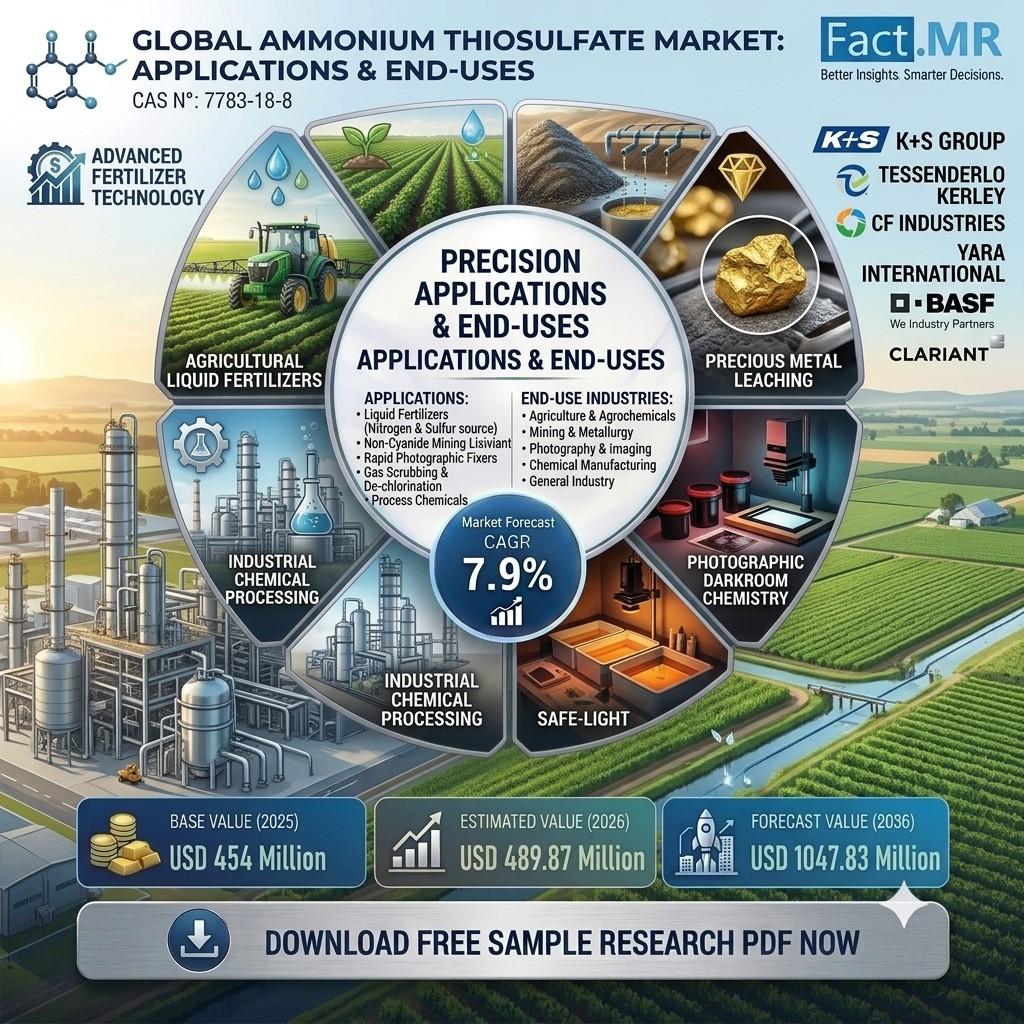
The global ammonium thiosulfate market is expected to expand from USD 489.87 million in 2026 to USD 1,047.83 million by 2036, registering a CAGR of 7.9% during the forecast period. According to Fact.MR, increasing demand for liquid nitrogen-sulfur fertilizers, growing adoption of precision agriculture, and rising requirements for sulfur-deficient soil treatment are supporting market expansion. The chemical is also gaining importance in mining operations, particularly as an alternative leaching agent for precious metal extraction.
Ammonium thiosulfate is widely used in agricultural nutrient management because it provides nitrogen and sulfur in liquid form, making it suitable for fertilizer blending and precision application systems. Growing concerns over soil nutrient deficiencies and the need to improve crop productivity are encouraging agricultural producers to adopt sulfur-based fertilizers. The increasing use of ammonium thiosulfate in urea ammonium nitrate (UAN) blends for corn, wheat, and canola cultivation is strengthening demand across major agricultural economies.
Industrial applications are creating additional opportunities. Mining companies are evaluating thiosulfate-based leaching processes as alternatives to conventional cyanide extraction methods for gold and silver recovery. Meanwhile, the development of regional fertilizer blending facilities and liquid chemical distribution networks is becoming increasingly important for maintaining supply during seasonal agricultural demand peaks.
Get detailed market forecasts, competitive benchmarking, and pricing trends:
https://www.factmr.com/connectus/sample?flag=S&rep_id=2421
Industrial Ammonium Thiosulfate Retains Dominant Position
By grade, industrial ammonium thiosulfate is expected to account for 82.0% of the global market in 2026. Its leading position is supported by extensive use in agricultural fertilizers, industrial chemical processing, and precious metal extraction. High product purity, consistent performance, and compatibility with bulk liquid distribution systems make industrial-grade formulations suitable for large-scale commercial applications.
Demand from fertilizer manufacturers remains particularly important as agricultural producers increasingly require nutrient solutions that can be integrated into existing liquid fertilizer systems. Industrial ammonium thiosulfate is also gaining attention in mining applications involving gold and silver recovery, where alternative leaching technologies are being evaluated to address environmental and operational requirements.
Agriculture represents the largest end-use segment, accounting for 64.0% of market demand in 2026. Increasing adoption of liquid fertilizers, expanding precision farming practices, and greater awareness of sulfur deficiency in agricultural soils are supporting this position. Ammonium thiosulfate-based formulations are used in crop nutrition programs for corn, soybean, alfalfa, and other arable crops.
Liquid fertilizers for arable crops are expected to remain an important growth area. Their compatibility with fertigation and precision nutrient application systems enables agricultural operators to manage fertilizer delivery more effectively. Growing investment in irrigation infrastructure and the need to improve nutrient-use efficiency are also contributing to demand.
China, Germany, and France Show Strong Growth Potential
China is projected to register a 10.6% CAGR between 2026 and 2036, representing the highest growth rate among the major countries assessed by Fact.MR. The country's extensive agricultural sector, increasing focus on crop productivity, and government initiatives supporting food security are strengthening demand for sulfur-based fertilizers. Expanding industrial chemical applications and mining activities are also contributing to ammonium thiosulfate consumption.
Germany is forecast to expand at a 6.4% CAGR through 2036. Its emphasis on sustainable agriculture, efficient fertilizer application, and environmental compliance is encouraging the adoption of advanced nutrient management solutions. The country's established chemical industry also supports ammonium thiosulfate applications in water treatment and photographic processing. Research activities focused on fertilizer efficiency and reduced environmental impact are expected to influence market development.
France is projected to record a 6.4% CAGR during the forecast period. Demand is supported by the broader European transition toward more efficient fertilizer management and agricultural production practices. Ammonium thiosulfate offers a liquid sulfur source for crop nutrition programs, making it relevant to fertilizer suppliers serving agricultural markets where nutrient efficiency and soil management are important purchasing considerations.
The United States is also expected to demonstrate steady expansion, with a projected CAGR of 6.8% from 2026 to 2036. Its advanced agricultural sector and widespread cultivation of corn and soybean crops are supporting the adoption of liquid sulfur fertilizers. Additional demand comes from industrial applications involving water treatment and metal processing.
Competitive Landscape
Competition in the ammonium thiosulfate market includes established fertilizer manufacturers, specialty chemical producers, and industrial suppliers. Key companies profiled by Fact.MR include Tessenderlo Kerley, Inc., Koch Nitrogen International Sarl, Kugler Co., Martin Midstream Partners, and TIB Chemicals AG. Other participants include Esseco Srl, PCI Nitrogen, Shakti Chemicals, Yara International ASA, and CF Industries Holdings, Inc.
Manufacturers are focusing on improving production efficiency, strengthening liquid fertilizer distribution networks, and developing formulations that meet changing agricultural requirements. Product consistency, raw material availability, transportation infrastructure, and reliable seasonal supply remain important competitive factors.
Procurement decisions are also influenced by sulfur and ammonia feedstock prices, fertilizer blending compatibility, and storage capabilities. Suppliers with established regional distribution facilities are better positioned to respond to concentrated demand during planting seasons.
Technology and Sustainability Developments Shape the Market
The ammonium thiosulfate industry is increasingly influenced by precision agriculture technologies and demand for efficient nutrient delivery systems. Fertilizer manufacturers are investing in improved blending processes and product formulations designed to support targeted sulfur application while reducing unnecessary nutrient losses.
Environmental considerations are also shaping industrial applications. Interest in non-cyanide gold extraction technologies is creating opportunities for thiosulfate-based leaching solutions, although commercial adoption depends on ore characteristics and process economics.
Digital monitoring, automated production systems, and improved supply chain management are expected to influence manufacturing and distribution strategies. However, fluctuations in sulfur and ammonia prices, liquid transportation costs, and regulatory requirements remain important challenges.
As agricultural producers seek more efficient fertilizer solutions and industrial users evaluate alternative chemical processes, ammonium thiosulfate demand is expected to maintain steady growth through 2036. The full Fact.MR report provides detailed market forecasts, segment analysis, country-level opportunities, and competitive intelligence.
Top Reports:
https://adamaamresearch.blogspot.com/2026/11/antiseptic-and-disinfectant-market-to.html
https://net-pals.com/blogs/72688/Antiseptic-and-Disinfectant-Market-Expansion-Supported-by-Institutional-Hygiene-Needs
https://acmingle.com/blogs/37965/Antiseptic-and-Disinfectant-Market-Expected-to-Grow-as-China-Leads
About Fact.MR
Fact.MR is a market research and consulting company providing market intelligence, competitive analysis, and forecasting across global industries. Its research supports businesses with data-driven insights into emerging markets, technology trends, competitive dynamics, regional opportunities, and changing demand patterns.

 English
 Arabic
 Spanish
 Portuguese
 Deutsch
 Turkish
 Dutch
 Italiano
 Russian
 Romaian
 Portuguese (Brazil)
 Greek