


Custom Printed Tuck Boxes for Retail Product Packaging
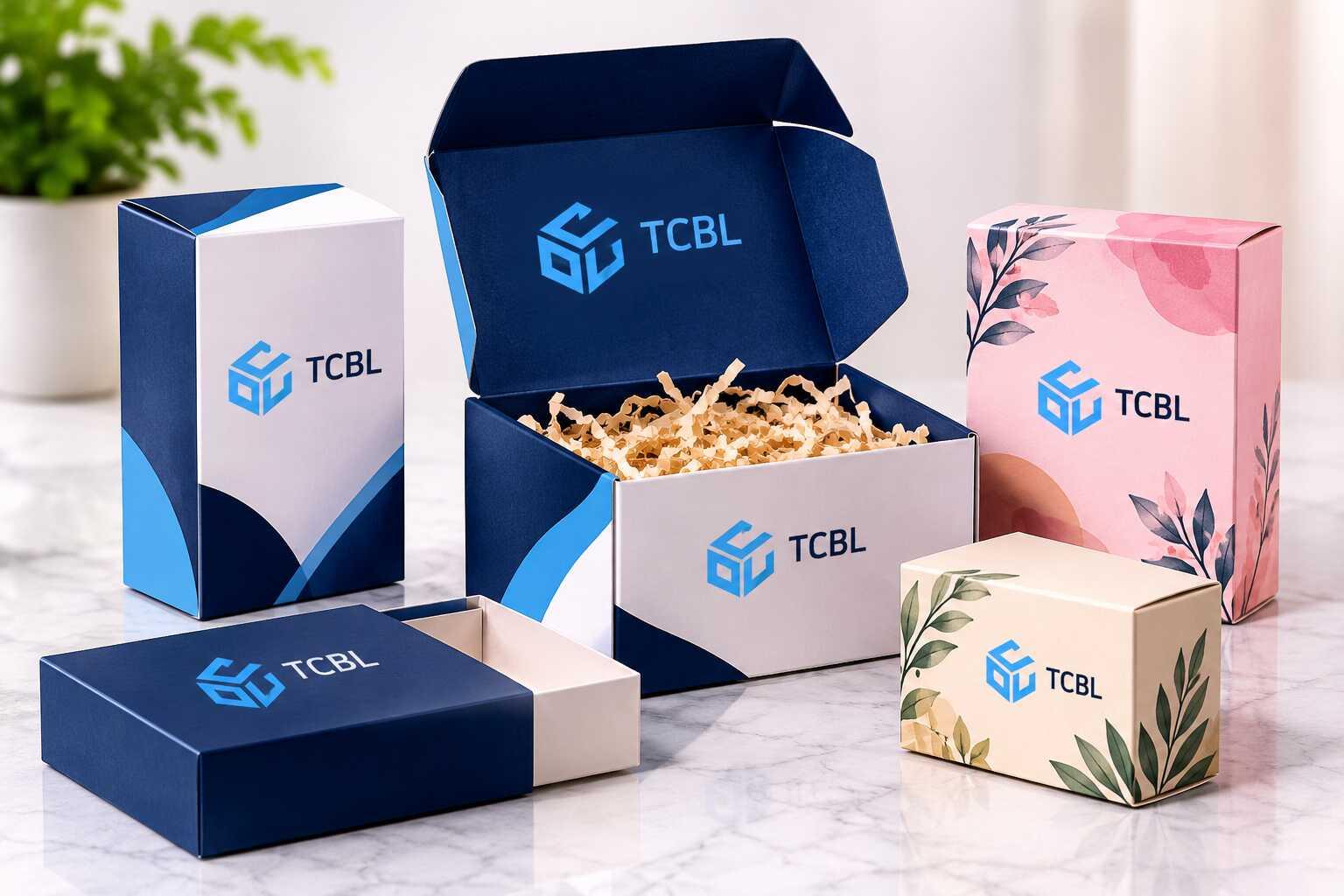
Custom printed tuck boxes are one-piece folding cartons that close by sliding a flap into the box opening, which makes them an inexpensive, shelf-friendly option for retail products like cosmetics, teas, chocolates, and small accessories. They ship flat, assemble fast, and give you a clean front panel for branding. This guide covers styles, materials, sizing, printing, and ordering for retail brands.
The Custom Box Lab offers straight tuck, reverse tuck, snap lock, and tuck top styles in custom sizes, with free 3D mockups before production.
Why Do Retail Brands Choose Tuck Boxes?
Tuck boxes cost less than rigid boxes, ship flat to save on freight, and don't need glue or tape to close, so customers can open and reclose them without tearing anything. That combination suits products that sit on a shelf and move quickly.
Products that commonly use them:
- Cosmetics and skincare, such as lipsticks, creams, and serums
- Teas, chocolates, and dry snacks
- Playing cards, flashcards, and tarot decks
- Small electronics and accessories
- Subscription box inserts and small-batch retail runs
Because the box is simple to fold, a small team can assemble packs by hand without special equipment, which matters for startups and makers who pack in-house.
| Format | Best For | Ships Flat? | Relative Cost |
|---|---|---|---|
| Tuck box | Retail shelf products, light to medium weight | Yes | Lower |
| Mailer box | E-commerce shipping and unboxing | Usually | Moderate |
| Rigid box | Premium gifts and luxury items | Usually not | Higher |
| Pillow or gable box | Small gifts and treats | Yes | Lower |
Which Tuck Box Style Fits Your Product?
Pick the style by how the box closes and how it needs to hold up. The Custom Box Lab lists straight tuck end, reverse tuck end, tuck top auto bottom, snap lock bottom, roll end tuck top, and tab lock tuck styles.
| Style | How It Closes | Good For |
|---|---|---|
| Straight tuck end | Top and bottom flaps open the same way | Shelf displays, cosmetics, cards |
| Reverse tuck end | Flaps open in opposite directions | Consistent front-panel branding, food items |
| Tuck top auto bottom | Tuck top with an auto-locking base | Heavier items that need base support |
| Snap lock bottom | Interlocking flaps form a stable base | Products that need a secure, flat bottom |
| Roll end tuck top | Full roll-end closure | Contents that need easy access |
| Tab lock tuck | Tab closure with a roll-end style | Secure but easy-to-close packs |
What's the Difference Between Straight Tuck and Reverse Tuck?
On a straight tuck box, both flaps open in the same direction, and on a reverse tuck box they open in opposite directions. Neither is better. The choice mostly changes how the box looks on a shelf and which panel faces forward, so a 3D mockup is a quick way to compare them.
What Material and Board Thickness Should You Choose?
Match the board to the product's weight and fragility, since thicker stock carries more. Tuck boxes are usually paperboard or cardstock, and thickness is measured in points (pt), with 14pt thinner than 24pt.
| Material | Typical Use |
|---|---|
| 14pt cardstock | Lightweight items, such as cards and single cosmetics |
| 18pt cardstock | Medium-weight retail packaging |
| 24pt cardstock | Products that need extra durability |
| Kraft board | Natural, rustic look; recyclable in most cases |
| Corrugated E-flute | Delicate items that need cushioning |
| Rigid stock | Premium, structured feel |
| Standard paperboard (SBS) | Smooth, bright print surface |
Most paper-based packaging is recyclable, though coatings and finishes can affect that, so ask if sustainability is part of your product story.
How Heavy a Product Can a Tuck Box Hold?
There's no single limit, because it depends on the board grade, the box style, and whether an insert supports the product. Share your product's weight and dimensions with the supplier and ask them to recommend a board. For heavier items, a style with a locking base is usually a safer pick than a basic tuck.
How Do You Size a Tuck Box for Retail?
Measure the product at its widest points and add a little clearance so it slides in without crushing the sides. The Custom Box Lab suggests about 1/16 inch of clearance per dimension for cardstock, though thicker board or an insert will need more.
- Length: the longest side of the product.
- Width: the shorter side of the base.
- Depth: straight up from bottom to top.
- Clearance: add a small allowance to each dimension.
- Shelf fit: check the shelf or peg space your retailer gives you.
For reference, a standard poker deck box runs about 2.5 by 3.5 by 0.75 inches. Stock-size ranges tend to start around 2 by 2 inches for small boxes, but custom dimensions are what remove empty space and keep the box from feeling loose around the product.
What Goes on a Retail Tuck Box?
The front panel sells, and the other panels have to carry the practical information. Plan the layout before you finalize artwork so nothing important lands on a fold.
| Panel | Typical Content |
|---|---|
| Front | Logo, product name, key benefit |
| Back | Directions, ingredients or specs, barcode |
| Sides | Brand details, short claims, website |
| Top or bottom flaps | Batch codes, secondary branding |
Leave a flat area for the barcode, away from folds, seams, and glossy coatings that can make it hard to scan. Retailers often have their own barcode size and placement rules, so check them first. Food and cosmetics also have labeling requirements, such as ingredient lists and net quantity, so leave room for whatever applies to your category.
What Printing and Finishes Work for Custom Printed Tuck Boxes?
Digital printing suits short runs and smaller orders, while offset is usually more economical for larger ones, and the site also lists flexographic and screen printing. Color options include CMYK, Pantone, full-color, interior printing, and full-surface coverage.
| Finish | Effect | Best Use |
|---|---|---|
| Gloss or matte coating | Smooth, protected surface | Everyday retail packs |
| Foil stamping or holographic foil | Metallic accent | Logos on premium lines |
| Spot UV | Gloss highlight on matte | Logos and patterns |
| Embossing or debossing | Raised or recessed detail | Brand marks |
Box color changes how a product reads on a shelf, and white and black tuck boxes each give a very different look. Match the color to your existing brand assets. If you also sell apparel or accessories, hang tags can carry the same print treatment for a matching look.
How Much Do Custom Printed Tuck Boxes Cost?
Cost depends on size, board thickness, print method, finishes, and quantity, and the per-unit price generally falls as the order grows. Faster delivery costs more, while the slowest option lowers the unit cost for brands that plan ahead.
| Factor | Effect on Price |
|---|---|
| Size | Larger boxes use more board |
| Board thickness | Thicker stock costs more |
| Finishes | Foil, spot UV, and embossing each add cost |
| Quantity | Higher volume generally lowers per-unit price |
| Delivery speed | Faster options cost more |
| Setup fees | Can be hidden in some quotes |
The Custom Box Lab lists no die and plate charges and free shipping. Ask any supplier for an itemized quote so you can compare the delivered cost per box.
Is There a Minimum Order, and What About Shipping?
Minimums vary by supplier. The Custom Box Lab advertises no MOQ, so a small brand can start with a modest run and reorder as sales pick up. Tuck boxes ship flat, which keeps freight lower, and the site lists free shipping, so location isn't a barrier to ordering.
How Fast Can You Get Them?
The Custom Box Lab offers Express at 7 to 10 working days, Standard at 15 to 20 working days, and Cost Saver at 45 to 55 working days, with an account manager confirming the exact date for each order. In round terms, that's about two weeks, three to four weeks, and nine to eleven weeks. Build in time for mockup approval before production starts, since a late artwork change is the most common source of delay.
How Do You Order Custom Printed Tuck Boxes?
- Choose a style and board from the tables above.
- Gather your product dimensions in inches, plus quantity and print colors.
- Request a quote through the form on the site.
- Review the dieline and 3D mockup. Free design help and mockups are included.
- Ask about a sample. Samples are available for select products.
- Approve and pay. Credit cards, debit cards, and wire transfers are accepted.
Conclusion
Custom printed tuck boxes work well for retail products because they're affordable, ship flat, and give you a clean front panel to sell from. Choose a style that fits how the product sits and ships, match the board to its weight, and plan the back panel for the barcode and any required labeling. Approve a mockup before production, order with enough lead time to avoid rush costs, and compare itemized quotes before you commit.
Frequently Asked Questions
What is the difference between straight tuck and reverse tuck boxes? Straight tuck boxes have top and bottom flaps that open in the same direction, while reverse tuck boxes have flaps that open in opposite directions. The choice mainly affects how the box displays on a shelf and which panel faces forward.
How much do custom printed tuck boxes cost? Cost depends on size, board thickness, print method, finishes, and quantity, and per-unit price generally falls as quantity rises. Request an itemized quote at your exact dimensions to see the real number.
How do I order custom printed tuck boxes? Choose a style, gather your dimensions, quantity, and print colors, and submit the quote form. Then review the dieline and 3D mockup before approving production, with free design help if you need it.
What material and thickness should I choose? Options include 14pt, 18pt, and 24pt cardstock, kraft board, corrugated E-flute, rigid stock, and standard paperboard. Match the thickness to your product's weight and fragility, and ask your supplier to confirm the grade.
Is there a minimum order quantity? The Custom Box Lab advertises no MOQ, so small brands can start with a modest run. Other suppliers may set minimums, so confirm before sending artwork.
How long does it take to make tuck boxes? Express takes 7 to 10 working days, Standard 15 to 20 working days, and Cost Saver 45 to 55 working days. Your account manager confirms the exact date for your order.
Do you offer tuck boxes near me, and is shipping free? The Custom Box Lab serves buyers nationwide with free shipping, so location isn't a limiting factor, and it also ships worldwide. Confirm delivery terms for your address on your quote.

 English
 Arabic
 French
 Spanish
 Portuguese
 Deutsch
 Turkish
 Dutch
 Italiano
 Romaian
 Portuguese (Brazil)
 Greek