


Coconut Cream Market Poised to Reach USD 1.1 Billion by 2036, Driven by 6.0% CAGR
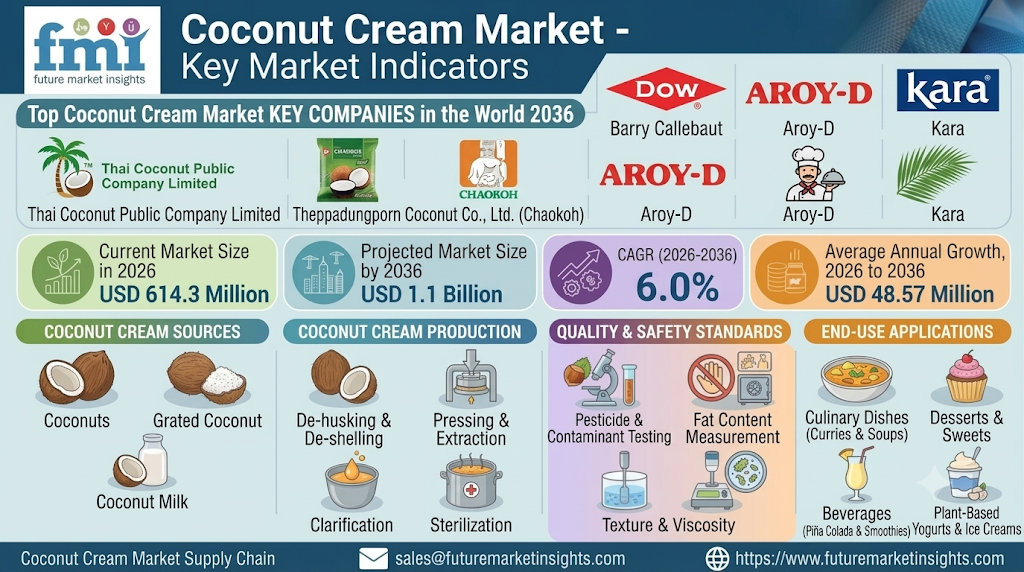
NEWARK, Del., November 16, 2026 — The global coconut cream market is witnessing steady growth as food and beverage manufacturers increasingly incorporate plant-based and dairy-free ingredients into sauces, curries, desserts, ice cream, bakery products, soups, and ready-to-eat meals. Rising consumer preference for vegan formulations, natural ingredients, and dairy alternatives is strengthening the commercial adoption of coconut cream across global food processing and foodservice supply chains.
According to the latest market intelligence report published by Future Market Insights (FMI), the global coconut cream market is estimated to reach USD 614.0 million in 2026, up from USD 579.0 million in 2025. The market is projected to expand to USD 1.10 billion by 2036, registering a compound annual growth rate (CAGR) of 6.0% during the 2026–2036 forecast period. The market is expected to generate an incremental revenue opportunity of approximately USD 486.0 million over the assessment period.
Get Detailed Market Forecasts, Competitive Benchmarking & Industry Insights: Request a Sample Report: https://www.futuremarketinsights.com/reports/sample/rep-gb-19878
The expansion reflects increasing demand for plant-based fats and dairy-free cream alternatives that provide rich texture, natural flavor, and formulation versatility. Coconut cream is increasingly used by food manufacturers, restaurants, dessert producers, and beverage companies seeking alternatives to conventional dairy cream while maintaining product consistency, creaminess, and functional performance.
Market Size & Growth Forecasts
The coconut cream market is entering a growth phase supported by increasing vegan food consumption, expanding dairy-free product portfolios, and rising demand for natural coconut-based ingredients. Manufacturers are focusing on processing efficiency, sustainable coconut sourcing, improved packaging technologies, and international distribution to address the evolving requirements of global food and beverage supply chains.
Conventional coconut cream is projected to account for 88.0% of the nature segment in 2026, supported by established coconut processing infrastructure, widespread raw material availability, and competitive pricing.
From an end-use perspective, food and beverage manufacturing is anticipated to account for 58.0% of market demand in 2026. Increasing use of coconut cream in sauces, curries, ice cream, desserts, soups, and ready meals is strengthening its position among industrial ingredient buyers.
Cans are expected to account for 50.0% of the packaging segment in 2026, supported by their shelf stability, convenient storage, and established international distribution networks.
From a sales channel perspective, B2B distribution is projected to capture 60.0% of market demand in 2026, reflecting strong procurement requirements from food manufacturers, restaurants, ingredient distributors, and commercial foodservice operators.
Key Market Takeaways
- Market Valuation: The global coconut cream market is projected to increase from USD 614.0 million in 2026 to USD 1.10 billion by 2036.
- Growth Rate: The market is expected to register a 6.0% CAGR between 2026 and 2036.
- Incremental Opportunity: The market is forecast to generate approximately USD 486.0 million in additional revenue during the assessment period.
- Leading Nature Segment: Conventional coconut cream is anticipated to capture 88.0% of the nature segment in 2026.
- Leading End Use: Food and beverage manufacturing is expected to account for 58.0% of market demand.
- Leading Packaging Format: Cans are projected to represent 50.0% of the packaging segment in 2026.
- Leading Sales Channel: B2B distribution is expected to account for 60.0% of market demand.
- Fastest-Growing Country: India is projected to lead evaluated national markets with a 7.4% CAGR through 2036.
- Regional Growth Opportunities: The Philippines is forecast to expand at 6.4%, Thailand at 5.6%, the United States at 5.2%, and Germany at 4.8% during the forecast period.
Plant-Based Food Innovation Strengthens Coconut Cream Demand
The growing preference for plant-based and dairy-free food products is emerging as a major growth catalyst for the global coconut cream market. Consumers are increasingly exploring vegan ingredients, natural food formulations, and dairy alternatives, encouraging manufacturers to incorporate coconut-based ingredients into mainstream and specialty food products.
Coconut cream provides a rich texture, creamy consistency, and characteristic coconut flavor, making it suitable for various food processing applications. Manufacturers are using it in dairy-free ice cream, desserts, sauces, curries, soups, bakery products, and ready-to-eat meals.
The expansion of plant-based desserts is creating additional opportunities for coconut cream suppliers. Ice cream and dessert manufacturers are incorporating coconut-derived fats into formulations to achieve creamy textures without relying on conventional dairy ingredients.
Foodservice operators are also contributing to market development. Restaurants and commercial kitchens are increasingly using coconut cream in Asian cuisines, plant-based menus, specialty sauces, and premium dessert preparations.
The growing international trade of coconut-based ingredients is further supporting market development. Producing countries are strengthening value-added processing capabilities and export infrastructure to serve international food manufacturers and distributors.
Conventional Coconut Cream and Food Manufacturing Shape Product Demand
Conventional coconut cream is expected to maintain a leading position, accounting for 88.0% of the nature segment in 2026. Its established supply infrastructure, broad availability, and cost competitiveness make it attractive for large-scale food manufacturers and commercial kitchens.
Organic coconut cream is gaining attention among premium food manufacturers and natural food retailers seeking ingredients aligned with organic certification, sustainable agricultural practices, and clean-label product positioning.
From an end-use perspective, food and beverage manufacturing is projected to hold a 58.0% share in 2026. Coconut cream is widely incorporated into sauces, curries, ice cream, soups, cakes, pastries, smoothies, and other processed food products.
Cosmetics and personal care applications are also creating opportunities for coconut cream suppliers. Its moisturizing properties and natural ingredient positioning support applications in moisturizers, body lotions, face masks, and hair care formulations.
Cans are expected to account for 50.0% of packaging demand in 2026. Their shelf stability and established distribution infrastructure make them suitable for household retail and international food ingredient supply.
B2B distribution is projected to represent 60.0% of sales channel demand in 2026, reflecting the importance of bulk procurement, contract manufacturing, and ingredient supply agreements.
Download the Market Research Summary (PDF) – Get Exclusive Industry Insights: https://www.futuremarketinsights.com/reports/sample/rep-gb-19878
Regional Growth Outlook: India, Philippines and Thailand Lead Expansion
The global coconut cream market is experiencing varied growth patterns across major national markets, driven by coconut cultivation, food processing investments, dairy-free product innovation, and expanding international trade.
India is projected to register the fastest growth among evaluated countries, with a 7.4% CAGR through 2036. Its established coconut cultivation base, expanding processing infrastructure, government support for coconut production, and increasing exports of value-added coconut products are expected to support market development.
The country produced approximately 20,301 million coconuts during 2024–2025. Government initiatives supporting coconut cultivation, replanting, rejuvenation, and integrated processing are strengthening the domestic coconut industry.
The Philippines is forecast to expand at a 6.4% CAGR during the assessment period. Increasing coconut production, established processing infrastructure, and strong international trade in coconut-derived ingredients are creating opportunities for coconut cream manufacturers.
Thailand is anticipated to register a 5.6% CAGR through 2036. Its established coconut processing industry, export-oriented manufacturers, and international distribution networks are supporting demand. Recovery in mature coconut availability is also expected to improve raw material access for processors.
The United States coconut cream market is expected to expand at a 5.2% CAGR through 2036. Growing demand for dairy-free desserts, plant-based ice cream, natural food ingredients, and coconut-based culinary products is creating opportunities for ingredient suppliers.
Germany is projected to grow at a 4.8% CAGR, supported by increasing demand for plant-based food products, vegan formulations, dairy alternatives, and natural ingredients across food manufacturing and retail channels.
Key Companies in the Coconut Cream Market
The competitive landscape includes international coconut processors, plant-based ingredient manufacturers, agricultural processing companies, and specialized coconut product suppliers.
Key companies covered in the Future Market Insights report and competitive analysis include:
- Thai Coconut Public Company Limited
- Theppadungporn Coconut Co., Ltd. (Chaokoh)
- Aroy-D
- Kara (Sambu Group)
- Kaira Organics
- Greenville Agro Corporation
- Zoic Cosmetic
- Red V Foods
- The Coconut Company
- Jaindi Exports (Pvt) Ltd.
- Natures-Spice
Market participants are focusing on processing efficiency, consistent coconut quality, sustainable sourcing, aseptic packaging, and stronger distribution relationships with industrial food and beverage manufacturers.
Thai Coconut Public Company Limited supplies branded, private-label, and industrial coconut products to international markets. Theppadungporn Coconut Co., Ltd. operates under the Chaokoh brand, while Aroy-D offers coconut cream and coconut milk products in convenient packaging formats.
Kara, associated with Indonesia's Sambu Group, has established an international presence through aseptic coconut cream and coconut-based ingredient offerings.
Supplier capabilities in traceable coconut sourcing, fat-content consistency, food safety certifications, processing capacity, and export-oriented packaging are expected to remain important competitive factors.
Growth Opportunities and Industry Challenges
The expansion of plant-based desserts, dairy-free food products, and international coconut ingredient trade is creating new opportunities for coconut cream suppliers. Manufacturers offering conventional and organic coconut cream, consistent fat content, flexible packaging, and reliable international supply arrangements are positioned to address evolving procurement requirements.
One important opportunity lies in the growing adoption of plant-based food formulations. Ice cream manufacturers, dessert producers, and foodservice operators are increasingly exploring coconut cream as a dairy-free fat ingredient that provides richness and texture.
Value-added processing in coconut-producing countries also offers significant opportunities. Investments in integrated processing facilities, improved agricultural productivity, and stronger relationships with coconut growers can help manufacturers improve supply reliability and strengthen export competitiveness.
Organic coconut cream presents additional opportunities in premium food and beverage categories. Growing interest in certified organic ingredients and sustainable agricultural sourcing is encouraging processors to strengthen relationships with certified suppliers.
However, seasonal coconut availability, weather-related crop fluctuations, and raw material price volatility may create challenges for manufacturers. Competition between coconut cream processors and coconut oil producers for mature coconuts can also influence raw material procurement costs.
Changes in coconut prices may affect production expenses and operating margins, particularly for manufacturers operating under fixed-price supply contracts. Differences in fat content, flavor, processing quality, and packaging requirements can further influence product consistency.
Manufacturers are therefore emphasizing diversified sourcing networks, improved processing technologies, long-term procurement partnerships, and flexible pricing strategies to manage supply-chain risks.
Future Market Outlook
The global coconut cream market is expected to benefit from the continued transformation of the international food and beverage industry. Growing demand for plant-based ingredients, dairy-free desserts, natural food formulations, and convenient coconut-based products will support long-term market opportunities.
For coconut processors, ingredient distributors, food manufacturers, and procurement teams, consistent coconut quality, reliable sourcing agreements, efficient processing capabilities, and product innovation will remain important factors in strengthening market positioning.
Future Market Insights expects the market to maintain a positive growth trajectory through 2036 as coconut cream continues to serve as a versatile plant-based ingredient across industrial food manufacturing, foodservice, household retail, and personal care applications.
Explore the market outlook, forecast analysis and competitive landscape in the Full Report: https://www.futuremarketinsights.com/reports/coconut-cream-market
About the Coconut Cream Market Report
Future Market Insights' Coconut Cream Market Report provides comprehensive insights into market size, growth forecasts, segment performance, regional opportunities, competitive benchmarking, and industry developments for the 2026–2036 assessment period.
The report evaluates the market across nature categories, including conventional and organic coconut cream, and end-use applications such as food and beverage manufacturing, household retail, foodservice, and cosmetics and personal care.
It also examines packaging formats, including cans, cartons and aseptic packs, pouches and sachets, and bulk and drums, alongside sales channels such as B2B, supermarkets and hypermarkets, online retail, specialty stores, and convenience stores.
The assessment covers key regional markets across North America, Latin America, Europe, East Asia, South Asia, Southeast Asia, Oceania, and the Middle East and Africa.
Related Food & Beverage Industry Reports
Blackcurrant Powder Market https://www.futuremarketinsights.com/reports/blackcurrant-powder-market
NPK Fertilizers Market https://www.futuremarketinsights.com/reports/npk-fertilizers-market
Wet Pet Food Market https://www.futuremarketinsights.com/reports/wet-pet-food-market
Drinkable Yogurt Market https://www.futuremarketinsights.com/reports/drinkable-yogurt-market
About Future Market Insights (FMI)
Future Market Insights (FMI) is a market intelligence and consulting firm providing data-driven research, strategic insights, and industry analysis to support business decision-making. FMI delivers market forecasts, competitive intelligence, demand assessments, and growth opportunity analysis across global industries, helping businesses identify emerging trends and develop informed growth strategies.
Media Contact
For Press & Corporate Inquiries
Rahul Singh
AVP – Marketing and Growth Strategy
Phone: +91 8600020075
For Sales: sales@futuremarketinsights.com
For Media: Rahul.singh@futuremarketinsights.com
Website: https://www.futuremarketinsights.com

 English
 Arabic
 French
 Spanish
 Portuguese
 Deutsch
 Turkish
 Dutch
 Italiano
 Russian
 Romaian
 Greek