


How to Start Your Own Payment Gateway (2026 Guide)
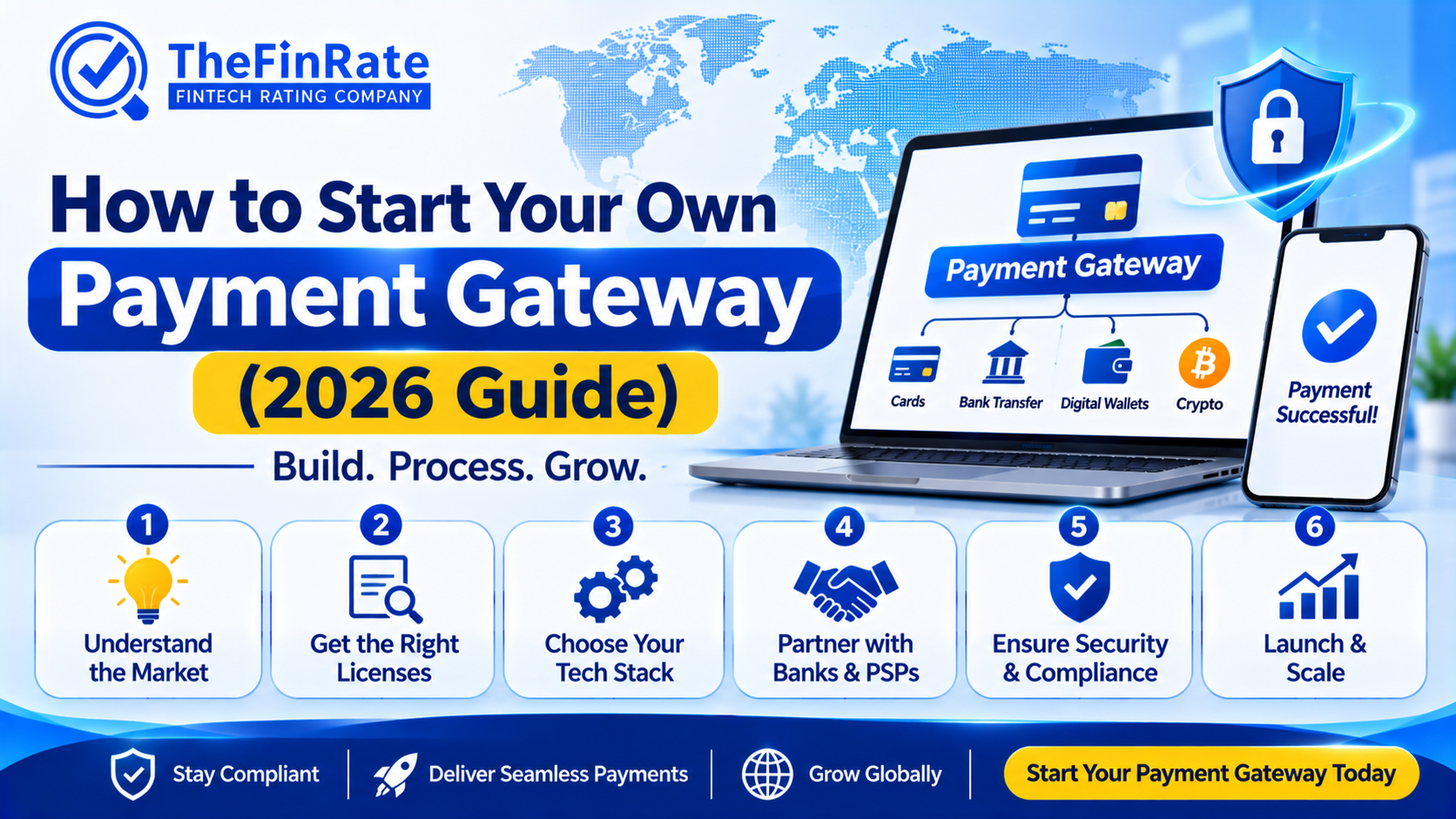
If you want to start your own payment gateway, the first decision is not about code. It is about which role you want in the payments chain, because that decides your licences, your bank relationships, your compliance workload and how long it takes to launch. This guide explains the four main routes, what each one needs, rough costs and timelines, and the steps to follow, so you can choose a starting point that fits your business.
Quick answer
● Fastest and cheapest start: Refer merchants as an ISO or reseller
● Own the merchant relationship under a bank’s licence: PayFac under a sponsor bank
● Your own branded product in weeks or months: Licence a white-label gateway
● Maximum control, maximum cost: Build from scratch
● Most new entrants: Start with a partner and move toward more ownership as volume grows
“Fastest” and “cheapest” here are based on published industry estimates, many from vendors with something to sell. This guide is general information, not legal advice. Check licensing rules with a lawyer in your target markets.
What owning a gateway means
A gateway encrypts card data, sends it for authorisation and returns the result at checkout. Owning one means you run that layer and usually brand it as your own. A gateway you own earns money from the spread between what each transaction costs you to process and what you charge your merchants.
Compare Payment Providers and Find the Right Partner
How we compared the routes
- Time to launch
- Upfront and running cost
- Licensing and compliance load
- Control over product and pricing
- Bank and acquirer dependence
- Best-fit builder
Estimates come from published industry sources, including vendors, so treat them as ranges and confirm with quotes.
Comparison table: four ways to start
| Route | Time to launch | Cost | Compliance load | Best for |
|---|---|---|---|---|
| ISO or referral | Days to weeks | Low | Light, the partner carries most of it | Testing the market |
| PayFac under a sponsor bank | Weeks to a few months | Moderate | Medium, you carry sub-merchant risk | Platforms and software companies |
| White-label gateway | Weeks to months | Moderate | Medium, vendor handles much of PCI | Branded product with fast launch |
| Build from scratch | 12 to 30 months | $500,000 to $1.5 million, vendor estimates | High | Well-funded regulated firms |
The 5 steps to start your own gateway
1. Define your model and your merchants
Decide whether you will serve small businesses, a software platform’s customers, high-risk sellers or a regional market. This choice drives licensing and bank appetite.
● Watch out: High-risk merchants raise your own underwriting duties and the number of banks willing to work with you
● Suits: Anyone, since every other step depends on it
2. Choose your route and your licensing path
Founders commonly choose between a payment institution or e-money licence in the EU and UK, money services business registration plus state licences in the US, or operating under a sponsor or PayFac arrangement. Early-stage companies often begin as a payment facilitator under a sponsor bank or acquiring partner, instead of becoming directly licensed and connected to the card schemes at the start. Another source lists the options as an ISO, PayFac-in-a-Box or full PayFac registration.
● Watch out: A sponsor arrangement is faster but means the bank sets your rules and takes part of the revenue
● Suits: Most first-time entrants
3. Secure an acquiring relationship early
A gateway needs at least one acquiring bank to process card transactions, and these relationships take time, so start before the gateway is built. Many operators keep more than one acquirer for routing and backup.
● Watch out: Banks review your merchant mix, risk controls and ownership before agreeing
● Suits: Anyone planning to process card payments
4. Choose how you build the technology
Building from scratch gives full control but is a large project. One vendor puts a from-scratch build at 12 to 24 months and $500,000 to $1.5 million, while a white-label deployment takes much less. Another source estimates 18 to 30 months for a gateway that also covers wallets, bank transfers and other methods. One white-label provider says it can get you live in two to four months with PCI DSS and GDPR compliance built into go-live. For crypto-focused builds.
● Watch out: Vendor timelines are marketing figures, so ask for named references and a written scope
● Suits: White-label for speed, custom build for control
5. Complete PCI DSS and launch with a pilot
A gateway must be PCI DSS certified before it handles live card transactions, and the highest level involves an annual audit by a Qualified Security Assessor. Tokenize early and keep card numbers off your own servers, which is a design choice and not just paperwork. Launch with a small group of merchants, watch declines, fraud and chargebacks, and expand once the numbers are stable.
● Watch out: Compliance is continuous, not a one-time certificate
● Suits: Every route except pure referral payadmitpayneteasy
Costs and revenue
● Build or licence: One-off development or setup, plus ongoing hosting and maintenance
● Compliance: PCI assessment, licences, AML and KYC tooling and legal fees
● Bank and network fees: Sponsor or acquirer fees, card network fees and revenue share
● Staffing: Engineering, risk, support and compliance
● Revenue: Per-transaction markup, monthly fees, and sometimes extra services such as fraud tools or payouts
Model your break-even on realistic merchant volume. At the volumes you start with, buying or partnering usually costs less in total than building in-house. decta
How to choose the right route
- Match the route to your capital. A from-scratch build needs deep funding.
- Match it to your timeline. Referral and white-label are fastest.
- Check your licensing exposure in each market you plan to serve.
- Ask who carries fraud and chargeback losses.
- Look for exit options, such as the right to move your merchants if you change vendors.
- Choose infrastructure that supports your future setup, not only today’s needs.
Common mistakes
● Starting with technology instead of licensing and bank relationships
● Underestimating PCI DSS scope and ongoing audits
● Building from scratch because it feels more valuable, when a partner would get you to market sooner
● Taking on high-risk merchants before your controls are ready
● Signing a vendor or sponsor contract without a clear exit plan
Verdict
There is no single best way to start. A referral model suits testing demand, a PayFac or white-label route suits most new businesses that want a branded product, and a custom build suits well-funded firms that need full control. Whatever you pick, secure the bank relationship and compliance plan first, and treat the technology as the last piece. Done in that order, a payment gateway can be a realistic business and not a long, expensive experiment.
Recent News and Developments in Merchant Account Providers Market
● September 2025: Fiserv acquired CardFree and completed the purchase of the remaining stake in AIB Merchant Services, strengthening its Clover platform and eCommerce acquiring presence in Europe.
● September 2025: Airwallex acquired OpenPay, adding usage-based and multicurrency billing capabilities to its payments product suite.
● April 2026: FIS completed its acquisition of Global Payments’ Issuer Solutions business, leaving Global Payments focused on merchant solutions after its Worldpay deal.
Frequently Asked Questions
- How much does it cost to start your own payment gateway?
It depends on the route. Vendor estimates for a build from scratch run from about $500,000 to $1.5 million over 12 to 24 months or more, while a white-label licence costs much less and launches faster. Budget separately for PCI DSS assessment, licences, legal fees, bank and network fees, and staff. Ask vendors for written quotes, because published figures come from companies that sell these services. - Do I need a licence to start a payment gateway?
It depends on your role and your country. In the EU and UK, firms that hold or move funds usually need a payment institution or e-money licence. In the US, many operators register as a money services business and obtain state licences, or work under a sponsor bank as a payment facilitator. A pure software gateway that never touches funds may need less, but your bank or acquirer will still set conditions. Get legal advice for each market. - How long does it take to launch?
A referral model can start in days or weeks. A white-label launch usually takes weeks to a few months. A build from scratch commonly takes 12 to 30 months, and the bank and licensing steps often take longer than the code. - What is the difference between a gateway, a PayFac and an ISO?
A gateway is the technology that sends card data for authorisation. A PayFac holds a master merchant account under a sponsor bank and onboards sub-merchants beneath it, so it carries their risk. An ISO usually refers merchants to an acquirer and earns a share of the processing revenue without holding funds.
Note: If you require specific details, provider comparisons, or insights that are not currently included in this overview, we are happy to accommodate your request. Please let us know your exact needs, and we will ensure the content is updated accordingly.
About Us:
TheFinRate is a B2B fintech information platform featuring payment provider reviews, comparisons, directories, industry guides, and educational resources. It helps online merchants, eCommerce businesses, SaaS companies, fintech startups, and payment professionals compare providers and make informed payment decisions.
Contact Us:
TheFinRate
Website: https://thefinrate.com/

 English
 French
 Spanish
 Portuguese
 Deutsch
 Turkish
 Dutch
 Italiano
 Russian
 Romaian
 Portuguese (Brazil)
 Greek