


Hiking Footwear Market Trends 2026–2036: USD 29.3 Billion Forecast, USA Growth at 3.9% CAGR
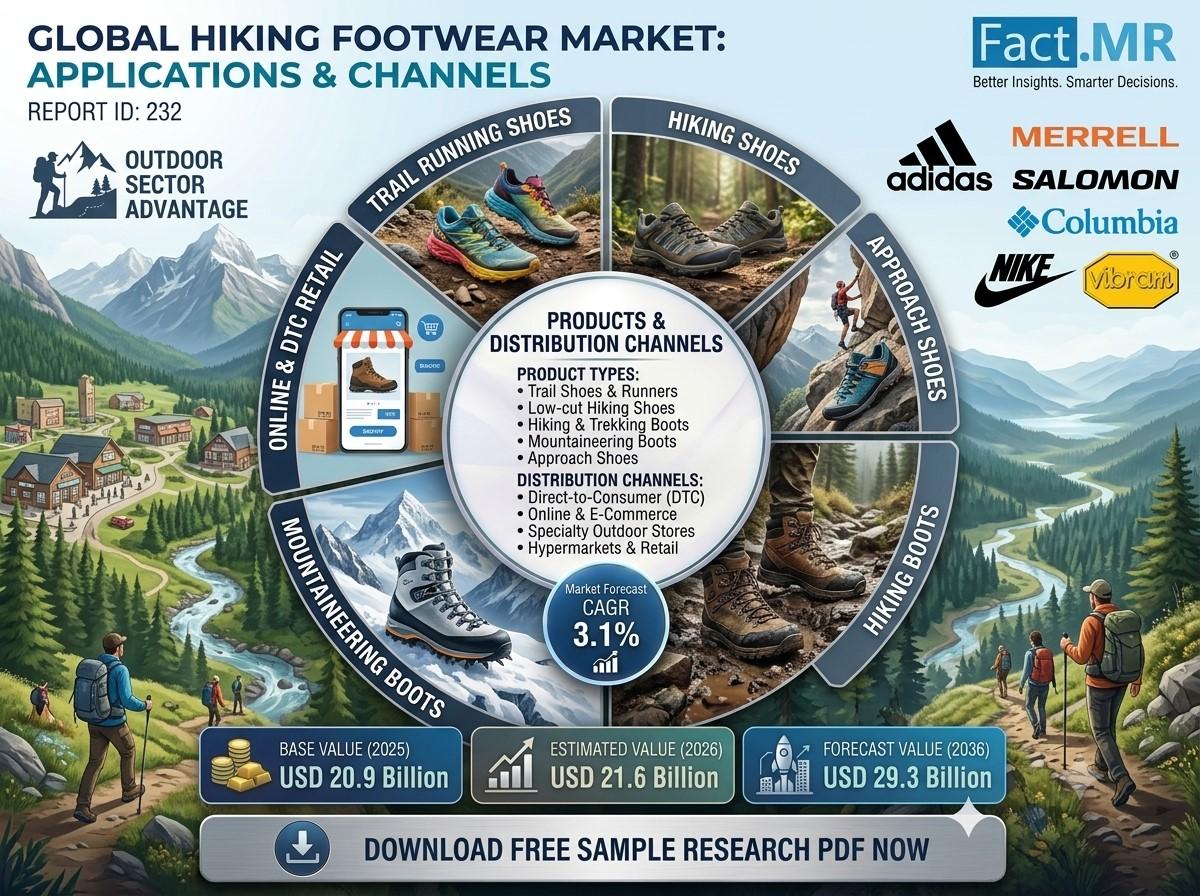
The global hiking footwear market is expected to grow from USD 21.6 billion in 2026 to USD 29.3 billion by 2036, registering a CAGR of 3.1% during the forecast period. According to Fact.MR, increasing participation in outdoor recreation, adventure tourism, and nature-based fitness activities is supporting demand for specialized footwear. Consumers are increasingly seeking durable shoes that provide traction, comfort, and foot protection across challenging terrain.
The growing popularity of trekking, mountaineering, camping, and recreational hiking is creating opportunities for footwear manufacturers. Hiking enthusiasts require products that provide stability on uneven surfaces while remaining comfortable during extended outdoor activities. Rising interest in exploring national parks, mountain trails, and remote destinations is also encouraging consumers to invest in purpose-built footwear rather than conventional shoes.
Get detailed market forecasts, competitive benchmarking, and pricing trends:
https://www.factmr.com/connectus/sample?flag=S&rep_id=232
Hiking Shoes Retain Leading Position
By product type, hiking shoes are expected to account for approximately 42% of the global hiking footwear market. Their leading position reflects demand for lightweight, durable footwear suitable for day hikes, moderate backpacking, and long-distance walking. These products offer a balance between the flexibility of trail running shoes and the protective characteristics of traditional hiking boots.
Hiking shoes are available in waterproof and non-waterproof designs, allowing consumers to select products according to trail conditions and outdoor requirements. Their ability to provide grip, support, and comfort is supporting adoption among recreational hikers and adventure travelers.
Trail shoes, approach shoes, mountaineering boots, and hiking boots also contribute to market demand. These categories address different terrain conditions and activity requirements. Mountaineering boots are designed for demanding environments, while trail shoes appeal to consumers seeking lighter footwear for outdoor movement.
Direct-to-customer online channels represent an important growth opportunity. Fact.MR's 2023–2033 analysis projects a 5.1% CAGR for this channel, with sales reaching USD 8.63 billion by 2033. Greater availability of hiking footwear brands through e-commerce platforms is making specialized products accessible to consumers across different locations.
USA, China, and United Kingdom Show Growth Potential
The United States remains an important market for hiking footwear manufacturers. Fact.MR's country-level analysis projects a 3.9% CAGR from 2023 to 2033, with sales reaching USD 8.63 billion by 2033. Growing participation in camping, wildlife photography, hiking, and other outdoor activities is supporting demand. The country's national parks and established outdoor recreation culture also create opportunities for specialized footwear manufacturers.
China is projected to register a 2.7% CAGR during the 2023–2033 forecast period. The country is expected to reach a market valuation of USD 4.49 billion by 2033. Rising interest in recreational hiking and adventure tourism is contributing to demand for footwear designed for challenging terrain. Growing consumer participation in outdoor experiences is also creating opportunities for manufacturers and retailers.
The United Kingdom is forecast to expand at a 2.2% CAGR through 2033, reaching USD 1.84 billion. The country's mountain destinations, established walking routes, and growing acceptance of mountaineering activities support demand for hiking shoes and boots. Consumers participating in countryside walking and outdoor exploration increasingly require footwear that offers traction and protection.
Japan is another market covered in the report, with demand projected to increase at a 1.8% CAGR and reach USD 1.23 billion by 2033. South Korea is forecast to register a 1.2% CAGR, reaching USD 775.14 million. Rising disposable income and interest in tourism and outdoor activities are contributing to demand in both countries.
Competitive Landscape
The hiking footwear market includes established global footwear manufacturers competing through product quality, distribution networks, brand recognition, and product development. Major companies identified by Fact.MR include New Balance Inc., Adidas AG, VF Corporation, Mizuno Corporation, NIKE Inc., Deckers Outdoor Corporation, and Wolverine World Wide Inc.
Other companies profiled include Skechers USA Inc., Amer Sports Corporation, PUMA SE, and Under Armour Inc. Manufacturers are strengthening supply chain management and expanding product portfolios to address different consumer requirements.
Competition is also influenced by the growing importance of online retail channels. Manufacturers are working with e-commerce platforms to improve product accessibility and reach consumers beyond traditional sporting goods outlets.
Product performance remains an important purchasing consideration. Consumers evaluate hiking footwear based on durability, comfort, traction, protective features, and suitability for different outdoor environments. Premium pricing and the availability of conventional footwear substitutes remain challenges for manufacturers seeking wider market adoption.
Product Innovation and Sustainability Trends Shape the Market
Growing consumer interest in environmentally responsible products is influencing hiking footwear development. Fact.MR identifies eco-friendly footwear as an opportunity for emerging manufacturers. The use of faux leather and ethically sourced synthetic materials is gaining attention among companies seeking to reduce environmental impact.
Manufacturers are also focusing on improved durability and protective performance. Hiking footwear must withstand uneven terrain, slippery surfaces, and prolonged outdoor use. Product development is therefore centered on maintaining comfort while providing dependable grip and foot protection.
Digital retail expansion is another important development. Direct-to-customer online platforms allow consumers to compare footwear designs and access specialized products from established brands. This is encouraging manufacturers to strengthen their online presence and distribution partnerships.
North America is expected to remain the leading regional market, accounting for approximately 35% of global demand. Continued participation in outdoor recreation and the presence of established footwear brands support its position.
As hiking and adventure tourism gain wider consumer interest, demand for specialized footwear is expected to remain steady. Manufacturers offering durable designs, improved comfort, and environmentally conscious material options are positioned to address evolving purchasing preferences through 2036.
To View Top Reports
https://adamaamresearch.blogspot.com/2026/11/oil-discharge-monitoring-equipment.html
https://net-pals.com/blogs/73753/Oil-Discharge-Monitoring-Equipment-Industry-Forecast-to-Reach-USD-405
https://acmingle.com/blogs/38450/Oil-Discharge-Monitoring-Equipment-Market-2035-Forecast-USD-405-6
About Fact.MR
Fact.MR is a market research and consulting company providing market intelligence, competitive analysis, and forecasting across global industries. Its research supports businesses with data-driven insights into emerging markets, technology trends, competitive dynamics, regional opportunities, and changing demand patterns.

 English
 French
 Spanish
 Portuguese
 Deutsch
 Turkish
 Dutch
 Italiano
 Russian
 Romaian
 Portuguese (Brazil)
 Greek