


Industrial Cooling Tower Applications Across Different Manufacturing Industries
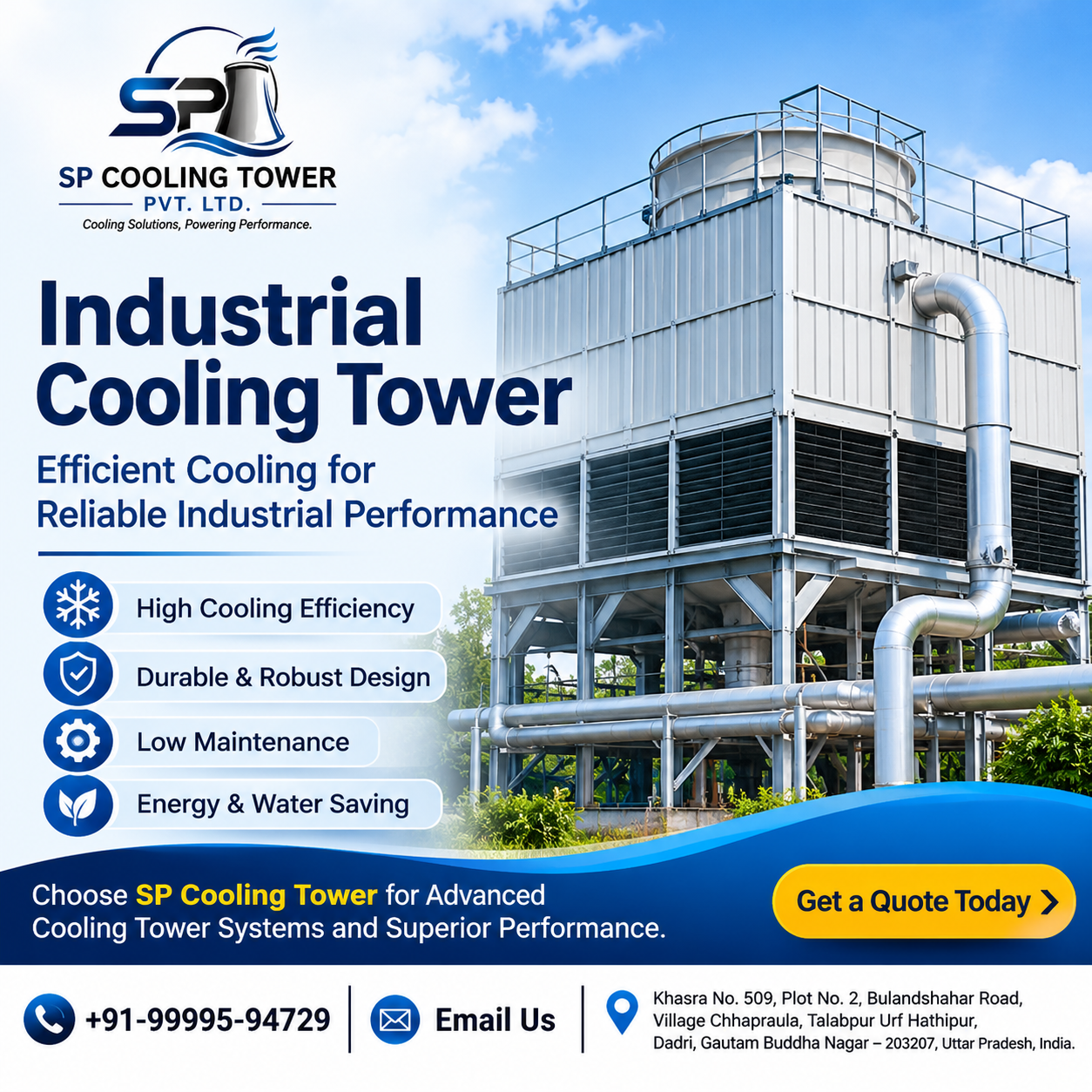
Heat generation is a common challenge across manufacturing and processing industries. Equipment such as compressors, condensers, heat exchangers, and production machinery requires suitable cooling arrangements to operate within recommended temperature limits. An Industrial Cooling Tower helps remove excess heat from circulating water and supports temperature management across a wide range of industrial applications.
The cooling requirements of each industry are different. Understanding these requirements is essential when choosing an appropriate cooling tower configuration, capacity, and construction material.
1. Cooling Towers in Chemical Processing Industries
Chemical manufacturing processes frequently involve reactions, heating, condensation, and other operations that generate considerable thermal energy.
Cooling towers support heat exchangers and process cooling loops by reducing the temperature of circulating water. Maintaining appropriate cooling conditions can help control process temperatures and protect connected equipment.
The selection of a cooling tower for chemical applications should consider the surrounding environment, corrosion exposure, cooling load, and water quality. Material selection is especially important where aggressive atmospheric conditions may affect structural components.
2. Cooling Towers in Pharmaceutical Manufacturing
Pharmaceutical facilities require controlled operating environments and reliable process equipment. Cooling systems may support chillers, manufacturing machinery, and temperature-sensitive processing operations.
Properly designed Cooling tower systems help reject heat from connected equipment and maintain stable cooling water conditions.
Facilities should evaluate hygiene-related requirements, water treatment arrangements, maintenance accessibility, and compatibility with their wider utility infrastructure.
3. Applications in Textile Industries
Textile manufacturing involves spinning, weaving, dyeing, finishing, and other production processes. Several machines and auxiliary systems generate heat during continuous operation.
Cooling towers can support process cooling, compressor cooling, and centralized HVAC systems in textile facilities.
For these applications, the required water flow, operating schedule, dust exposure, and available installation space should be considered during equipment selection.
4. Cooling Towers in Power Generation
Power generation facilities use cooling water to remove heat from condensers and other thermal equipment.
Cooling towers help reject this heat into the atmosphere, allowing cooled water to return to the circulating cooling water system.
The required cooling capacity depends on plant load, condenser requirements, local wet-bulb temperature, and the overall cooling system configuration.
5. Food and Beverage Manufacturing
Food and beverage plants use cooling equipment for production machinery, refrigeration systems, and process temperature control.
Cooling tower selection should account for operating schedules, water quality, environmental conditions, and applicable facility hygiene practices.
Regular inspection and water treatment help maintain reliable cooling performance.
6. Steel and Metal Processing
Steel plants and metal processing facilities operate furnaces, rolling mills, hydraulic systems, and other heat-generating equipment.
Cooling water may be used to remove heat from machinery and process equipment. Reliable cooling infrastructure is important because high operating temperatures can affect production reliability and equipment condition.
Different Cooling Tower Designs for Industrial Applications
Not every industrial application requires the same tower design.
Induced Draft Cooling Towers: These use fans to draw air through the tower and are commonly used in industrial cooling installations.
Forced Draft Cooling Towers: These push air into the cooling tower and may suit specific site layouts and operational requirements.
Cross-Flow Cooling Towers: Water flows vertically downward while air moves horizontally across the fill. Gravity-based water distribution is commonly used.
Counterflow Cooling Towers: Air moves upward against the downward flow of water. Pressurized spray nozzles distribute water across the fill.
Choosing between these configurations requires consideration of cooling performance, space availability, maintenance access, and operating conditions.
Selecting Reliable Industrial Cooling Tower Manufacturers in India
Selecting the right manufacturing partner is an important part of an industrial cooling project. Experienced Industrial Cooling Tower Manufacturers should understand different industrial applications and the technical requirements associated with each installation.
Companies searching for Industrial Cooling Tower Manufacturers in India should evaluate engineering capabilities, product specifications, construction quality, material options, and technical support.
Dependable industrial cooling tower suppliers can help buyers compare equipment and identify appropriate configurations. When choosing industrial cooling tower suppliers in India, businesses should also consider installation guidance, maintenance assistance, component availability, and product documentation.
For international requirements, Industrial Cooling Tower Exporters serve industrial customers across different markets. Industrial Cooling Tower Exporters in India can also support overseas procurement requirements through suitable product information and export coordination.
Factors That Influence Long-Term Cooling Tower Performance
The performance of a cooling tower depends on several operating and maintenance factors.
-
Correct water flow and distribution.
-
Suitable fan speed and airflow.
-
Clean and properly maintained fill material.
-
Effective drift eliminators.
-
Appropriate water treatment.
-
Proper blowdown and makeup-water management.
-
Regular mechanical inspections.
Industries should also monitor inlet and outlet water temperatures to understand whether the tower is achieving the required cooling range.
Importance of Preventive Maintenance
Preventive maintenance helps reduce unexpected equipment failures and supports consistent performance. Operators should inspect motors, fans, bearings, gearboxes, nozzles, fill, and water basins according to the equipment manufacturer's maintenance recommendations.
Water quality should be monitored to control scaling, corrosion, and biological growth. Maintenance records can help identify recurring issues and support better operational planning.
Conclusion
Industrial cooling towers are essential for heat rejection across chemical, pharmaceutical, textile, power generation, food processing, and metal manufacturing industries. Selecting the right equipment requires understanding application-specific cooling loads, operating conditions, construction materials, and maintenance requirements. Businesses should work with experienced Industrial Cooling Tower Manufacturers to identify appropriate cooling equipment for their industrial processes and long-term operational needs.

 English
 Arabic
 French
 Spanish
 Portuguese
 Deutsch
 Turkish
 Dutch
 Russian
 Romaian
 Portuguese (Brazil)
 Greek