


Beyond Fragmented Prompts: Why Ecommerce Brands Need an Agent-Based Model for Modern Ecommerce Marketing Strategy
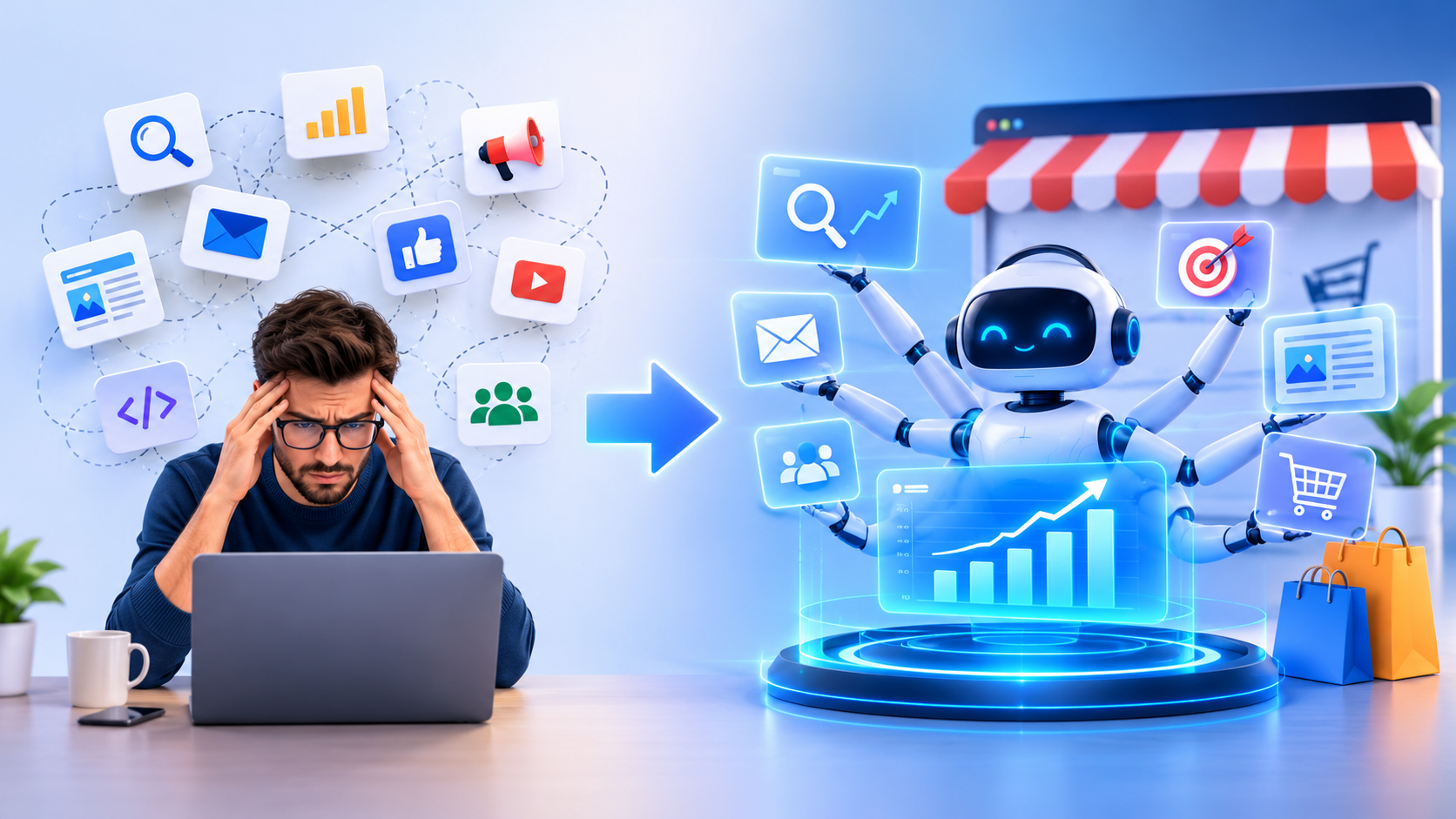
Open the typical ecommerce marketing team’s workflow and you will find a pattern. One person has a saved prompt for product descriptions. Another pastes subject lines into a chatbot. A third asks an assistant to summarize last week’s ad performance. Each task gets done faster, yet the business does not move faster as a whole. The work is still stitched together by humans copying outputs from one window into another.
This is the fragmented prompt problem. It is also why brands that adopted generative AI early are now discovering that speed on individual tasks does not add up to a better marketing strategy. The next stage is an agent-based model, where AI does not just answer a question but owns an outcome, uses live data, and acts across the customer journey.
The Fragmented Prompt Problem
Prompting is a useful skill, but it has structural limits when it becomes the backbone of a marketing operation.
- No memory or context. Every prompt starts from scratch. The model does not know your margins, your inventory, your returns data, or what your best customers bought last month unless someone pastes it in.
- No connection to systems. A prompt can draft an email, but it cannot check stock, pull a customer segment, schedule the send, and read the results.
- Inconsistent quality. Ten team members writing ten different prompts produce ten different brand voices and ten different standards.
- Hidden manual labor. Humans become the integration layer, copying, pasting, reformatting, and approving at every step.
- No accountability for results. A prompt produces text. It is not responsible for conversion rate, return on ad spend, or customer retention.
The result is a pile of disconnected productivity gains. Teams feel busier with AI, yet campaign cycles are not noticeably shorter and customer experiences are not noticeably better.
What an Agent-Based Model Actually Means
An AI agent is software that can reason about a goal, plan the steps needed, use tools and data to carry them out, and adjust based on what happens. In ecommerce, that means an agent might monitor a product’s performance, notice rising returns, check reviews for the cause, update the product page, pause a related ad, and alert a human only when a judgment call is needed.
An agent-based model organizes marketing around specialized agents, each with a clear job, access to the right data, and defined limits on what it may do on its own. Common examples include:
- Merchandising and catalog agents that keep product data complete, accurate, and optimized for search and AI discovery.
- Campaign agents that build audiences, generate creative variations, launch tests, and shift budget toward winners.
- Customer service agents that handle order status, returns, and exchanges using live order data.
- Retention agents that predict churn, trigger personalized offers, and time messages to individual behavior.
- Insight agents that watch dashboards continuously and surface what changed and why.
Industry analysts expect this to roll out in stages rather than as one all-knowing master agent. Brands are piloting specialized, purpose-built agents first, because they are easier to govern and show value sooner than complex multi-agent networks.
Why This Matters Right Now
The shift is no longer theoretical. Several data points from the past year show how quickly shopper behavior is changing.
AI is becoming a real traffic source. Salesforce predicts that 20% of all 2026 holiday ecommerce traffic will originate from AI chat agents, a mix of consumer-facing assistants, autonomous agents running backend tasks, and systems that scrape competitor prices. Adobe forecasts that AI-assisted traffic to US retail sites will grow 130% year over year between November 1 and December 31, 2026. After the 2025 holiday season, Adobe reported a 693.4% jump in generative AI traffic to retail sites, during a season that set a record of $257.8 billion in US online spending.
AI traffic now converts better. Adobe found that in August 2025, AI-referred visits converted worse than other traffic. By September 2026, AI traffic was generating 83% more revenue per visit than other sources, and Adobe expects that advantage to widen during the holidays.
Traffic alone is not the prize. Salesforce’s Shopping Index showed global digital traffic up 18% in the second quarter of 2026, while order volume rose only 1%. Getting attention is no longer the same as closing the sale, which is exactly the gap that agents working on conversion, service, and personalization are meant to close.
Brands with their own agents are pulling ahead. In the 2025 holiday season, retailers using branded AI shopper agents saw sales growth of 6.2%, compared with 3.9% for those without, a difference of 59%. Salesforce now expects one in three ecommerce sites to have a site-specific shopper agent live by Cyber Week 2026.
The long-term runway is large. eMarketer forecast that AI platforms would account for 1.5% of US retail ecommerce sales in 2026, about $20.57 billion and nearly four times the 2025 figure. Morgan Stanley has projected that nearly half of online shoppers will use AI shopping agents by 2030, representing roughly 25% of their spending.
A Reality Check on the Hype
A balanced view matters here. Adobe itself has noted that the number of consumers using AI chatbots to shop remains modest, and much of AI’s influence so far has come through customer service rather than autonomous purchasing. Interest in agentic checkout cooled from its spring 2026 peak, many pilots never complete an actual purchase, and some retailers have pushed back on letting third-party agents control the buying experience. Measurement is another open challenge, since attribution across agent-driven journeys is still immature.
None of this weakens the case for an agent-based model. It sharpens it. Brands do not need to bet everything on fully autonomous shopping. They need infrastructure and workflows that perform well whether the customer arrives from a search engine, a social feed, a chat assistant, or a shopping agent acting on someone’s behalf.
Understanding the Difference in Practice
Many leaders still treat everything labeled AI as one category, which leads to poor buying and planning decisions. The distinction between AI Tools vs Ecommerce AI Agents is one of ownership and action. A tool waits for a person to give it a task and returns a result, such as a caption or a summary. An agent is given an objective, such as reducing cart abandonment in a product category, and then gathers data, makes decisions within set rules, takes action in connected systems, and reports back on the outcome. Tools make individuals faster. Agents change how the whole operation runs.
How an Agent-Based Marketing Strategy Changes the Work
Here is how common ecommerce marketing activities look under each model.
| Activity | Fragmented prompts | Agent-based model |
|---|---|---|
| Product content | Staff prompt for each description and paste it into the store | A catalog agent enriches, validates, and syncs product data continuously |
| Ad optimization | Weekly manual review, with prompts used for copy ideas | Campaign agent tests creative, reallocates budget, and flags anomalies daily |
| Customer support | Chatbot answers generic questions | Service agent checks live orders, processes returns, and escalates edge cases |
| Email and SMS | Prompted copy, manually scheduled | Retention agent selects segment, offer, timing, and channel per customer |
| Reporting | Analyst asks AI to summarize exports | Insight agent monitors metrics and explains changes in real time |
Preparing Your Brand to Be Found by Agents
An agent-based model has two sides. Brands deploy their own agents, and they must also be legible to the agents that shoppers use.
- Clean, rich product data. Agents compare products on attributes, so incomplete titles, vague specs, and missing details cost you visibility. Structured, accurate data is the new shelf space.
- Real-time catalog access. An agent is only as good as the data it can reach. Stale exports lead to wrong prices, wrong availability, and lost trust.
- Protocol readiness. Emerging standards such as Google’s Universal Commerce Protocol, along with related protocols like A2A and AP2, will shape how agents access merchant catalogs and complete transactions. Early participation can provide infrastructure advantages.
- Content that machines can read. Reviews, FAQs, comparison pages, and creator content get crawled and summarized by AI systems. Some brands now deliberately support creator content, knowing transcripts will be picked up by AI crawlers.
- Measurement that includes AI referrals. Track AI-sourced visits, assisted conversions, and revenue per visit separately so you can see what is working.
A Practical Roadmap for Brands
You do not need a company-wide transformation to begin. A staged approach works best.
Step 1: Audit the fragments. List every place your team uses prompts today. Note which tasks repeat, which depend on live data, and which cause delays because of manual handoffs.
Step 2: Pick one high-value use case. Customer service on order status and returns, product data enrichment, and abandoned cart recovery are strong starting points because outcomes are measurable and risk is contained.
Step 3: Connect the data. Give the agent secure, real-time access to your store platform, inventory, customer records, and order history. This is where most of the value, and most of the difficulty, lives.
Step 4: Define guardrails. Decide what the agent can do alone, such as sending a standard return label, and what needs approval, such as issuing refunds above a set amount or changing prices.
Step 5: Measure against a baseline. Compare conversion rate, response time, resolution rate, cost per contact, and revenue per visit before and after.
Step 6: Expand deliberately. Add agents one function at a time, then let them share context, so insights from service feed retention and insights from retention feed merchandising.
Risks and Responsibilities
Agents act, which means mistakes can scale. Brands should plan for data privacy, consent, and security when agents touch customer information. Human oversight should remain in place for pricing, financial decisions, and sensitive customer situations. Transparency matters too, since shoppers should know when they are dealing with an AI. Questions about attribution, fair access, and platform governance are still evolving, so build flexibility into your stack rather than locking into a single vendor’s approach.
The Bottom Line
Fragmented prompts gave marketing teams a taste of what AI can do. They also exposed the ceiling of working that way: no context, no connection, no ownership of results. The brands pulling ahead are the ones moving from isolated assistance to coordinated agents that act on live data, serve both human shoppers and AI intermediaries, and are measured on business outcomes.
With AI-driven traffic growing quickly, converting at higher rates, and increasingly arriving through agents that decide what to recommend, the question for ecommerce leaders is no longer whether to adopt AI. It is whether their marketing strategy is built around an operating model that can use it. Start with one agent, one use case, and one measurable goal, and build from there.

 English
 Arabic
 French
 Portuguese
 Deutsch
 Turkish
 Dutch
 Italiano
 Russian
 Romaian
 Portuguese (Brazil)
 Greek