


Disposable Food Containers Market to Grow at 9.8% CAGR Through 2036 as Sustainable Materials Gain Adoption
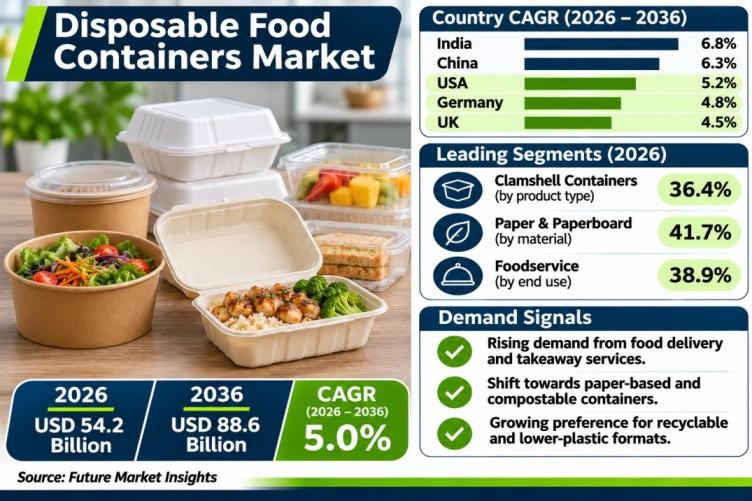
The global disposable food containers market is projected to reach USD 22.8 billion in 2026, rising from USD 20.8 billion in 2025. Future Market Insights (FMI) forecasts the market to reach USD 58.1 billion by 2036, registering a 9.8% CAGR between 2026 and 2036. This represents an additional USD 35.3 billion in market revenue over the forecast period.
Food delivery, takeaway orders and institutional catering are increasing demand for containers that protect meals during transport. Buyers are also reviewing material choices as regulations and recycling requirements influence packaging specifications.
The short version
- The market is forecast to grow from USD 22.8 billion in 2026 to USD 58.1 billion by 2036, at a 9.8% CAGR.
- Rigid containers and bottles lead packaging formats with a 44.0% share. Recycled paperboard accounts for 34.1% of material demand.
- Food and beverage represents 40.5% of end-use revenue. Mexico is the fastest-growing evaluated country, with an 11.0% CAGR.
>> Get Detailed Market Forecasts, Competitive Benchmarking, and Pricing Trends: https://www.futuremarketinsights.com/reports/sample/rep-gb-13468
Three numbers that matter
|
Market indicator |
2026 value |
|
Global market size |
USD 22.8 billion |
|
Rigid containers and bottles |
44.0% |
|
Recycled paperboard |
34.1% |
Food and beverage contributes a further 40.5% of end-use revenue. This reflects the high volume of containers used by quick-service restaurants, cloud kitchens and retail food counters.
Where growth is strongest
FMI's country comparison identifies Mexico as the fastest-growing evaluated market. The listed country forecasts are:
- Mexico – 11.0% CAGR: Urban food delivery, industrial canteen catering and local restrictions on foam containers are supporting demand for paperboard and polypropylene alternatives.
- Italy – 10.2% CAGR: Tourism-related foodservice, takeaway demand and established organic-waste collection systems support adoption of fibre and certified compostable formats.
- Australia – 9.4% CAGR: State-level restrictions on expanded polystyrene and selected single-use plastics are encouraging a shift towards paperboard and moulded-fibre containers.
- Spain – 8.6% CAGR: The tax on non-reusable virgin plastic packaging is encouraging foodservice operators to consider recycled fibre and rPET formats.
- Germany – 7.8% CAGR: Packaging Act compliance and recycling requirements support demand for mono-material and fibre-based containers.
USA data: The report includes the United States in its geographical coverage, but its published country comparison does not state a US CAGR. The rate is therefore not included as a numerical forecast.
Who is moving
The market is seeing activity across recyclable paperboard, rigid containers, barrier coatings and foodservice packaging.
Recent developments
- July 2026: Smurfit Westrock partnered with Coca-Cola on paper-based World Cup packaging solutions designed to serve event and foodservice demand.
- June 2026: Crown Holdings published its 2025 Sustainability Report, highlighting lightweight and recyclable metal food and beverage containers across the Americas and Europe.
- March 2026: Sealed Air reported USD 5.4 billion in annual revenue for 2025 and highlighted the expansion of its recyclable food tray systems.
- January 2026: Smurfit Westrock won 15 awards at the WorldStar 2026 Packaging Competition for recyclable paper-based and corrugated food and beverage structures.
- July 2025: Huhtamaki launched recyclable and compostable paperboard ice cream cups and lids with water-based barrier coatings across North America.
- April 2025: Amcor completed its combination with Berry Global, bringing together their global packaging operations.
Key players profiled
- Amcor plc
- Berry Global Group, Inc.
- Smurfit Westrock plc
- Sealed Air Corporation
- Ball Corporation
- Crown Holdings, Inc.
- Silgan Holdings Inc.
- Huhtamaki Oyj
- Mondi plc
- Sonoco Products Company
These companies compete across rigid thermoformed containers, paperboard cartons, moulded-fibre bowls, metal containers and flexible food packaging. Supplier selection depends on food-contact performance, barrier technology, substrate expertise and distribution reach.
Where to act
- Prioritise rigid formats: Rigid containers and bottles hold a 44.0% share. Leak-resistant closures, stackability and protection during delivery remain important buying criteria.
- Expand recycled paperboard options: The material accounts for 34.1% of demand. Water-based dispersion coatings can help improve grease resistance while supporting paper recovery.
- Target foodservice buyers: Food and beverage represents 40.5% of end-use demand. Restaurant chains and cloud kitchens need reliable supply and consistent container performance.
- Develop PFAS-free barriers: Fluorine-free grease-resistant coatings can help converters meet changing food-contact requirements.
- Improve material efficiency: Lightweight containers and flat-blank shipping formats can reduce material use and transport costs.
>> Access Detailed Market Insights: https://www.futuremarketinsights.com/reports/disposable-food-containers-market
Where to be careful
Recycled paperboard and post-consumer recycled plastics need careful food-contact controls. Decontamination, barrier performance and migration testing remain important when packaging is used with hot or greasy meals.
Material premiums can also affect margins. Food-grade recycled resin and coated paperboard may cost more than conventional alternatives. Compostable packaging does not guarantee composting in every location, so buyers should check local collection and processing facilities before changing specifications.
Analyst perspective
Nandini Roy Choudhury, Principal Consultant at Future Market Insights, states:
“Foodservice operators will not pay a green premium for a container that leaks sauce or collapses under steam condensation.”
The report highlights the importance of combining PFAS-free water-based barrier coatings with high-speed thermoforming or folding-carton production. Suppliers must maintain food protection and manufacturing efficiency while meeting material requirements.
Questions for your next planning meeting
- Can our current containers maintain leak resistance and structural strength during hot-food delivery?
- Which recycled paperboard, moulded-fibre or mono-material formats meet our food-contact and recycling requirements?
- Can our suppliers support consistent quality, competitive pricing and reliable delivery across multiple restaurant locations?
Realted Report Of Packaging Industry :
Non-UV Dicing Tapes Market: https://www.futuremarketinsights.com/reports/non-uv-dicing-tapes-market
Bio PE Pouches Market: https://www.futuremarketinsights.com/reports/bio-pe-pouches-market
Insulated Coolers Market: https://www.futuremarketinsights.com/reports/insulated-coolers-market
MEDIA CONTACT
Contact Person: Media Relations Team
Designation: Corporate Communications
Email: sales@futuremarketinsights.com
Phone: +1-347-918-3531
Website: https://www.futuremarketinsights.com/
ABOUT FUTURE MARKET INSIGHTS
Future Market Insights, Inc. (FMI) is an ESOMAR-certified market research and consulting firm headquartered in Delaware, USA, with offices in the United Kingdom, the United Arab Emirates, and India. FMI delivers syndicated and custom research across food and beverage, healthcare, chemicals, technology, packaging, consumer goods, and industrial sectors. Its research helps organizations assess market opportunities, understand industry developments, and make informed strategic decisions.

 English
 Arabic
 French
 Spanish
 Deutsch
 Turkish
 Dutch
 Italiano
 Russian
 Romaian
 Portuguese (Brazil)
 Greek