


What Does CPM Mean in a Golf Shaft? (And Why It Tells You More Than R, S or X)
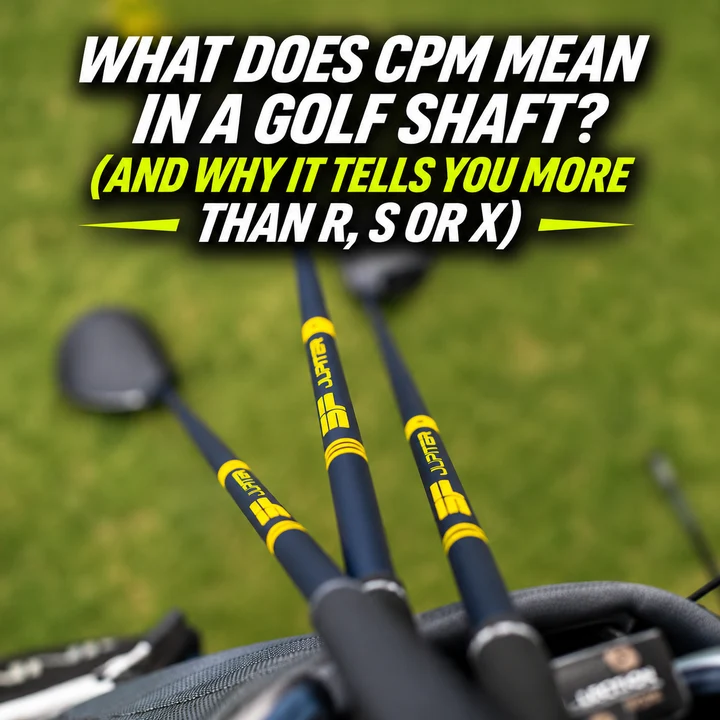
Two golf shafts can have the same X-Stiff label and still feel completely different. One might feel firm and controlled, while the other feels noticeably more flexible. That's because golf shaft flex labels aren't standardized across manufacturers.
So how can you tell how stiff a shaft actually is?
One useful measurement is CPM, or cycles per minute. It gives golfers a numerical way to understand shaft stiffness instead of relying only on letters such as R, S, or X.
For example, Steadfast Golf's JUPITER One driver shafts range from 227 CPM in Senior flex to 273 CPM in X-Stiff. Each flex has its own frequency measurement, weight, and recommended swing speed range.
But CPM isn't the whole story. Shaft length, weight, bend profile, and your swing tempo also matter.
Here's what CPM means in a golf shaft, how it's measured, and how to use it when choosing your next driver shaft.
What Does CPM Mean in a Golf Shaft?
CPM stands for cycles per minute. It measures how frequently a golf shaft vibrates when it's clamped at one end, bent slightly, and released.
Think about a diving board. A flexible board bends easily and bounces relatively slowly. A stiffer board resists bending and vibrates more quickly.
A golf shaft behaves in a similar way.
Under identical testing conditions, a shaft with a higher CPM generally has greater measured bending stiffness. A lower CPM indicates a more flexible shaft.
For example, if two driver shafts are tested using the same equipment and procedure, one measuring 240 CPM and another measuring 260 CPM, the second has a higher measured frequency.
However, CPM doesn't directly measure how far you'll hit the ball, how straight your shots will travel, or how the entire shaft bends during your swing.
It's a useful fitting measurement, not a complete performance rating.
How Is Golf Shaft CPM Measured?
Golf shaft CPM is measured using a frequency analyzer.
The butt end of the shaft, near the grip, is secured in a clamp. A specified weight is attached near the tip, and the shaft is pulled slightly to one side before being released.
The analyzer measures the shaft's vibration frequency and displays the result in cycles per minute.
A reading of 250 CPM means the shaft vibrates at a frequency equivalent to 250 cycles per minute under that particular testing setup.
Why the testing setup matters
Not every frequency analyzer produces directly comparable results.
Several factors can influence the reading:
-
Clamp length: A longer clamp generally increases CPM because less shaft length remains free to bend.
-
Shaft length: Shortening the free bending length generally increases frequency when other conditions remain unchanged.
-
Tip weight: Different testing weights can produce different readings.
-
Grip installation: A shaft measured with a grip may produce a different reading from the same shaft measured without one.
-
Testing procedure: Equipment setup and measurement methods can affect the result.
This is why you shouldn't assume that a 270 CPM shaft from one manufacturer has exactly the same stiffness as a 270 CPM shaft from another.
The most useful comparisons involve shafts measured under consistent conditions.
Why Does CPM Tell You More Than Regular, Stiff or X-Stiff?
Traditional golf shaft flex labels are helpful starting points, but they aren't universal measurements.
One manufacturer's Regular shaft may feel similar to another manufacturer's Stiff shaft. Even two shafts labeled X-Stiff can have noticeably different bending characteristics.
CPM provides another piece of information by assigning a numerical frequency measurement to the shaft.
For example, consider a golfer comparing two Stiff driver shafts. If one measures 245 CPM and another measures 265 CPM under identical testing conditions, the golfer can see that their measured frequencies differ.
The Stiff label alone doesn't communicate that difference.
This is particularly useful when comparing Driver Shaft Flex options or moving from one shaft manufacturer to another.
Still, a higher CPM doesn't automatically mean a better shaft. It simply provides more information about stiffness.
The best-fitting shaft depends on how the golfer swings and how the club performs.
What Are the CPM Numbers for JUPITER One Driver Shafts?
The Steadfast Golf JUPITER One Driver Shaft is available in four flex options, each with a published CPM measurement and recommended swing speed range.
All four options are listed with a 45.5-inch playing length.
Senior Flex: 227 CPM
The JUPITER One Senior flex measures 227 CPM and weighs approximately 50 grams.
It's recommended for golfers with driver swing speeds between 70 and 89 mph.
This option may appeal to players who prefer a more flexible shaft response.
However, golfers comparing the best senior driver shafts should focus on their swing characteristics rather than age alone.
Regular Flex: 241 CPM
The Regular flex measures 241 CPM and weighs approximately 55 grams.
It's recommended for golfers with swing speeds between 90 and 99 mph.
Compared with the Senior option, it has a 14 CPM higher frequency measurement.
Stiff Flex: 258 CPM
The Stiff flex measures 258 CPM and weighs approximately 58 grams.
It's recommended for golfers swinging between 100 and 109 mph.
Its frequency is 17 CPM higher than the Regular option.
X-Stiff Flex: 273 CPM
The X-Stiff flex measures 273 CPM and weighs approximately 61 grams.
It's recommended for golfers with swing speeds between 110 and 129 mph.
It measures 15 CPM higher than the Stiff option.
How many CPM equal one shaft flex?
You may hear that approximately 10 CPM represents one flex difference. That's a common rule of thumb, not an industry-wide standard.
Within the JUPITER One driver range, adjacent flex options differ by 14 to 17 CPM.
These numbers demonstrate why actual frequency measurements can be more informative than assuming every step from Regular to Stiff or Stiff to X-Stiff represents the same change.
Why Do Shorter Golf Shafts Have Higher CPM Readings?
A shorter free bending length generally produces a higher frequency reading when other testing conditions remain the same.
This helps explain why driver shafts and fairway wood shafts can have different CPM measurements despite sharing the same flex label.
Steadfast Golf provides frequency measurements for its JUPITER One driver, 3-wood, and 5-wood shafts.
The listed playing lengths are 45.5 inches for the driver, 43 inches for the 3-wood, and 42 inches for the 5-wood.
For Senior flex, the published readings are 227 CPM for the driver, 237 CPM for the 3-wood, and 267 CPM for the 5-wood.
For Regular flex, they are 241 CPM, 251 CPM, and 275 CPM, respectively.
For Stiff flex, the readings are 258 CPM for the driver, 271 CPM for the 3-wood, and 300 CPM for the 5-wood.
For X-Stiff flex, they are 273 CPM, 278 CPM, and 322 CPM.
One interesting comparison is the Regular 5-wood at 275 CPM and the Stiff driver at 258 CPM.
The Regular 5-wood has the higher published frequency, but that doesn't make it an X-Stiff driver shaft.
These clubs have different lengths and may have different shaft designs and measurement conditions.
The practical lesson is simple: compare CPM within the same club category and using consistent testing procedures. Don't treat driver and fairway wood frequency numbers as interchangeable flex ratings.
What Can't CPM Tell You About a Golf Shaft?
CPM is useful for measuring frequency, but it doesn't describe everything that makes a shaft feel or perform differently.
A golf shaft has several characteristics that influence how it responds during the swing.
Shaft weight affects the overall feel of the club. Two shafts with similar CPM measurements may feel very different if one weighs 50 grams and the other weighs 70 grams.
Bend profile describes how stiffness is distributed along the shaft. Some shafts are firmer near the tip, while others have different stiffness characteristics through the middle or butt section. Two shafts can have similar overall frequency readings but different bend profiles.
Torque measures resistance to twisting under a specified load. It is separate from CPM and can influence shaft feel.
Swing tempo also matters. A golfer with a quick transition may prefer a different shaft from someone with a smooth transition, even when both have the same swing speed.
As GOLF.com explains in its guide to golf shaft CPM, frequency measurements are especially useful for comparing similar shafts, but they cannot fully describe how a shaft plays.
Golf+1
That's why golfers looking for a Driver Shaft for Accuracy or the Best Golf Shaft for Distance should consider CPM alongside other fitting information.
What Do Golfers Say About Shaft Flex?
Real customer experiences show why selecting the right shaft involves more than matching a swing speed to a flex label.
On October 25, 2026, Gary Adams shared his experience with a Regular-flex JUPITER One installed in a Ping G440 LST driver.
He reported gaining approximately 10 yards compared with his previous Regular-flex shaft. However, he also said the shaft felt somewhat whippy when he swung aggressively at 92–95 mph, sometimes producing a miss to the right.
His swing speed falls within Steadfast Golf's recommended Regular-flex range, but his feedback suggests that his transition and preferred feel may also influence his ideal choice.
Another customer, Michael Huff, reported initially selecting Senior flex before finding it too flexible and moving to Regular.
Customer P.B. described enjoying the shaft's feel and being able to slow the swing slightly for better control.
These are individual customer experiences, not controlled tests. They don't establish that CPM caused the reported changes.
What they demonstrate is that two golfers can have different preferences, even when a shaft falls within their recommended swing speed range.
How Should You Use CPM When Choosing a Golf Shaft?
Start with your swing speed, then use CPM to understand the differences between suitable shaft options.
1. Find your average swing speed
Your driver swing speed is a useful starting point for selecting flex.
If you don't have access to a launch monitor, Steadfast Golf's guide to estimating driver swing speed explains how to make an estimate.
2. Choose a suitable flex range
Compare your swing speed with the manufacturer's recommendations. For JUPITER One, Regular is recommended for 90–99 mph, while Stiff is recommended for 100–109 mph.
These are fitting starting points rather than absolute rules.
3. Compare frequency measurements
Look at CPM readings within the same shaft family and club category.
If you're comparing Custom Golf Shafts from different manufacturers, remember that differences in testing methods may limit direct comparisons.
4. Consider your transition and tempo
A golfer with a smooth swing may prefer a different shaft response from someone who makes a faster, more aggressive transition.
Steadfast Golf recommends considering the stronger flex when you're between two ranges because its shafts are designed to play slightly softer.
5. Test the shaft's feel and ball flight
Finally, compare your actual shots.
Pay attention to average carry distance, contact quality, shot dispersion, and how comfortable the shaft feels.
CPM can narrow your options, but your results should guide the final decision.
Where Does JUPITER One Fit Into the CPM Comparison?
The JUPITER One Driver Shaft is Steadfast Golf's premium carbon fiber golf shaft, available in Senior, Regular, Stiff, and X-Stiff flexes.
Its published CPM measurements range from 227 to 273, with shaft weights between approximately 50 and 61 grams.
Steadfast Golf also provides swing speed recommendations and frequency measurements for its matching fairway wood shafts.
This information can help golfers compare options within the JUPITER One range instead of choosing solely by the flex letter.
For eligible purchases, Steadfast Golf offers a 60-day flex satisfaction guarantee. If the selected flex isn't suitable, customers may qualify for an exchange to another flex. This is not a refund policy, and custom builds are excluded.
Frequently Asked Questions About Golf Shaft CPM
What does CPM stand for in golf?
CPM stands for cycles per minute. It measures the frequency at which a golf shaft vibrates during a standardized test. Club fitters use this measurement to help evaluate shaft stiffness and compare similar shafts under consistent testing conditions.
Is a higher CPM golf shaft stiffer?
Generally, yes. Under identical testing conditions, a shaft with a higher CPM reading has greater measured bending stiffness. However, shaft length, clamp setup, and testing weight can affect the result, so CPM numbers from different setups aren't always directly comparable.
What is a good CPM for a driver shaft?
There is no single ideal CPM for every golfer. The appropriate reading depends on the shaft model, measurement setup, and individual swing. For example, JUPITER One driver shafts range from 227 CPM in Senior flex to 273 CPM in X-Stiff.
How many CPM equal one shaft flex?
Approximately 10 CPM is sometimes used as a general reference, but it isn't a universal standard. Within the JUPITER One driver shaft range, adjacent flexes differ by 14 to 17 CPM. Different shaft models may use different frequency progressions.
Can two Stiff shafts have different CPM readings?
Yes. Golf shaft manufacturers use different designs and flex classifications. Two shafts labeled Stiff can have different frequency measurements, weights, and bend profiles. CPM is most useful when comparing similar shafts measured using the same procedure.
Why does a 5-wood have a higher CPM than a driver?
A 5-wood generally has a shorter shaft than a driver. Shortening the free bending length tends to increase frequency when other conditions remain equal. Shaft construction and testing setup also affect the reading, so the two club types shouldn't be compared as equivalent flex measurements.
Can CPM tell me which driver shaft flex I need?
CPM can help you compare stiffness, but it cannot select the ideal flex by itself. Start with swing speed, then consider your tempo, transition, shaft weight, and ball flight. Testing suitable options is more reliable than choosing based only on a frequency number.
Does CPM affect driver distance or accuracy?
CPM is a measurement of shaft frequency, not distance or accuracy. A shaft with suitable stiffness characteristics may help some golfers achieve more consistent timing or contact, but higher CPM doesn't automatically produce longer or straighter shots.
Final Thoughts: Is CPM More Useful Than Shaft Flex Labels?
CPM gives golfers a measurable way to understand shaft stiffness beyond traditional labels such as Regular, Stiff, and X-Stiff.
A higher CPM generally indicates greater measured stiffness under the same testing conditions, while a lower CPM indicates greater flexibility.
However, CPM should never be treated as the only factor in choosing a shaft.
Shaft length, weight, bend profile, swing speed, and tempo all contribute to how a club feels and performs.
Whether you're comparing a High Performance Golf Shaft or simply trying to find the Best Driver Shaft for your swing, the goal is to find a setup that produces comfortable, repeatable results.
For golfers interested in comparing actual frequency measurements, the Steadfast Golf JUPITER One Driver Shaft provides published CPM figures, weights, and swing speed recommendations for all four flex options.
The right shaft isn't necessarily the one with the highest CPM. It's the one that fits your swing.

 Arabic
 French
 Spanish
 Portuguese
 Deutsch
 Turkish
 Dutch
 Italiano
 Russian
 Romaian
 Portuguese (Brazil)
 Greek