


Global Meal Replacement Products Market Size Projected to Reach USD 27.0 Billion by 2034 with a CAGR of 5.88%
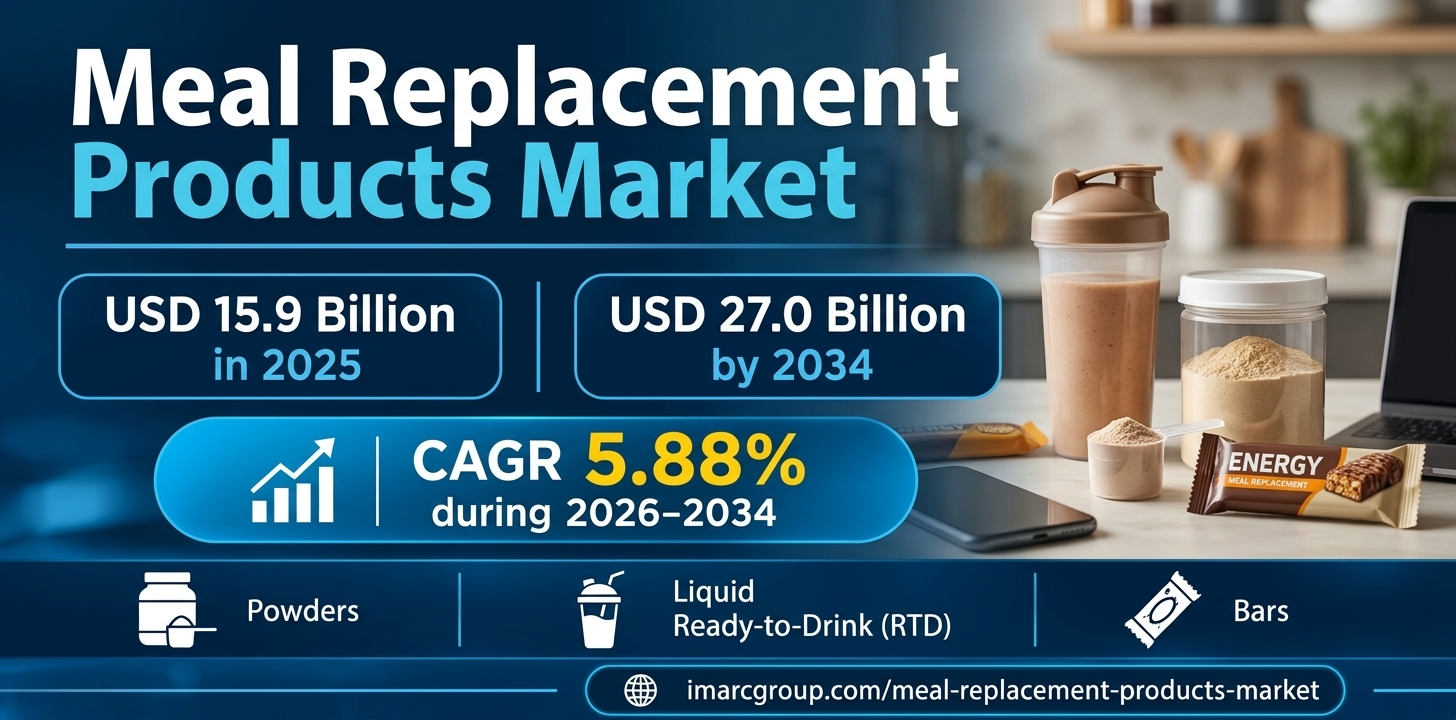
IMARC Group has recently released a new research study titled “Meal Replacement Products Market Report by Product Type, Distribution Channel, Application, and Region, 2026–2034,” which offers a detailed analysis of the market drivers, segmentation, growth opportunities, trends and competitive landscape to understand the current and future market scenarios.
Meal Replacement Products Market Size, Growth, and Forecast (2026–2034)
The meal replacement products market size reached USD 15.9 Billion in 2025 and is projected to reach USD 27.0 Billion by 2034, growing at a CAGR of 5.88% during 2026–2034. Rising health consciousness, busy lifestyles, and increasing demand for weight management solutions are the primary factors driving the meal replacement market.
Meal replacement products are nutritionally balanced, portion-controlled foods and beverages designed to substitute for a regular meal. They are available as powders, ready-to-drink shakes, and edible bars, and are fortified with protein, fiber, vitamins, and minerals to deliver complete nutrition in a convenient format.
North America currently dominates the meal replacement market with a 43.7% share in 2025, supported by strong fitness culture, high obesity awareness, and a mature e-commerce landscape. Growing adoption of plant-based and functional ingredients is also widening the consumer base across regions.
Explore Growth Opportunities in the Meal Replacement Products Market: Grab Your Sample Report for Evaluation: https://www.imarcgroup.com/meal-replacement-products-market/requestsample
Key Trends Driving the Meal Replacement Products Market
• Weight management and GLP-1 companion nutrition: Rising obesity and related conditions such as diabetes and cardiovascular disease are increasing demand for portion-controlled nutrition, and one of the most visible meal replacement trends is products tailored to people using GLP-1 medications. For instance, in December 2024, Nestlé introduced Boost Pre-Meal Hunger Support protein shots in the US, each serving 45 calories and 10 grams of whey protein.
• Busy lifestyles and online convenience: Working professionals, students, and active consumers are turning to quick, balanced meal options, while online platforms and subscription models make these products easier to compare, personalize, and reorder. Customer reviews and influencer marketing on e-commerce sites further build trust in the meal replacement market.
• Plant-based and diverse dietary preferences: Growing interest in vegan, gluten-free, low-carb, and high-protein diets is pushing manufacturers to widen their ranges. For instance, in May 2026, Huel launched Huel Lite Vanilla Matcha, a 190-calorie ready-to-drink shake with 25 grams of plant-based protein, reflecting demand for lighter, functional meal formats.
Meal Replacement Products Market Report Segmentation:
The Meal Replacement Products Market report provides a detailed segmentation analysis to help businesses identify key growth segments and evolving industry dynamics. The market is categorized based on product type, distribution channel, and application, with forecasts at the global, regional, and country level from 2026–2034.
Product Type Insights:
• Powdered Products: Powdered products are the largest segment, capturing 64.5% of the market in 2025. They are easy to store, carry, and customize, and bulk packaging lowers serving costs for long-term users.
• Ready-to-Drink Products: Ready-to-drink products appeal to consumers who want zero-preparation convenience, supported by improving taste and texture and wider availability in retail and online channels.
• Edible Bars: Edible bars serve on-the-go consumers looking for compact, portion-controlled nutrition that fits into travel, work, and fitness routines.
• Others: Other formats, including instant and savory meals, are expanding the category beyond shakes as brands target new eating occasions.
Distribution Channel Insights:
• Hypermarkets and Supermarkets: Hypermarkets and supermarkets contribute a major portion of sales by offering multiple brands under one roof, visible labeling, and bulk discounts.
• Convenience Stores: Convenience stores provide quick access to meal replacement bars and drinks for consumers in transit or on hectic days.
• Specialty Stores: Specialty health and nutrition outlets curate vegan, gluten-free, and low-carb options for health-oriented shoppers.
• Online Stores: Online stores are becoming a major driver, giving consumers wide variety, reviews, and access to global brands from home.
• Others: Other channels include direct selling and brand-owned subscription platforms that support personalized offerings.
Application Insights:
• Weight Loss: Weight loss products offer calorie-conscious, portion-controlled options fortified with fiber and nutrients to support satiety.
• Weight Gain: Weight gain products help individuals raise calorie and nutrient intake through protein, healthy fats, and vitamins.
• Physical Fitness: Fitness-focused products provide balanced macronutrients, especially protein, to support muscle recovery, endurance, and performance.
• Wound Healing: Wound healing products deliver targeted nutrients that support tissue repair and immune function for patients recovering from surgery, injury, or illness.
• Others: Other applications include general daily nutrition and specialized dietary needs.
Regional Insights:
• North America: North America leads with a 43.7% share in 2025, driven by weight control interest, gym culture, advanced retail and e-commerce infrastructure, and FDA labeling oversight. The United States accounts for 87.90% of the regional market.
• Asia Pacific: Asia Pacific is expanding on the back of urbanization, rising disposable incomes, adoption of western eating habits, and growing e-commerce penetration in markets such as China and India.
• Europe: Europe is supported by obesity concerns, urban lifestyles, and strong demand for plant-based protein, particularly in Germany and the United Kingdom.
• Latin America: Latin America is growing as high urbanization, fitness trends, and weight management interest push consumers toward easy-to-consume meal solutions.
• Middle East and Africa: The Middle East and Africa is seeing rising demand as health awareness, urban lifestyles, and disposable incomes increase.
Meal Replacement Products Market: Recent News and Developments
• January 2026: Danone launched Alpro Meal To Go in Europe, a plant-based ready-to-drink positioned as a nutritionally complete meal, marking the company’s entry into the meal replacement category.
• September 2026: Danone completed its acquisition of Huel, the direct-to-consumer meal replacement brand whose products deliver 27 vitamins and minerals alongside protein, essential fats, carbohydrates, and fiber, in a deal reported to be worth around EUR 1 billion.
Challenges Impacting the Meal Replacement Products Market
Meal replacements have struggled to shed an ultra-processed image, and some consumers remain wary of replacing whole-food meals with formulated products, which can slow adoption in the meal replacement market.
Intense competition from established nutrition companies and new entrants also pressures pricing and shelf space, while strict labeling and safety regulations add compliance costs for manufacturers.
Investment Opportunities in the Meal Replacement Products Market
The meal replacement products market presents compelling investment opportunities supported by its projected growth from USD 15.9 Billion in 2025 to USD 27.0 Billion by 2034. Plant-based, high-protein, and functional formulations are high-value areas as consumers look for cleaner, more targeted nutrition.
Direct-to-consumer and subscription platforms using data-driven personalization are a growing frontier, as are products designed for specific needs such as weight management support and medical nutrition. Brands that pair strong formulation science with omnichannel reach can build durable positions.
Outlook of the Meal Replacement Products Market (2026–2034)
The outlook for the meal replacement market is positive, supported by health awareness, busy lifestyles, and continuous product innovation. The market is projected to grow from USD 15.9 Billion in 2025 to USD 27.0 Billion by 2034 at a CAGR of 5.88%.
Evolving meal replacement trends, including plant-based formats, personalized nutrition, and e-commerce-led distribution, will be the defining forces shaping the meal replacement products market through 2034.
Key Players in the Meal Replacement Products Market
The meal replacement products market is served by global food, nutrition, and wellness companies competing on product innovation, formulation quality, and distribution reach.
• Nestlé SA: A global food and beverage leader, Nestlé serves the category through its nutrition brands and introduced Boost Pre-Meal Hunger Support protein shots in the US in December 2024, targeting consumers interested in weight loss, including those using GLP-1 medications.
• Herbalife International of America Inc.: A leading health and wellness company, Herbalife is known for its Formula 1 Healthy Meal Nutritional Shake Mix, and in May 2026 launched its Fuel Like Ronaldo campaign to bring performance nutrition to everyday routines.
Frequently Asked Questions (FAQs): Meal Replacement Products Market
1. What is the current meal replacement products market size?
The meal replacement products market size reached USD 15.9 Billion in 2025 and is projected to reach USD 27.0 Billion by 2034, growing at a CAGR of 5.88% during 2026–2034.
2. What are meal replacement products?
Meal replacement products are nutritionally balanced, portion-controlled powders, ready-to-drink shakes, and bars designed to substitute for a regular meal while providing protein, fiber, vitamins, and minerals.
3. What are the key drivers of the meal replacement market?
Key drivers include rising health consciousness, busy lifestyles, growing demand for weight management solutions, and expanding vegan, gluten-free, and low-carb dietary preferences, alongside the growth of online and subscription channels.
4. Which region leads the meal replacement products market?
North America leads the meal replacement products market with a 43.7% share in 2025, supported by strong fitness culture, weight management interest, and well-developed retail and e-commerce networks.
5. Who are the key players in the meal replacement products market?
Key players in the meal replacement products market include Nestlé SA and Herbalife International of America Inc., alongside Abbott Laboratories, General Mills, Glanbia Plc, Kellogg Company, and Unilever Plc.
Author IMARC Group
IMARC Group is a global management consulting firm that helps the world’s most ambitious changemakers to create a lasting impact. The company provide a comprehensive suite of market entry and expansion services. IMARC offerings include thorough market assessment, feasibility studies, company incorporation assistance, factory setup support, regulatory approvals and licensing navigation, branding, marketing and sales strategies, competitive landscape and benchmarking analyses, pricing and cost research, and procurement research.
Contact Us
IMARC Group,
134 N 4th St. Brooklyn, NY 11249, USA,
Email: sales@imarcgroup.com,
United States: +1–201971–6302

 Arabic
 French
 Spanish
 Portuguese
 Deutsch
 Turkish
 Dutch
 Italiano
 Russian
 Romaian
 Portuguese (Brazil)
 Greek