


PLC Programming: Driving Efficiency and Innovation in Industrial Automation
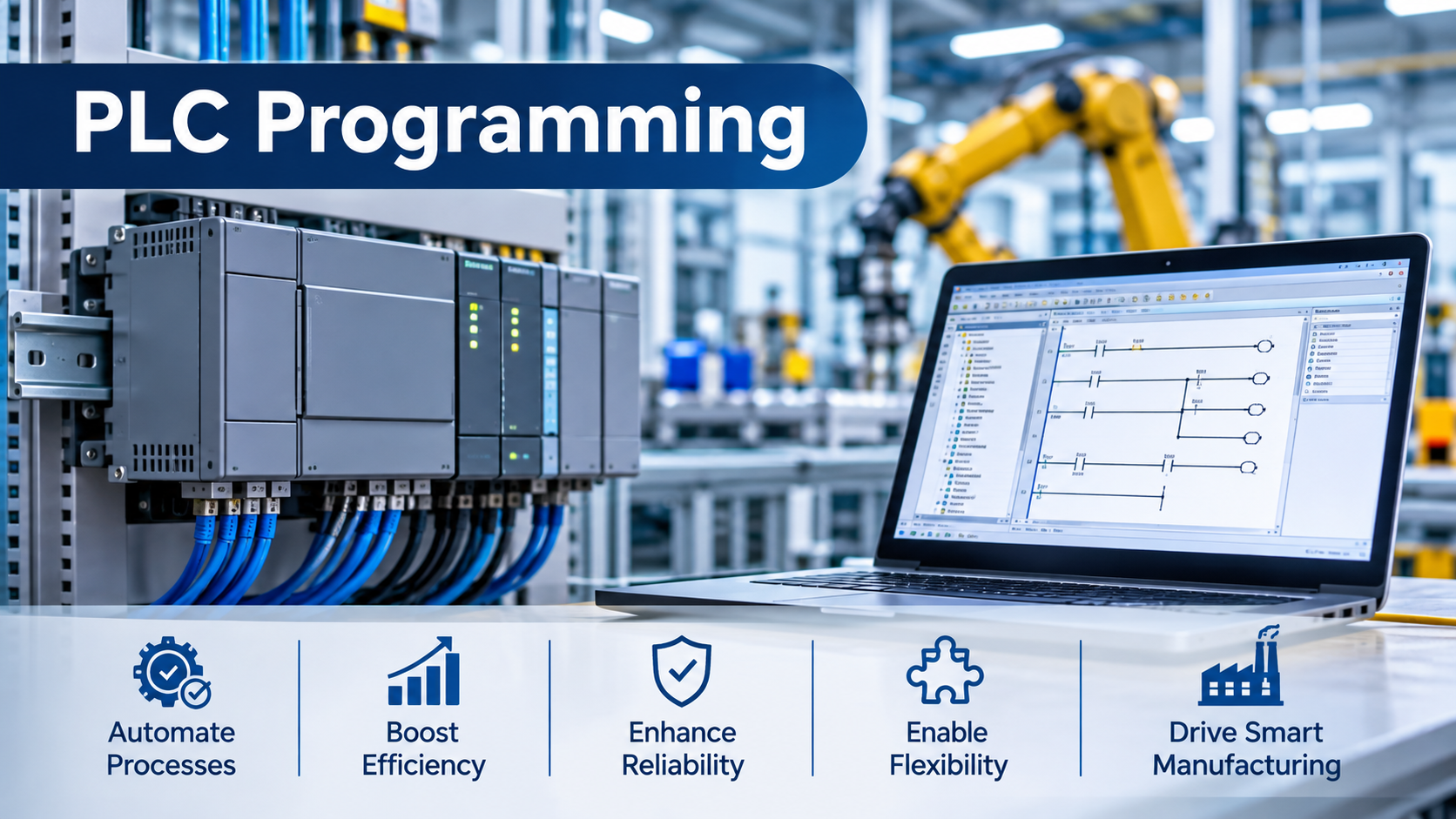
Industrial automation is transforming the way manufacturing and industrial businesses operate. Companies are increasingly adopting advanced control technologies to improve production efficiency, reduce manual intervention, and maintain consistent product quality. One of the most important technologies supporting this transformation is Programmable Logic Controller (PLC) programming.
PLC programming plays a critical role in automating industrial machines, production lines, and complex manufacturing processes. It enables machines to perform specific operations based on predefined instructions, sensor inputs, and real-time operating conditions. From controlling individual machines to managing entire production systems, PLCs provide the flexibility, reliability, and precision required in modern industrial environments.
What Is PLC Programming?
PLC programming is the process of developing instructions that control the operation of industrial machines and automated systems using Programmable Logic Controllers.
A PLC is a specialized industrial computer designed to monitor inputs, process programmed instructions, and control outputs. It receives signals from connected devices such as sensors, switches, and control panels. Based on the programmed logic, it sends commands to motors, actuators, valves, conveyors, and other industrial equipment.
Unlike traditional control systems, PLCs are designed to operate reliably in demanding industrial environments where temperature variations, electrical noise, vibration, and continuous operation are common.
Common PLC programming languages include:
-
Ladder Logic (LD): Uses graphical symbols similar to electrical relay circuits.
-
Structured Text (ST): A high-level programming language suitable for complex control logic and calculations.
-
Function Block Diagram (FBD): Uses interconnected functional blocks to represent control operations.
-
Sequential Function Chart (SFC): Organizes control processes into structured steps and transitions.
The choice of programming language depends on the machine requirements, system complexity, and engineering preferences.
How PLC Programming Works
A PLC-based automation system generally operates through three main stages.
1. Input Processing: The PLC receives signals from sensors, push buttons, limit switches, and other input devices. These signals provide information about the machine's current operating conditions.
2. Logic Execution: The PLC processes the received information according to the programmed instructions. It evaluates conditions, performs calculations, and determines the appropriate control actions.
3. Output Control: Based on the programmed logic, the PLC activates or deactivates connected devices such as motors, pumps, valves, and actuators.
This process repeats continuously, allowing automated equipment to respond quickly to changing operating conditions.
Key Benefits of PLC Programming in Industrial Automation
1. Improved Operational Efficiency
PLC programming automates repetitive industrial processes and reduces the need for manual control. Machines can perform predefined operations consistently, helping businesses improve production speed and operational efficiency.
2. Greater Accuracy and Reliability
Automated control systems execute programmed instructions with high consistency. This reduces human error and helps maintain reliable machine performance, especially in applications requiring precise timing and sequencing.
3. Flexible Machine Control
PLC programs can be modified to accommodate changing production requirements. Businesses can update control logic, adjust machine sequences, and introduce new automation functions without completely redesigning the control system.
4. Reduced Operational Downtime
Modern PLC systems support fault detection, diagnostics, and system monitoring. Engineers can identify control-related issues more efficiently, troubleshoot problems, and reduce unnecessary equipment downtime.
5. Easy Integration
PLCs can communicate with various industrial devices, sensors, Human-Machine Interfaces (HMIs), Supervisory Control and Data Acquisition (SCADA) systems, and other automation technologies. This enables better coordination between different components of an industrial system.
Role of CODESYS in Modern PLC Programming
CODESYS is a widely used development environment for industrial automation and programmable controllers. It supports IEC 61131-3 programming languages, allowing engineers to develop structured and reusable control applications.
Using the CODESYS platform, developers can create machine control logic, configure automation functions, and work with different programming approaches within a unified environment.
CODESYS supports applications such as:
-
Industrial machine automation.
-
Motion and sequence control.
-
Process automation.
-
Communication between control devices.
-
Equipment monitoring and diagnostics.
-
Development of customized control applications.
Its flexible development environment makes it suitable for a wide range of industrial automation projects.
Applications of PLC Programming Across Industries
PLC programming is used in various industries where automated control, precision, and operational reliability are essential.
Manufacturing: PLCs control assembly lines, packaging machines, material handling systems, and production equipment. They help maintain consistent production processes and improve manufacturing efficiency.
Automotive: Automotive manufacturers use PLC-based systems for robotic assembly, welding operations, conveyor systems, and automated inspection processes.
Agriculture: Modern agricultural machinery uses programmable control systems to manage machine functions, hydraulic operations, and equipment performance.
Construction and Mining: Heavy equipment manufacturers use PLCs and programmable controllers to manage machine operations, safety functions, and automated processes.
Food and Beverage: PLC-based automation helps control processing equipment, packaging operations, temperature regulation, and production sequences.
Importance of Professional PLC Programming Services
Developing an effective PLC-based automation system requires a clear understanding of machine behaviour, electrical architecture, control requirements, and industrial communication protocols.
Professional PLC programming services help businesses design, develop, test, and implement customized control solutions based on their operational needs.
Engineering teams can support control logic development, system integration, troubleshooting, software modifications, and validation. Properly developed PLC applications also help improve maintainability, simplify future upgrades, and support long-term equipment reliability.
The Future of PLC Programming
The future of PLC programming is closely connected with Industry 4.0, Industrial IoT (IIoT), artificial intelligence, and smart manufacturing.
Modern industrial systems are becoming increasingly connected, allowing machines to exchange information with centralized monitoring platforms and enterprise applications. PLCs are evolving alongside these technologies to support advanced communication, remote monitoring, and data-driven automation.
Integration with robotics, cloud platforms, digital twins, and predictive maintenance systems will further expand the capabilities of industrial control solutions.
As manufacturing businesses continue investing in smart automation, PLC programming will remain an essential technology for developing flexible, efficient, and intelligent industrial systems.
Conclusion
PLC programming is a fundamental component of modern industrial automation. It enables businesses to automate machine operations, improve production efficiency, reduce downtime, and maintain reliable control over industrial processes.
With technologies such as CODESYS, industrial communication networks, and advanced control systems, businesses can develop customized automation solutions that meet evolving operational requirements.
Investing in professional PLC programming and engineering expertise helps manufacturers build smarter machines, improve system performance, and prepare their operations for the future of industrial automation.

 English
 French
 Spanish
 Portuguese
 Deutsch
 Turkish
 Dutch
 Italiano
 Russian
 Romaian
 Portuguese (Brazil)
 Greek