


Hiking Footwear Market Analysis: Growth Drivers and Future Prospects
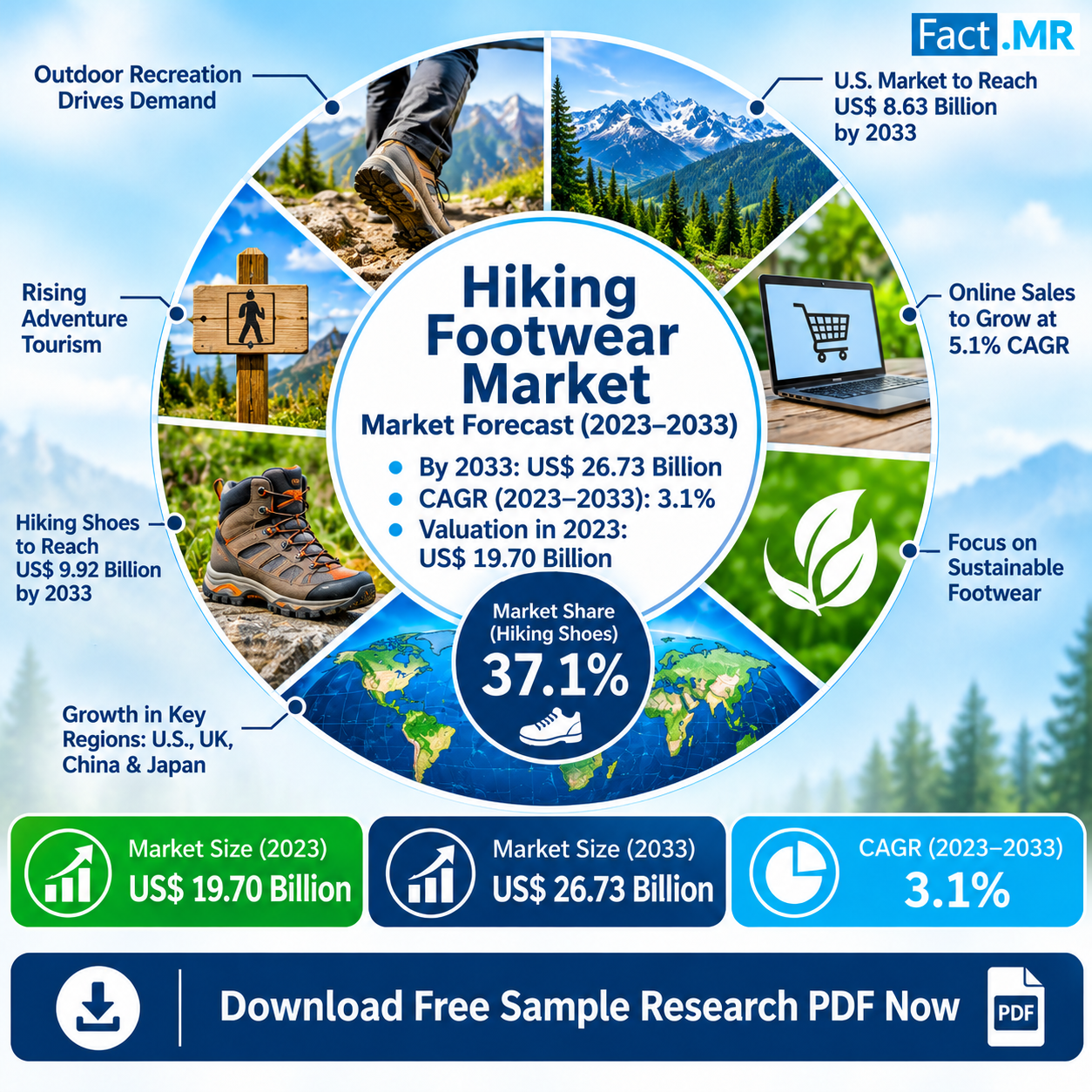
Rockville, MD, November 20, 2026 — The global hiking footwear market is projected to reach US$ 26.73 billion by the end of 2033, increasing from US$ 19.70 billion in 2023 at a compound annual growth rate (CAGR) of 3.1%, according to Fact.MR's industry research. Rising participation in outdoor recreation, adventure tourism and nature-based activities is supporting demand for specialized footwear designed to provide grip, stability and protection across challenging terrain.
The hiking footwear market is attracting demand from recreational hikers, adventure travelers, researchers and consumers involved in outdoor activities. The United States is expected to remain a major national market, reaching US$ 8.63 billion by 2033 at a CAGR of 3.9%. Online distribution is also gaining ground, with direct-to-customer online sales forecast to reach US$ 8.63 billion by the same year, expanding at a CAGR of 5.1%.
Request for PDF Report Sample Pages: https://www.factmr.com/connectus/sample?flag=S&rep_id=232
Outdoor Recreation and Adventure Tourism Support Market Expansion
Hiking has become an established recreational activity among consumers seeking opportunities to spend time outdoors. Participation in activities such as rock climbing, mountain biking, cave exploration, camping and wildlife photography is contributing to the need for footwear suited to uneven surfaces and extended walking.
Hiking shoes and boots are designed to protect the feet and ankles while providing traction on slippery or debris-covered trails. Their construction supports movement across rough terrain, making them relevant to consumers visiting mountain destinations, archaeological sites and ancient monuments. Visitors exploring these locations often spend several hours walking, creating demand for footwear that offers comfort and protection.
Outdoor research activities are another source of demand. Forest and wildlife researchers frequently work in environments where insect exposure, uneven ground and changing weather conditions require suitable footwear. Fishing and hunting also contribute to product usage.
According to the Outdoor Foundation's 2019 Special Report on Fishing, 49.4 million people in the United States participated in fishing activities across rivers, oceans, streams and lakes in 2018. This participation figure highlights one of the outdoor activities connected to the broader consumer base for protective footwear.
Hiking Shoes Segment to Reach US$ 9.92 Billion
Hiking shoes are projected to reach a market valuation of US$ 9.92 billion by 2033, expanding at a CAGR of 3.7%. These products occupy a position between trail running shoes and traditional hiking boots, offering a combination of protection and lighter construction.
Consumers use hiking shoes for day hikes, lightweight long-distance walking and moderate backpacking. Manufacturers offer waterproof and non-waterproof models to address different trail conditions and customer requirements.
Product demand is also distributed across trail shoes, approach shoes, mountaineering boots and hiking boots. Design categories include low-cut, mid-cut and high-cut footwear. Differences in ankle coverage, weight and intended terrain influence purchasing decisions.
Direct-to-Customer Online Sales Gain Momentum
Online distribution is emerging as an important channel for hiking footwear suppliers. Direct-to-customer online sales are forecast to expand at a CAGR of 5.1%, reaching US$ 8.63 billion by 2033.
The availability of established footwear brands through e-commerce platforms gives consumers access to products beyond their immediate retail markets. Increasing reliance on mobile shopping and online purchasing is supporting this distribution model.
For manufacturers, direct online channels provide an additional route to reach customers in geographically distant locations. Collaborations with e-commerce platforms are also helping brands expand their distribution networks.
The projected US$ 8.63 billion valuation of this channel is a notable detail in the market outlook, as it represents a substantial online sales opportunity within the broader hiking footwear industry.
United States and Asian Markets Present Regional Opportunities
The United States hiking footwear market is forecast to reach US$ 8.63 billion by 2033, advancing at a CAGR of 3.9%. Camping, river rafting, bird watching and wildlife photography are among the activities supporting demand. National parks also attract visitors interested in hiking and outdoor recreation.
The United Kingdom market is projected to reach US$ 1.84 billion by 2033, growing at a CAGR of 2.2%. Mountain destinations and increasing acceptance of mountaineering are supporting the country's market outlook.
Japan is expected to record a market value of US$ 1.23 billion by 2033, with sales increasing at a CAGR of 1.8%. South Korea's hiking footwear market is projected to reach US$ 775.14 million, registering a CAGR of 1.2%.
In China, the market is forecast to reach US$ 4.49 billion by 2033. Growing interest in outdoor activities and rising spending capacity are among the factors supporting demand across Asian markets.
Product Costs and Substitute Footwear Remain Challenges
Despite the positive market outlook, adoption faces certain limitations. Hiking footwear generally costs more than conventional shoes, which can discourage consumers who do not regularly participate in outdoor activities.
Limited consumer awareness also affects purchasing decisions. Some buyers continue using regular boots or running shoes for hiking rather than investing in purpose-built footwear. Design preferences create another challenge, particularly when consumers find premium hiking boots less appealing than conventional fashion-oriented shoes.
To address changing preferences, emerging manufacturers are expected to explore environmentally conscious product development. Faux leather and ethically sourced synthetic materials are among the options being considered for eco-friendly hiking and trail footwear.
Competitive Landscape and Industry Developments
Companies operating in the hiking footwear market are focusing on product development, supply chain improvements and strategic acquisitions to strengthen their market positions.
In August 2019, Lowa acquired Rika Sports S.r.l., an Italian producer of sports footwear, including hiking footwear. The acquisition was expected to support Lowa's workforce expansion.
Key companies profiled in the Fact.MR research include New Balance Inc., Adidas AG, VF Corporation, Mizuno Corporation, NIKE Inc., Skechers USA Inc., Deckers Outdoor Corporation, Amer Sports Corporation, Wolverine World Wide Inc., PUMA SE and Under Armour Inc.
View Related Reports :
Footwear Market : https://www.factmr.com/report/120/footwear-market
Athletic Footwear Market : https://www.factmr.com/report/225/athletic-footwear-market
Sports Footwear Market : https://www.factmr.com/report/281/sports-footwear-market
Outdoor Footwear Market : https://www.factmr.com/report/outdoor-footwear-market
About Fact.MR
Fact.MR is a market research and competitive intelligence provider offering industry analysis, market forecasts and strategic insights across multiple sectors. Its research covers market sizing, growth projections, competitive positioning and emerging industry trends to support business and investment decisions.

 English
 Arabic
 French
 Spanish
 Portuguese
 Deutsch
 Turkish
 Dutch
 Italiano
 Romaian
 Portuguese (Brazil)
 Greek