


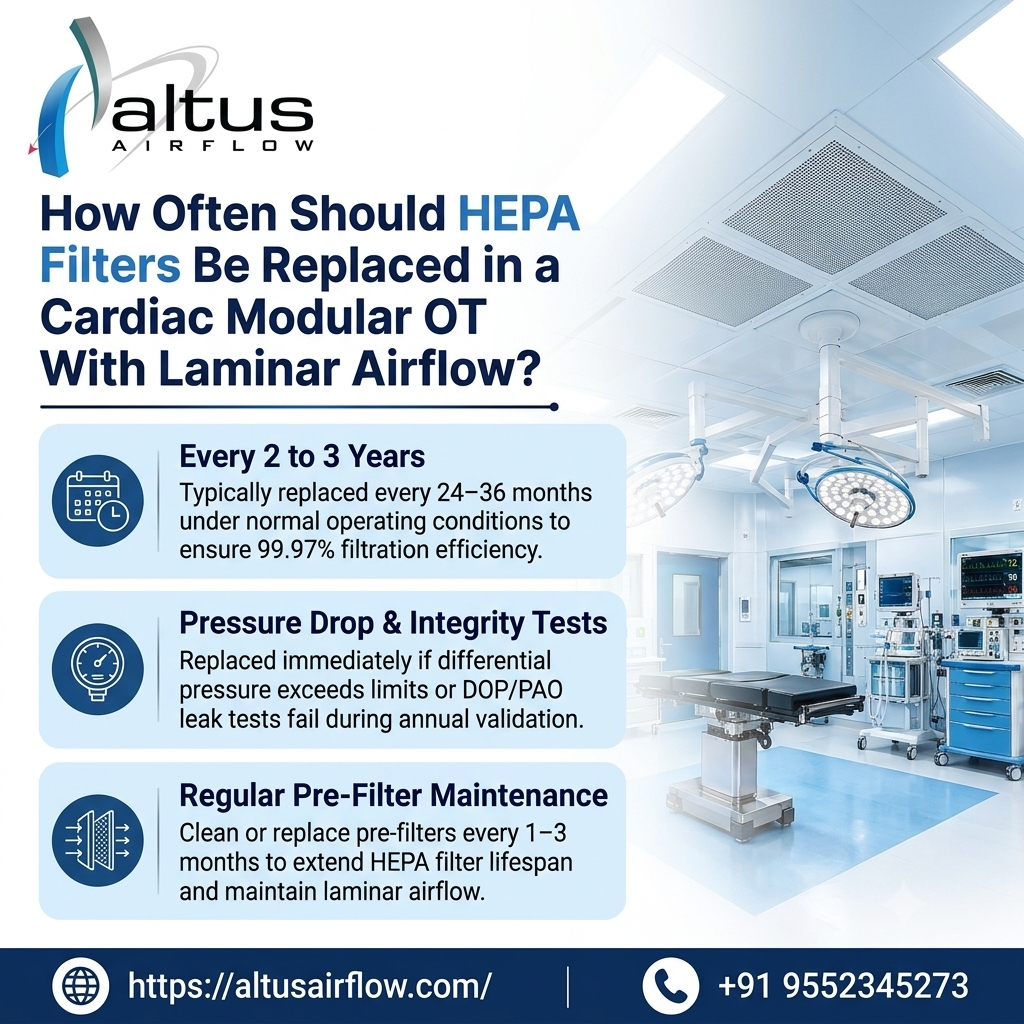
How Often Should HEPA Filters Be Replaced in a Cardiac Modular OT With Laminar Airflow?
Introduction
Altus Airflow focuses on developing advanced modular operating theatre environments that support surgical safety, controlled ventilation, and infection prevention. A Cardiac Modular OT With Laminar Airflow requires properly maintained HEPA filtration systems to maintain the desired air cleanliness and reduce airborne contamination risks. However, HEPA filters do not have one fixed replacement schedule for every operating theatre. Their replacement depends on operating hours, pressure drop, airflow performance, environmental conditions, and manufacturer recommendations. Regular inspection and performance testing help hospitals determine the appropriate replacement time.
Maintaining an effective filtration system is particularly important in cardiac operating theatres, where controlled airflow and environmental conditions support demanding surgical procedures. Understanding filter maintenance, inspection methods, and replacement indicators helps hospitals maintain reliable ventilation performance.
1. Understanding the Role of HEPA Filters in Cardiac Operating Theatres
HEPA stands for High-Efficiency Particulate Air. These filters are designed to capture very small airborne particles and help maintain controlled air cleanliness in specialised healthcare environments.
In cardiac operating theatres, HEPA filters are generally integrated into the HVAC system to provide filtered air to designated areas.
Their primary functions include:
-
Capturing airborne particulate matter.
-
Reducing the circulation of dust and other contaminants.
-
Supporting controlled air cleanliness.
-
Helping maintain the required ventilation performance.
-
Supporting infection prevention measures.
HEPA filtration is particularly important in operating theatres because airborne particles can affect environmental cleanliness.
However, HEPA filters are only one component of infection prevention. Proper cleaning procedures, staff practices, equipment sterilisation, ventilation design, and environmental monitoring are equally important.
2. How Often Should HEPA Filters Be Replaced?
There is no universal replacement interval for HEPA filters used in cardiac operating theatres. Replacement frequency depends on the filter design, operating conditions, maintenance history, and manufacturer specifications.
Some facilities may operate filters for several years, while others may require earlier replacement because of high particulate loading, damaged media, or declining performance.
Hospitals should avoid replacing filters based only on a fixed calendar schedule.
Instead, replacement decisions should consider:
Pressure differential: Increasing pressure drop across a filter may indicate that it is becoming loaded with particles.
Airflow performance: Reduced airflow can affect the ventilation system's ability to maintain its designed operating conditions.
Filter integrity: Damaged media, gasket deterioration, or leakage around the filter housing can compromise filtration.
Operating hours: Systems operating continuously may experience different loading conditions from systems used intermittently.
Environmental conditions: Construction dust, surrounding pollution, and other airborne contaminants may influence filter loading.
Manufacturer recommendations: Technical specifications provide important guidance regarding inspection, service life, and replacement.
Regular monitoring helps determine whether a filter can continue operating safely or requires replacement.
3. Factors That Affect HEPA Filter Replacement Frequency
Several factors influence how long a HEPA filter remains suitable for use in a cardiac operating theatre.
A. Operating Hours
The number of hours an HVAC system operates can influence the rate at which particles accumulate within filtration media.
Operating theatres with continuous ventilation may experience different filter-loading conditions compared with facilities that operate their systems for limited periods.
Hospitals should maintain records of operating hours and filter maintenance activities.
B. Airborne Particle Concentration
The surrounding environment has a direct influence on filtration requirements.
Hospitals located in areas with high dust levels, construction activities, or significant outdoor pollution may experience increased particulate loading.
Pre-filters and suitable ventilation arrangements help reduce the amount of larger particulate matter reaching HEPA filters.
C. HVAC System Design
The overall ventilation design also affects filter performance.
Factors such as air volume, filter dimensions, air velocity, pre-filtration stages, and system configuration influence the operating conditions of HEPA filters.
A properly designed filtration arrangement can help improve filter service life and maintain consistent airflow.
D. Maintenance Practices
Regular HVAC maintenance helps identify developing problems before they affect operating theatre performance.
Poor maintenance, damaged filter housings, inadequate sealing, and neglected pre-filters may create additional filtration challenges.
Scheduled inspections help maintain the condition of the complete ventilation system.
4. Important Signs That Indicate HEPA Filter Replacement
Hospitals should monitor filter performance regularly rather than waiting for visible problems.
Certain indicators may suggest that replacement or further technical investigation is necessary.
1. Increased Differential Pressure
A rising pressure difference across the filter may indicate particle accumulation. If the pressure drop reaches the manufacturer's specified terminal limit, the filter should be evaluated for replacement.
2. Reduced Airflow
A filter with excessive resistance can contribute to reduced airflow. However, airflow problems may also originate from fans, dampers, ducts, or other HVAC components.
3. Damaged Filter Media
Physical damage, tears, or deterioration of the filtration material can compromise filter integrity.
4. Seal or Gasket Leakage
Even a high-efficiency filter cannot perform as intended if air bypasses the filter through damaged seals or improperly installed connections.
5. Failed Integrity Testing
Filter integrity testing may identify leakage through the media, frame, or sealing arrangement. A failed test requires investigation and corrective action.
6. Manufacturer-Defined Service Limits
Filters should be replaced when they reach applicable manufacturer-defined limits or cannot meet the required performance specifications.
These indicators help maintenance teams make evidence-based replacement decisions.
5. Importance of Differential Pressure Monitoring
Differential pressure monitoring is one of the most useful methods for evaluating HEPA filter loading.
It measures the pressure difference between the upstream and downstream sides of the filter.
As particles accumulate within the filter media, resistance to airflow may increase. This can result in a higher pressure differential.
Hospitals can use differential pressure gauges or electronic monitoring systems to track these changes.
Important monitoring practices include:
-
Recording initial pressure readings after installation.
-
Establishing manufacturer-recommended operating limits.
-
Checking readings at scheduled intervals.
-
Comparing current readings with historical records.
-
Investigating sudden pressure changes.
-
Documenting maintenance and replacement activities.
It is important to understand that pressure readings alone cannot confirm filter integrity.
A filter may show acceptable pressure differential while still having leakage through damaged media or seals. Therefore, pressure monitoring should be combined with appropriate integrity testing.
6. HEPA Filter Integrity Testing and Performance Verification
Integrity testing is essential for determining whether a HEPA filter and its installation arrangement are functioning correctly.
Depending on the filter type and applicable testing protocol, specialised aerosol-based testing may be used to identify leaks.
During the process, trained technicians evaluate the filter media, frame, and sealing areas.
The testing process may involve:
-
Inspecting the filter installation.
-
Checking the filter housing and gasket arrangement.
-
Introducing an appropriate test aerosol upstream.
-
Measuring downstream particle concentration using suitable equipment.
-
Scanning the filter surface and sealing areas.
-
Recording the results.
-
Correcting identified leakage issues.
Testing should follow applicable standards, manufacturer instructions, and the hospital's approved maintenance programme.
If leakage is detected, the technical team should determine whether the issue is related to installation, sealing, housing damage, or filter media failure.
Corrective action may involve resealing, reinstalling, or replacing the filter, depending on the findings.
7. Role of Laminar Airflow in HEPA Filter Performance
Laminar airflow arrangements are designed to provide controlled air movement over designated surgical areas.
In operating theatres, the ventilation system is planned to deliver filtered air according to the approved airflow design.
The performance of the system depends on several interconnected components:
-
Properly selected HEPA filters.
-
Suitable air handling units.
-
Correct ductwork design.
-
Appropriate airflow distribution.
-
Proper filter installation and sealing.
-
Regular environmental monitoring.
If filtration performance decreases, the quality and consistency of the supplied air may be affected.
However, replacing HEPA filters alone does not guarantee proper laminar airflow. The complete system must be evaluated, including air velocity, distribution patterns, pressure relationships, and other relevant environmental parameters.
This is why ventilation maintenance should always consider the complete HVAC arrangement.
8. Recommended HEPA Filter Maintenance Schedule
Although replacement frequency varies, hospitals should establish a structured inspection and maintenance programme.
The following schedule provides a general framework. Actual intervals should be determined by the HVAC design, manufacturer recommendations, applicable standards, and hospital risk assessment.
| Maintenance activity | Suggested frequency |
|---|---|
| Visual inspection of accessible components | Monthly |
| Differential pressure monitoring | Regularly, as specified by the maintenance programme |
| HVAC operational inspection | As per maintenance schedule |
| Airflow performance assessment | Periodically and after relevant system changes |
| HEPA filter integrity testing | At commissioning and at risk-based or standard-required intervals |
| Filter replacement | Based on condition, test results, and manufacturer limits |
Hospitals should maintain a detailed record of inspection dates, pressure readings, testing results, corrective actions, and filter replacement history.
A documented maintenance programme makes it easier to identify performance changes and plan replacement activities.
9. Steps to Follow When Replacing HEPA Filters
Replacing HEPA filters requires careful handling because improper installation can compromise filtration performance.
The replacement procedure should be performed by trained technicians following approved safety and maintenance protocols.
Step 1: Review Filter Specifications
Identify the existing filter model, dimensions, efficiency classification, airflow capacity, and compatibility requirements.
Step 2: Prepare the Operating Theatre
Coordinate replacement activities with hospital management to prevent disruption to surgical operations.
Step 3: Follow Safety Procedures
Technicians should use appropriate personal protective equipment and follow procedures for handling potentially contaminated filters.
Step 4: Remove the Existing Filter
Carefully remove the used filter without damaging the housing or releasing accumulated particles.
Step 5: Inspect the Filter Housing
Check the frame, mounting arrangement, gasket, and sealing surfaces for damage or deterioration.
Step 6: Install the New Filter
Position the replacement filter according to the manufacturer's installation instructions and verify correct sealing.
Step 7: Perform Integrity and Performance Testing
After installation, carry out applicable leak testing, airflow measurements, and other required verification activities.
Step 8: Update Maintenance Records
Document the replacement date, filter specifications, test results, and responsible technicians.
The operating theatre should return to clinical use only after the relevant environmental and operational requirements have been verified.
10. Common Mistakes to Avoid During HEPA Filter Maintenance
Improper maintenance can reduce filtration effectiveness and affect the performance of the operating theatre ventilation system.
Hospitals should avoid the following mistakes:
Replacing filters without testing: Calendar-based replacement without performance evaluation may result in unnecessary expenditure or missed filter problems.
Ignoring pressure changes: Unusual differential pressure readings should be investigated promptly.
Using incompatible filters: Replacement filters must match the approved technical specifications.
Neglecting filter seals: Improper sealing can allow unfiltered air to bypass the filter media.
Skipping commissioning checks: Newly installed filters must undergo appropriate verification.
Ignoring pre-filters: Poor pre-filtration maintenance can increase the particulate load reaching HEPA filters.
Failing to maintain records: Missing documentation makes it difficult to track filter performance and maintenance history.
Avoiding these mistakes helps hospitals maintain a reliable filtration system.
11. Why Professional HVAC Maintenance Is Important?
Maintaining a specialised cardiac operating theatre requires knowledge of healthcare ventilation systems, filtration technology, and environmental monitoring.
Professional HVAC maintenance teams can help hospitals evaluate filter conditions and identify issues affecting system performance.
Their responsibilities may include:
-
Inspecting HEPA filter installations.
-
Monitoring differential pressure.
-
Checking airflow distribution.
-
Evaluating filter housing conditions.
-
Performing integrity testing.
-
Recommending suitable replacement filters.
-
Maintaining technical documentation.
-
Supporting ventilation system commissioning.
A Cardiac Modular OT With Laminar Airflow requires coordinated maintenance of its filtration and ventilation components to support consistent environmental performance.
Professional maintenance also helps hospitals plan replacement activities, reduce unexpected downtime, and maintain the reliability of their operating theatre infrastructure.
12. Benefits of Proper HEPA Filter Replacement and Maintenance
Following an organised maintenance programme provides several operational advantages.
Improved air cleanliness: Properly functioning filtration helps maintain the required airborne particle control.
Reliable airflow: Timely maintenance supports the designed ventilation performance.
Reduced contamination risks: Effective filtration forms part of a broader infection prevention strategy.
Better equipment performance: Maintaining filters within their specified operating limits supports HVAC efficiency.
Reduced unexpected downtime: Planned replacement helps prevent sudden maintenance requirements.
Better compliance documentation: Inspection and testing records support internal quality reviews and applicable regulatory assessments.
These benefits demonstrate why HEPA filter maintenance should be treated as an essential part of operating theatre management.
Conclusion
HEPA filter replacement in a cardiac operating theatre should be based on filter condition, differential pressure, airflow performance, integrity testing, and manufacturer recommendations rather than a universal replacement interval. Regular inspections and documented maintenance help hospitals identify problems early and maintain the required environmental conditions.
Choosing an experienced Cardiac Modular OT With Laminar Airflow specialist helps healthcare facilities plan suitable filtration systems and maintenance arrangements. Altus Airflow supports the development of specialised modular operating theatre environments through technical planning and ventilation integration. With proper installation, regular monitoring, and timely filter replacement, hospitals can maintain reliable airflow performance and support their infection prevention practices.
Frequently Asked Questions (FAQs)
1. How often should HEPA filters be replaced in a Cardiac Modular OT With Laminar Airflow?
A Cardiac Modular OT With Laminar Airflow does not have one fixed HEPA filter replacement interval. Replacement depends on pressure drop, filter integrity, airflow performance, and manufacturer recommendations.
2. What is the main purpose of HEPA filters in cardiac OTs?
HEPA filters capture airborne particles and help maintain the required air cleanliness inside operating theatres.
3. How can hospitals identify a clogged HEPA filter?
Increasing differential pressure and reduced airflow may indicate filter loading and should be investigated.
4. Is HEPA filter replacement based only on time?
No. Replacement should consider filter condition, testing results, operating conditions, and manufacturer specifications.
5. Why is differential pressure monitoring important?
It helps identify increasing resistance across the filter and indicates when further inspection may be necessary.
Read Our Previous Blog --------------->What storage solutions are available in a Cardiac Modular Operation Theatre?

 Arabic
 French
 Spanish
 Portuguese
 Deutsch
 Turkish
 Dutch
 Italiano
 Russian
 Romaian
 Portuguese (Brazil)
 Greek