


Chatbot vs Voicebot: Key Differences, Benefits, Costs, and Which Is Better for Your Business in 2026?
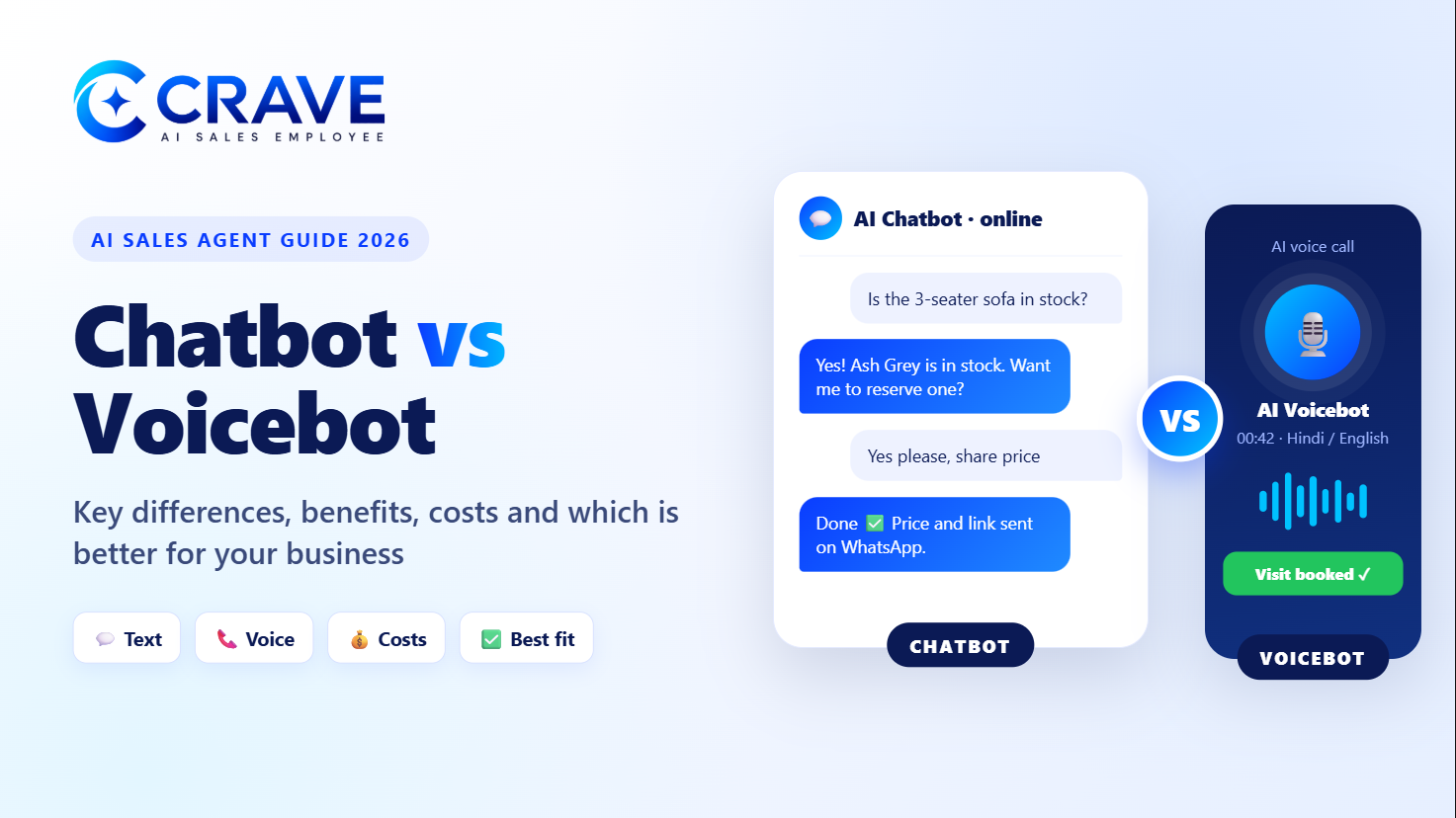
A customer messages your website at midnight asking about price. Another calls your number during lunch hour because they want to book a visit today. Both are ready to buy. Both expect an answer in seconds. One types, and one talks.
That is the real question behind chatbot vs voicebot. A chatbot is an AI assistant that talks with customers through text, on your website, WhatsApp, or app. A voicebot is an AI assistant that talks with customers through speech, usually over phone calls. Both understand questions, answer from your business knowledge, and take actions like capturing leads or booking meetings. The difference is the channel, the technology behind it, the cost, and the kind of conversation each one handles best.
In this guide, we break down the difference between chatbot and voicebot technology, the benefits of each, what they cost in 2026, and a simple way to decide which one your business needs first. We also explain why many growing businesses now run both from one AI agent.
What Is a Chatbot?
A chatbot is software that holds a text conversation with people. Customers type a question, and the chatbot replies in writing within seconds.
Older chatbots followed fixed buttons and scripts. Modern AI chatbots use natural language processing (NLP) and large language models (LLMs) to understand free-form questions, even with typos or slang. They answer from your website pages, product catalog, price list, and policies.
Where chatbots usually live:
-
Website chat widgets
-
WhatsApp Business and other messaging apps
-
Mobile apps and customer portals
-
Social media inboxes like Instagram and Facebook Messenger
A good AI chatbot for business does more than answer FAQs. It collects the visitor's name and number, asks qualifying questions, recommends products, and books the next step.
What Is a Voicebot?
So, what is a voicebot? A voicebot (also called a voice bot or AI voice agent) is software that holds a spoken conversation. It answers or makes phone calls, listens to what the caller says, and replies in a natural, human-like voice.
A modern voicebot runs four technologies in real time:
-
Speech recognition: Automatic speech recognition (ASR) turns the caller's words into text.
-
Understanding: An LLM works out what the caller wants and decides the best reply or action.
-
Actions: The voicebot checks your calendar, CRM, or order system to book slots or look up details.
-
Speech synthesis: Text-to-speech (TTS) turns the reply into natural speech.
This is very different from old IVR phone menus that said "press 1 for sales." A conversational voicebot lets callers explain their need in their own words.
Chatbot vs Voicebot: Key Differences
Here is the difference between chatbot and voicebot systems, point by point.
1. Communication Channel
-
Chatbot: Text-based. Works on websites, WhatsApp, apps, and social inboxes.
-
Voicebot: Speech-based. Works on phone calls, smart speakers, and voice apps.
2. Technology Stack
-
Chatbot: NLP and an LLM, connected to a chat interface.
-
Voicebot: Everything a chatbot uses, plus speech recognition, text-to-speech, and telephony. That extra layer makes voice more complex to build and tune.
3. Speed and Response Expectations
-
Chatbot: Customers accept a reply in a few seconds. Conversations can also pause and resume later.
-
Voicebot: Replies must feel instant. Even a short silence on a call feels awkward, so low latency is critical.
4. Type of Conversation
-
Chatbot: Great for browsing, comparing, sharing links, images, product cards, and payment links. Customers can scroll back and reread details.
-
Voicebot: Great for urgent, high-intent, or emotional conversations where people prefer to talk. Callers get answers hands-free while driving, cooking, or working.
5. Customer Effort
-
Chatbot: Requires typing and a screen. Easy for quick questions, slower for long explanations.
-
Voicebot: No typing needed. Speaking is faster for most people and more accessible for customers who struggle with text.
6. Multitasking and Scale
-
Chatbot: One AI can handle thousands of chats at the same time.
-
Voicebot: One AI can also handle many calls at once, but each call uses phone lines and minutes, which adds cost.
7. Records and Data
-
Chatbot: A written transcript exists automatically.
-
Voicebot: Needs recording and transcription. Good voice platforms write a call summary and push it to your CRM.
8. Cost Structure
-
Chatbot: Usually priced per chat or per message, and cheaper per interaction.
-
Voicebot: Usually priced per call minute, plus phone number and telephony costs. More expensive per interaction, but each call is often worth more.
9. Language and Accent Handling
-
Chatbot: Handles many languages in writing with good accuracy.
-
Voicebot: Must also understand accents, background noise, and mixed-language speech, which is harder.
10. Best Fit
-
Chatbot: Website visitors, WhatsApp shoppers, support FAQs, order tracking, and lead capture.
-
Voicebot: Inbound calls, missed-call recovery, instant callbacks to new leads, appointment booking, and reminders.
Benefits of Chatbots for Business
An AI chatbot is often the easiest first step into automation. Here are the main benefits.
-
24/7 answers without extra staff: Visitors get help at midnight, on weekends, and during holidays.
-
Low cost per conversation: Text interactions cost far less to run than calls.
-
Handles huge volume: One chatbot can manage thousands of conversations during a sale or product launch.
-
Rich replies: Chatbots can send images, catalogs, links, videos, and payment links that a call cannot.
-
Better lead capture: The bot asks the right questions at the right moment and saves the lead.
-
Customer insights: Chat logs show what people ask most, which helps you fix website content and offers.
-
Easy setup: Many chatbots install on WordPress, Shopify, or any site with one line of code.
Demand for instant answers is real. Salesforce research found that 67% of consumers get frustrated when customer service cannot resolve their issue instantly.
The chatbot market reflects this shift. Grand View Research projects the global chatbot market will grow from USD 11.8 billion in 2026 to USD 41.2 billion by 2033.
Benefits of Voicebots for Business
Phone calls remain one of the highest-intent channels a business has. A caller usually wants to buy, book, or solve a problem right now. Voicebots protect that moment.
-
No more missed calls: The voicebot answers every call, including after hours and during busy periods.
-
Instant callbacks to new leads: When someone fills out a form or clicks an ad, the voicebot can call within seconds while interest is high.
-
Human-like conversations: Callers explain their needs naturally, and the AI asks follow-up questions.
-
Hands-free convenience: Customers can talk while driving or working, with no typing.
-
Higher trust for big decisions: Many buyers prefer a voice conversation before spending more money, booking a visit, or sharing personal details.
-
Consistent qualification: The voicebot asks the same qualifying questions on every call and writes a clean summary.
-
Multilingual reach: Modern voice agents can speak several languages, which helps businesses serve diverse customers.
Speed matters most in sales. Research published in Harvard Business Review found that firms contacting leads within an hour were nearly seven times as likely to qualify them as firms that waited longer.
Voice is also the faster-growing market. Grand View Research estimates the AI voice agents market at USD 3.5 billion in 2026, rising to USD 35.2 billion by 2033, a CAGR of 39%. It also notes the U.S. held the largest share in 2025.
Limitations to Consider
Neither option is perfect. Knowing the limits helps you plan.
Chatbot Limitations
-
Customers must type, which some people avoid for complex or urgent issues.
-
Chats are easy to abandon. A visitor can close the tab in one click.
-
Without good training data, chatbots can give vague or wrong answers.
Voicebot Limitations
-
Higher cost per interaction because of minutes and phone numbers.
-
Background noise, poor networks, and strong accents can reduce accuracy.
-
Outbound calling has legal rules. In the United States, the FCC ruled in 2024 that AI-generated voices count as "artificial" voices under the Telephone Consumer Protection Act (TCPA), so businesses generally need proper prior consent before AI calls to consumers.
-
Calls cannot share images, links, or catalogs during the conversation.
The common fix for both is a clear human handoff. When the AI is unsure, it should pass the conversation to your team with full context.
Chatbot vs Voicebot Costs in 2026
Cost is often the deciding factor. Here is how the pricing usually works for each, without vague guesses.
How Chatbot Pricing Works
-
Platform subscription: Most businesses pay a monthly plan based on the number of chats, team seats, and channels.
-
Messaging fees: Channels like WhatsApp may charge per-message fees on top of the platform price.
-
Setup: Ready-made platforms take days. Custom builds take weeks and cost more.
-
Maintenance: Someone needs to review conversations and update the knowledge base.
How Voicebot Pricing Works
-
Call minutes: Most voice AI platforms charge by the minute or include a set number of minutes in a plan.
-
Phone numbers: Dedicated local or international numbers may add monthly cost.
-
Telephony charges: Carrier fees for inbound and outbound calls may apply.
-
Integrations: Connecting calendars, CRMs, and ad lead forms adds setup work.
Hidden Costs to Watch
-
Extra chats or minutes beyond your plan
-
Extra team members or phone numbers
-
Content cleanup before training the AI
-
Compliance reviews for calling and data privacy
A Real Pricing Example: Crave
Crave's pricing shows how chatbot and voicebot costs differ in practice (prices in INR, plus 18% GST, as listed in November 2026):
-
Basic, ₹2,499/month: Web chat and WhatsApp AI, 300 chats, 2 team members. No voice calls. This is a pure chatbot plan.
-
Grow, ₹4,999/month: Adds the AI voice agent with 100 call minutes, 1 dedicated Indian phone number, missed-call callbacks, lead scoring, and meeting booking, with 500 chats.
-
Standard, ₹12,499/month: 1,500 chats, 300 call minutes, 2 numbers (India and international), outbound AI follow-up calls, ad lead callbacks, e-commerce automation, and CRM integrations like Zoho and HubSpot.
-
Enterprise, ₹34,999/month: 5,000 chats, 1,200 call minutes, 5 numbers, multi-branch routing, API, and webhooks.
-
Custom: White label and custom limits.
The pattern is clear. Adding voice roughly doubles the entry price, because calls carry minute and number costs. But voice also captures the calls and hot leads that text alone often misses.
How to Judge ROI
Do not compare cost per message with cost per minute. Compare:
-
Cost per qualified lead
-
Cost per booked meeting or visit
-
Cost per resolved support request
-
Revenue recovered from missed calls and abandoned chats
A voicebot that books one extra high-value visit a week can pay for itself, even if each call costs more than a chat.
Chatbot vs Voicebot by Industry
Different industries lean toward different channels. Here is a practical view.
Retail and E-Commerce
-
Chatbot first: Product questions, stock checks, order tracking, and cart recovery work best in text, with links and images.
-
Voicebot adds: Order confirmations and follow-ups for high-value items.
-
See how this works on Crave for retail.
Real Estate
-
Voicebot first: Property buyers expect a quick call after they inquire. Instant callbacks and site-visit booking drive results.
-
Chatbot adds: Brochures, floor plans, and location details on WhatsApp.
-
Explore the real estate AI agent use case.
Healthcare and Clinics
-
Both matter: Patients often call to book, while others prefer WhatsApp for reminders and directions.
-
Clinics in the U.S. should review how any platform handles patient data under HIPAA.
-
Learn more on Crave for healthcare.
Home Services and Local Businesses
-
Voicebot first: Customers with urgent needs call, and a missed call often goes to a competitor.
-
Chatbot adds: Quotes, photos of the issue, and appointment confirmations.
Education, Travel, and Professional Services
-
Chatbot first: Course details, itineraries, and service packages are easier to share in writing.
-
Voicebot adds: Admission counseling, booking confirmations, and consultation scheduling.
Which Is Better for Your Business in 2026?
There is no single winner in the voicebot vs chatbot debate. The right choice depends on how your customers reach you and what each conversation is worth.
Choose a Chatbot First If
-
Most of your leads come from your website, WhatsApp, or social media
-
Your customers ask many repeat questions about price, stock, or orders
-
You want the lowest cost per conversation
-
You need to share links, images, catalogs, or payment links
-
You are a small team starting with automation for the first time
Choose a Voicebot First If
-
You get many phone calls and miss some of them
-
Your leads come from ads or forms and need an instant callback
-
Your deals are high-value, such as property, healthcare, or B2B services
-
Your customers prefer talking over typing
-
You need to book visits, demos, or appointments quickly
Choose Both If
-
Your customers move between your website, WhatsApp, and phone
-
You want to follow up on chats with calls, and on calls with WhatsApp messages
-
You want one view of every lead, no matter which channel they used
For most growing businesses in 2026, the answer is both. Customers do not stick to one channel. A lead may chat on your site at night, get a call the next morning, and confirm a visit on WhatsApp. When the chatbot and voicebot share one brain, nothing gets lost between channels.
Why an Omnichannel AI Agent Beats Separate Tools
Running a chatbot from one vendor and a voicebot from another creates problems:
-
Two knowledge bases that drift apart and give different answers
-
Leads split across separate inboxes
-
No shared history, so customers repeat themselves
-
Double setup, double billing, and double training
A single omnichannel AI agent solves this. It uses one knowledge base, one lead record, and one conversation history across text and voice. Your team sees the full journey in one place.
How Crave Combines Chatbot and Voicebot in One AI Sales Employee
Crave is an AI sales employee that answers enquiries on WhatsApp, your website, and phone calls. It qualifies each lead, books the visit, follows up, and hands your team buyers who are ready. Based on its published features, here is how each part works.
Crave as a Chatbot
-
The Crave web chat agent learns from your website and documents, answers questions about products, prices, and stock, and collects visitor details.
-
The Crave WhatsApp AI agent replies to WhatsApp enquiries within seconds, qualifies leads, and follows up.
Crave as a Voicebot
-
The Crave AI voice agent answers calls on your business number and calls back missed callers.
-
It can call new Google and Meta ad leads back instantly (on Standard and higher plans).
-
It writes a summary after each call, with what the caller wants, the next step, and a lead rating.
-
It speaks English and several Indian languages, including Hindi.
One CRM and Lead Flow
Every chat and call lands in one place. The built-in CRM and lead flow scores leads, tracks follow-ups, books meetings, and shows your conversion funnel from new lead to closed sale. Your team only steps in when a buyer is ready, or when the AI is unsure.
Getting started is simple. Crave says you can go live in an afternoon, with no credit card required and setup help included. You can also read the Crave help center before you begin.
How to Get Started: A Simple 5-Step Plan
-
Map your channels. Count how many leads arrive by website chat, WhatsApp, and phone each month. Note how many calls you miss.
-
Pick one goal. For example, answer every chat in seconds, or call every ad lead within one minute.
-
Train the AI on accurate content. Use your website, price list, policies, and top customer questions.
-
Set handoff rules. Decide which topics, deal sizes, or upset customers always go to a person.
-
Measure and expand. Track response time, qualified leads, and booked meetings. Add the second channel once the first one works.
Conclusion: Text, Voice, or Both?
The chatbot vs voicebot decision comes down to your customers. Chatbots win on cost, scale, and rich text replies. Voicebots win on speed, trust, and capturing high-intent calls that would otherwise go to voicemail. The businesses that grow fastest in 2026 use both, connected to one CRM, so every enquiry gets a fast reply on the channel the customer prefers.
If you are losing chats after hours or missing calls during busy hours, start with the channel that leaks the most leads, then add the other.
Ready to see it on your own leads? Train your Crave AI agent or book a demo to watch one AI sales employee handle your website chat, WhatsApp, and calls together.
FAQs
1. What is the main difference between a chatbot and a voicebot? A chatbot talks with customers through text on websites, WhatsApp, and apps. A voicebot talks through speech, usually on phone calls. Both use AI to understand questions and take actions, but voicebots add speech recognition, text-to-speech, and telephony.
2. Is a voicebot more expensive than a chatbot? Usually, yes, per interaction. Chatbots are priced per chat or message, while voicebots are priced per call minute plus phone numbers. For example, Crave's chat-only Basic plan starts at ₹2,499 per month, while plans with the AI voice agent start at ₹4,999 per month.
3. Can one AI agent work as both a chatbot and a voicebot? Yes. Omnichannel platforms like Crave use one AI agent and one knowledge base across website chat, WhatsApp, and phone calls, so leads and conversation history stay in one CRM.
4. Which is better for lead generation, a chatbot or a voicebot? Chatbots capture more leads from website and WhatsApp traffic at a low cost. Voicebots convert high-intent leads faster by calling them back within seconds. For most businesses, combining both gives the best results.
5. Are AI voicebots legal for sales calls in the US? They can be, but rules apply. The FCC confirmed in 2024 that AI-generated voices fall under the TCPA's artificial voice rules, so businesses generally need proper prior consent before AI calls to consumers. Review your process with legal counsel before outbound campaigns.

 English
 French
 Spanish
 Portuguese
 Deutsch
 Turkish
 Dutch
 Italiano
 Russian
 Romaian
 Portuguese (Brazil)
 Greek