


Smart Home Upgrades Strengthen the Global Home Improvement Market Outlook
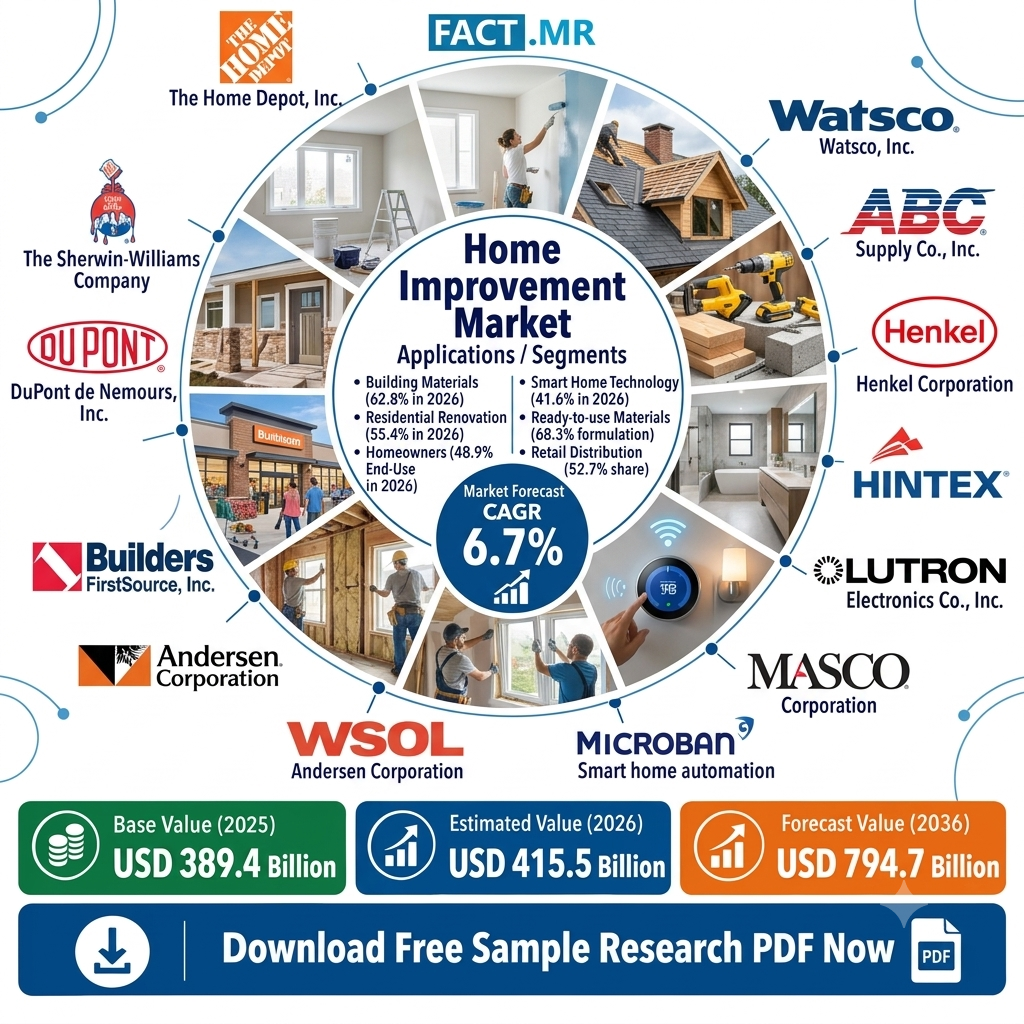
Rockville, MD, November 23, 2026 — The global home improvement market is projected to grow from USD 415.5 billion in 2026 to USD 794.7 billion by 2036, registering a compound annual growth rate (CAGR) of 6.7% during the forecast period, according to Fact.MR. The market was valued at USD 389.4 billion in 2025, with an absolute dollar opportunity of USD 379.2 billion expected between 2026 and 2036.
Demand for home improvement products and services is gaining support from recurring household repair requirements, energy-efficiency regulations and rising interest in connected residential technologies. Aging roofs, plumbing systems, electrical components and interior finishes are creating recurring replacement needs. At the same time, government-backed renovation programs in Germany, Brazil and the UK are encouraging homeowners to invest in existing properties rather than postpone essential upgrades.
Request for PDF Report Sample Pages: https://www.factmr.com/connectus/sample?flag=S&rep_id=242
Existing Housing Renovation Shapes Home Improvement Market Demand
The home improvement market is increasingly connected to the economics of maintaining and modernizing existing residential properties. Homeowners are allocating budgets toward necessary repairs while considering improvements that can reduce energy consumption and improve everyday living conditions.
According to Harvard Joint Center for Housing Studies, annual U.S. homeowner improvement and repair spending is projected to reach approximately USD 519 billion through mid-2027, although growth is expected to remain modest. This spending outlook highlights the scale of recurring renovation activity even when residential property transactions slow.
Energy-efficiency policies are adding another demand channel. The revised European Union Energy Performance of Buildings Directive requires national building renovation plans, encouraging improvements involving insulation, windows and heating systems. Germany's KfW programs also support energy-efficient renovation of existing residential properties.
Public financing is widening access to renovation projects. Brazil's Reforma Casa Brasil program has expanded across all 5,571 municipalities, providing eligible financing for construction materials, labor, project design and technical support.
Building Materials Account for 62.8% of the Product Segment
Building materials are projected to represent 62.8% of the home improvement market by product in 2026. Renovation projects require physical inputs for structural repairs, interior replacements and exterior improvements. Cement, concrete products, bricks, blocks, timber, paints, coatings and flooring materials remain important purchasing categories.
Residential renovation is expected to account for 55.4% of application demand in 2026. Homeowners are investing in kitchen and bathroom remodeling, interior upgrades and structural improvements as residential properties age.
Homeowners represent 48.9% of the end-use segment. Their purchasing decisions directly influence the timing of repairs, replacement activities and modernization projects across owner-occupied properties.
Smart home technology accounts for 41.6% of the technology segment in 2026. Connected lighting, security automation and energy-management systems are increasingly being incorporated into renovation projects, particularly when electrical wiring or heating infrastructure is already undergoing replacement.
Ready-to-use construction materials hold a 68.3% share of formulation demand. Pre-mixed cement systems and pre-finished panels reduce preparation requirements at installation sites. Retail stores account for 52.7% of distribution, supported by immediate product availability, physical product comparisons and project-based purchasing assistance.
Germany Leads Country Growth at 7.7% CAGR
Germany is forecast to register the fastest growth among the five profiled countries, expanding at a CAGR of 7.7% through 2036. KfW adjusted federal funding for efficient buildings in July 2026 and continues to support residential renovation projects. Subsidized renovation credit can reach EUR 150,000 per dwelling.
Brazil follows with a projected CAGR of 7.0%. The expansion of Reforma Casa Brasil across 5,571 municipalities is improving access to financing for residential repair and renovation activities.
The USA home improvement market is forecast to grow at 6.4% CAGR. Harvard Joint Center for Housing Studies estimates homeowner improvement and repair expenditure at approximately USD 519 billion through mid-2027.
The UK is projected to expand at 5.7% CAGR. Private housing repair and maintenance increased 2.9% in the three months to September 2025, according to the Office for National Statistics. Japan is expected to register 5.0% CAGR through 2036, supported by renovation measurement initiatives and energy-efficiency equipment adoption.
Project Costs and Labor Availability Remain Key Challenges
Rising project costs and labor expenses remain important restraints on household renovation budgets. Fact.MR estimates that project cost and labor expense exert an approximately 1.1% negative impact on market CAGR. Financing pressure and housing turnover contribute another 0.9% negative impact, while skilled trade availability accounts for 0.7%.
These constraints can encourage homeowners to divide larger renovation projects into phases. Contractors offering essential repairs first, followed by decorative improvements or smart-home installations, may find opportunities to accommodate tighter household budgets.
Competitive Landscape and Industry Outlook
The competitive landscape includes retailers, construction material manufacturers and residential improvement suppliers. Major companies profiled by Fact.MR include The Home Depot, Inc., The Sherwin-Williams Company, DuPont de Nemours, Inc., Watsco, Inc., ABC Supply Co., Inc., Henkel Corporation, Andersen Corporation, Lutron Electronics Co., Inc., Builders FirstSource, Inc. and Masco Corporation.
The Home Depot, Inc. reported 2,359 retail stores as of February 1, 2026, alongside more than 1,250 locations within its SRS businesses, according to its fiscal 2025 annual report. This distribution footprint provides an important channel for building-material purchases and professional project supply.
Shambhu Nath Jha, Principal Consultant at Fact.MR, commented:
"Home improvement demand through 2036 will be shaped by the economics of improving existing homes and by the need to keep aging properties functional."
Jha added:
"Suppliers that combine dependable product availability with simpler installation and project support can capture spending across homeowner-led work and professionally managed renovation."
Fact.MR is a market research and consulting firm that provides industry analysis, market sizing, competitive assessments and demand forecasts across global business sectors. Its home improvement market assessment examines purchasing patterns across product, application, end use, technology, formulation and distribution channels.
View Related Reports :
Wellness Festival Operators Market : https://www.factmr.com/report/wellness-festival-operators-market
Youth Wellness Resorts Market : https://www.factmr.com/report/youth-wellness-resorts-market
Neuroarchitecture Advisory Services Market : https://www.factmr.com/report/neuroarchitecture-advisory-services-market
Men’s Social Wellness Clubs Market : https://www.factmr.com/report/mens-social-wellness-clubs-market
About Fact.MR
Fact.MR is a global market research and consulting firm delivering actionable insights, industry analysis and strategic intelligence to businesses across diverse sectors. Its research combines primary interviews, secondary data analysis, company portfolio assessments and market forecasting to evaluate industry developments, competitive positioning and emerging opportunities.

 English
 Arabic
 Spanish
 Portuguese
 Deutsch
 Turkish
 Dutch
 Italiano
 Russian
 Romaian
 Portuguese (Brazil)
 Greek