


Passive Fire Protection Market Size, Share and Growth 2034
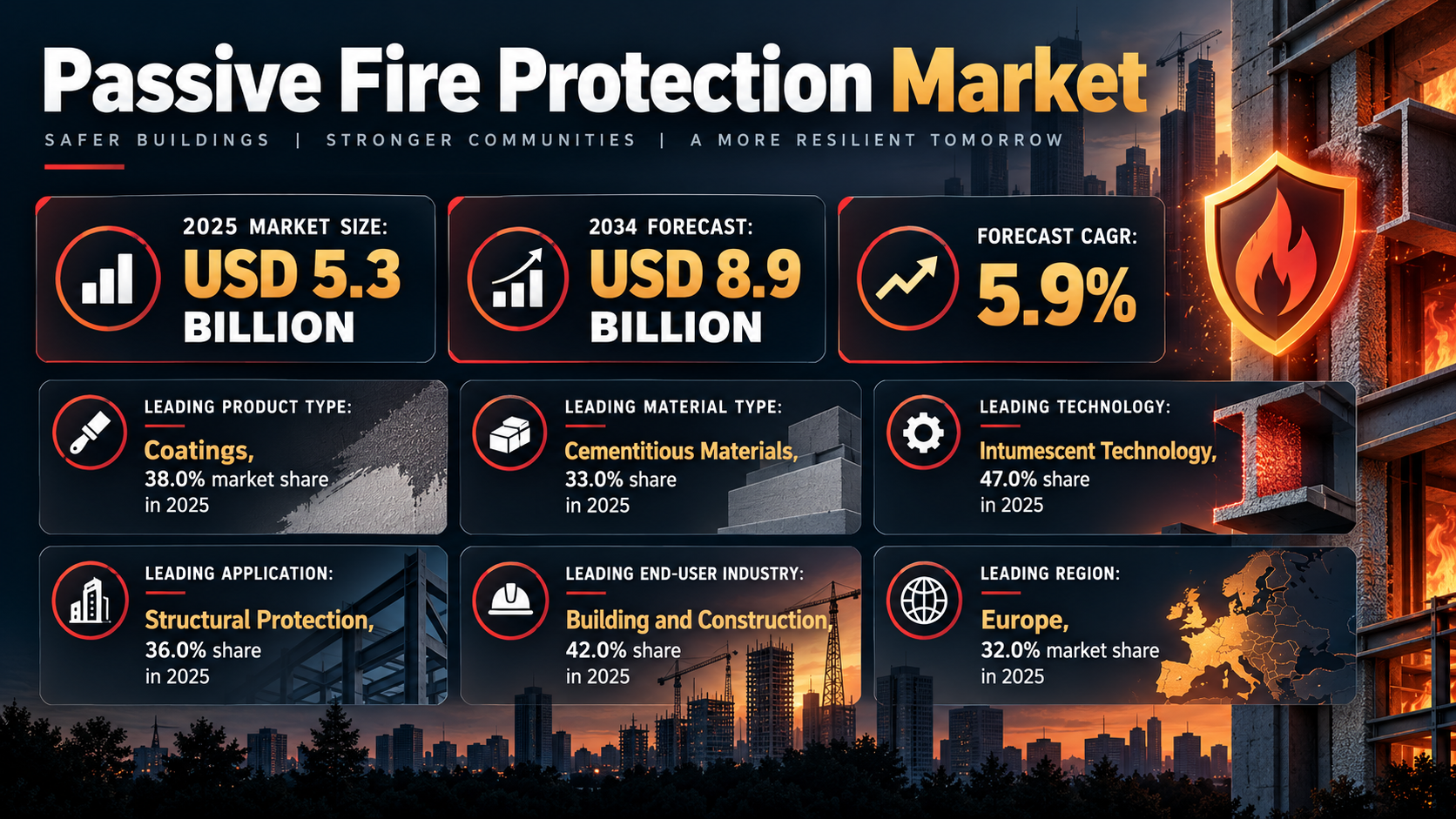
The global Passive Fire Protection Market Size is expanding as construction companies, industrial operators, and infrastructure developers prioritize structural fire resistance and effective fire containment.
According to Dimension Market Research, the global Passive Fire Protection Market is projected to reach USD 5.3 billion in 2025 and increase to USD 8.9 billion by 2034, recording a CAGR of 5.9% during the forecast period.
Increasing construction activity, fire safety requirements, industrial infrastructure investment, and demand for certified fire-resistant building materials are influencing market development.
What Is Passive Fire Protection?
Passive fire protection involves building materials and structural measures designed to resist fire, limit its spread, and maintain structural integrity without requiring activation through external power or human intervention.
Unlike active fire protection systems such as alarms and sprinklers, passive systems are incorporated into buildings and infrastructure.
Examples include fire-resistant walls, doors, coatings, insulation, panels, barriers, and penetration seals.
These systems can help compartmentalize fires, protect evacuation routes, and delay damage to load-bearing structural components.
Their effectiveness depends on appropriate product specification, installation quality, compatibility with surrounding building elements, and ongoing maintenance.
Why Is the Passive Fire Protection Market Growing?
Fire safety regulations and building standards are central drivers of demand.
Commercial buildings, industrial facilities, transportation infrastructure, and public institutions must address fire resistance requirements during design, construction, and renovation.
Urban development is also increasing demand for fire-rated construction materials.
As buildings become more complex, fire protection requires careful coordination between structural systems, mechanical services, electrical installations, and interior construction.
Industrial facilities present additional requirements because equipment and operations may involve combustible materials or elevated temperatures.
The report identifies construction, oil & gas, and industrial sectors as important demand sources.
Get a Free Customized Sample of This or Any Other Market Research Report
https://dimensionmarketresearch.com/request-sample/passive-fire-protection-market/
Passive Fire Protection Market Segmentation
The market is segmented by product type, material type, technology, application, and end-user industry.
Product Types
The report covers Coatings, Sealants and Fillers, Boards and Panels, Spray Shields and Blankets, Mortars, and Others.
Intumescent coatings are important because they can expand when exposed to high temperatures, forming an insulating protective layer over underlying surfaces.
Sealants and fillers help maintain fire resistance around joints, gaps, and penetrations through walls and floors.
Boards and panels provide fire-resistant barriers and structural enclosure solutions.
Mortars and spray-applied protection systems support applications requiring specific fire resistance characteristics.
Materials and Applications
Different fire protection materials are selected according to exposure conditions, required fire resistance ratings, structural characteristics, and installation constraints.
Fire-resistant products must be evaluated as part of complete assemblies rather than solely on individual material properties.
Applications include structural steel protection, fire compartmentation, building penetrations, equipment protection, and industrial infrastructure.
End-User Demand
Commercial construction is an important market because offices, shopping facilities, hotels, and public buildings require integrated fire protection designs.
Industrial facilities, oil & gas operations, transportation systems, and critical infrastructure create additional demand.
Healthcare facilities and data centers may also require specialized fire protection strategies designed to preserve critical operations.
Regional Outlook: Europe Holds a Leading Position
Europe is projected to lead the Passive Fire Protection Market in 2025, with an estimated market value of USD 1.7 billion.
Building regulations, industrial safety requirements, renovation activity, and investment in fire-resistant construction materials support regional demand.
Germany, the United Kingdom, and France are among the important European markets discussed in the report.
North America represents another substantial market.
The United States market is projected at USD 1.2 billion in 2025 and forecast to reach USD 2.0 billion by 2034, growing at a CAGR of 5.5%.
Demand in the United States is influenced by building codes, renovation of aging infrastructure, commercial development, and industrial safety investment.
Asia-Pacific also provides opportunities through expanding construction activity and infrastructure development.
Technology Trends and Competitive Differentiation
Passive fire protection manufacturers are investing in advanced intumescent materials, fire-resistant insulation, modular barriers, and improved protective coatings.
Sustainable construction requirements are influencing interest in products with reduced volatile organic compound emissions and appropriate environmental performance.
Building Information Modeling can support better coordination of fire protection requirements during the planning process.
Manufacturers and installation specialists compete through product certification, tested performance, application suitability, installation efficiency, and technical support.
For construction project owners, selecting appropriate systems can reduce the risk of expensive modifications or compliance problems during later stages of development.
Challenges and Opportunities
Material costs, complex installation requirements, inconsistent workmanship, and the need for specialized technical expertise can restrain market development.
Fire protection performance depends on correct installation and preserving system integrity when buildings are modified.
Growth opportunities include infrastructure modernization, industrial facility expansion, advanced protective coatings, and retrofit projects.
The increasing complexity of buildings creates a need for integrated passive fire protection solutions supported by reliable technical documentation.
Explore the Complete Passive Fire Protection Market Analysis
https://dimensionmarketresearch.com/checkout/passive-fire-protection-market/
Frequently Asked Questions
1. What is the size of the Passive Fire Protection Market?
The global market is projected at USD 5.3 billion in 2025 and is forecast to reach USD 8.9 billion by 2034.
2. What is the expected CAGR of the Passive Fire Protection Market?
The market is projected to expand at a CAGR of 5.9% during the forecast period.
3. Which region leads the Passive Fire Protection Market?
Europe is projected to lead in 2025, with an estimated regional market value of USD 1.7 billion.
4. What products are included in passive fire protection?
Major product categories include Coatings, Sealants and Fillers, Boards and Panels, Spray Shields and Blankets, and Mortars.
5. What factors support market growth?
Construction investment, fire safety regulations, industrial infrastructure development, and demand for fire-resistant materials support market expansion.
Conclusion
The Passive Fire Protection Market demonstrates the importance of integrating structural fire safety into modern buildings and industrial facilities.
Regulatory compliance, infrastructure investment, and advanced materials are influencing demand for systems that support fire containment and structural protection.
Companies offering tested products, effective installation support, and reliable technical performance can pursue opportunities across construction, manufacturing, and critical infrastructure.
Related Market Research Insights
The India Transformer Fire Protection Equipment Market Size examines fire safety technologies used to protect electrical transformer infrastructure in India. The research provides a complementary perspective on specialized fire protection requirements within power networks and industrial electrical installations, where risk assessment and equipment protection are critical considerations.

 Arabic
 French
 Spanish
 Portuguese
 Deutsch
 Turkish
 Dutch
 Italiano
 Russian
 Romaian
 Portuguese (Brazil)
 Greek