


Getting Started with Solar Smash: A Friendly Guide to Destroying Planets (Responsibly, of Course!)
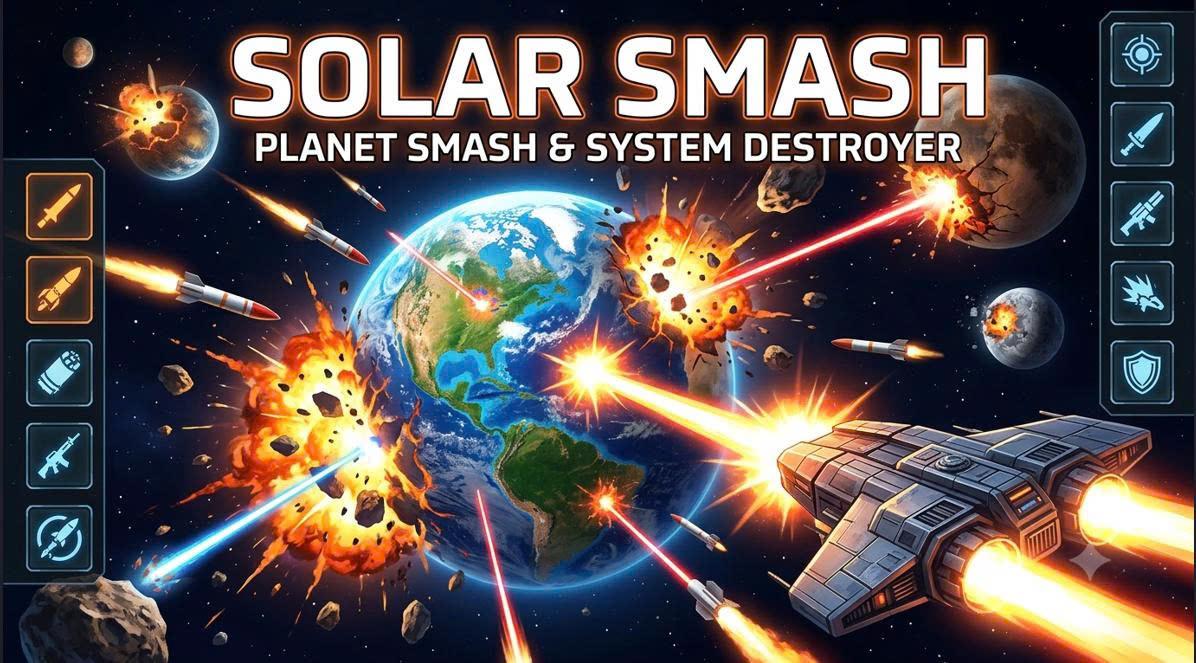
There's something oddly satisfying about watching a planet break apart. Maybe it's the physics, maybe it's the chaos, or maybe it's just the thrill of pressing a button and seeing what happens. Solar Smash is a physics-based planet destruction simulator built around exactly that feeling. It lets you unleash powerful weapons on planets, moons, and entire solar systems, then sit back and watch the debris fly.
If you're curious about the game but don't know where to start, this guide walks through the basics, shares a few tips that helped me, and offers some ideas for getting the most out of your sessions. You can find the game itself at Solar Smash, where you can jump right in.
Gameplay: The Basics
When you first open Solar Smash, the interface may look a little busy, but it becomes intuitive quickly. Your main job is simple: choose a celestial body, pick a tool, and see what happens.
Choosing your target. The game gives you a range of objects to work with, from small moons and rocky planets to gas giants and even stars. Each has its own mass, density, and gravitational pull, which affects how it reacts to impacts. Starting with a smaller object is a good way to learn how the physics respond before moving on to bigger targets.
Selecting weapons. Solar Smash offers a variety of tools, such as projectiles, explosions, and other forces that can be applied to a planet. Each weapon behaves differently. Some break surfaces into chunks, while others push or pull material away. Experimenting is the best way to understand their effects.
Watching the physics. The real appeal is the simulation itself. Debris scatters according to momentum and gravity, fragments can orbit or fall back, and larger impacts can change the trajectory of nearby bodies. Take a moment to observe these interactions rather than rushing to the next target. Much of the fun comes from noticing how one small change ripples through the whole system.
Building your own system. As you get comfortable, you can start arranging multiple bodies into a system and seeing how they interact. Placing a moon near a planet, or setting two worlds on a collision course, creates scenarios that are fun to watch and sometimes surprisingly unpredictable.
Tips for a Better Experience
Start small. Smaller bodies are quicker to break apart and make it easier to understand cause and effect. Once you know how a particular weapon behaves, scale up.
Change one variable at a time. If you're comparing results, adjust only one thing, such as the speed of an impact or the angle of approach. This makes it much easier to see what actually made the difference.
Pay attention to angles. A head-on hit and a glancing blow can produce very different outcomes. Some of the most interesting results come from off-center impacts.
Give the simulation time. Debris can take a while to settle, and gravitational effects can unfold over several moments. Patience often reveals patterns you would otherwise miss.
Keep notes or screenshots. If you enjoy experimenting, jot down setups that produced surprising results. It's a great way to share discoveries with other players on forums.
Don't be afraid to get creative. Some of the best fun comes from setting playful challenges, like trying to destroy a planet with the fewest shots or building a miniature solar system and seeing how long it survives.
Conclusion
Solar Smash is a simple idea executed with a lot of curiosity: how do things break, fall, and drift when physics is in charge? Whether you're a casual player looking for a few minutes of stress-free destruction or someone who enjoys studying how systems behave, there's plenty to explore. Take your time, experiment often, and enjoy the strange beauty of a universe reshaping itself one impact at a time.
If you have your own favorite setups or tips, share them in the comments or on your favorite forum. Happy smashing!

 English
 Arabic
 French
 Spanish
 Portuguese
 Deutsch
 Turkish
 Italiano
 Russian
 Romaian
 Portuguese (Brazil)
 Greek