


How Often Should Andrology Room Design Facilities Be Validated?
Introduction
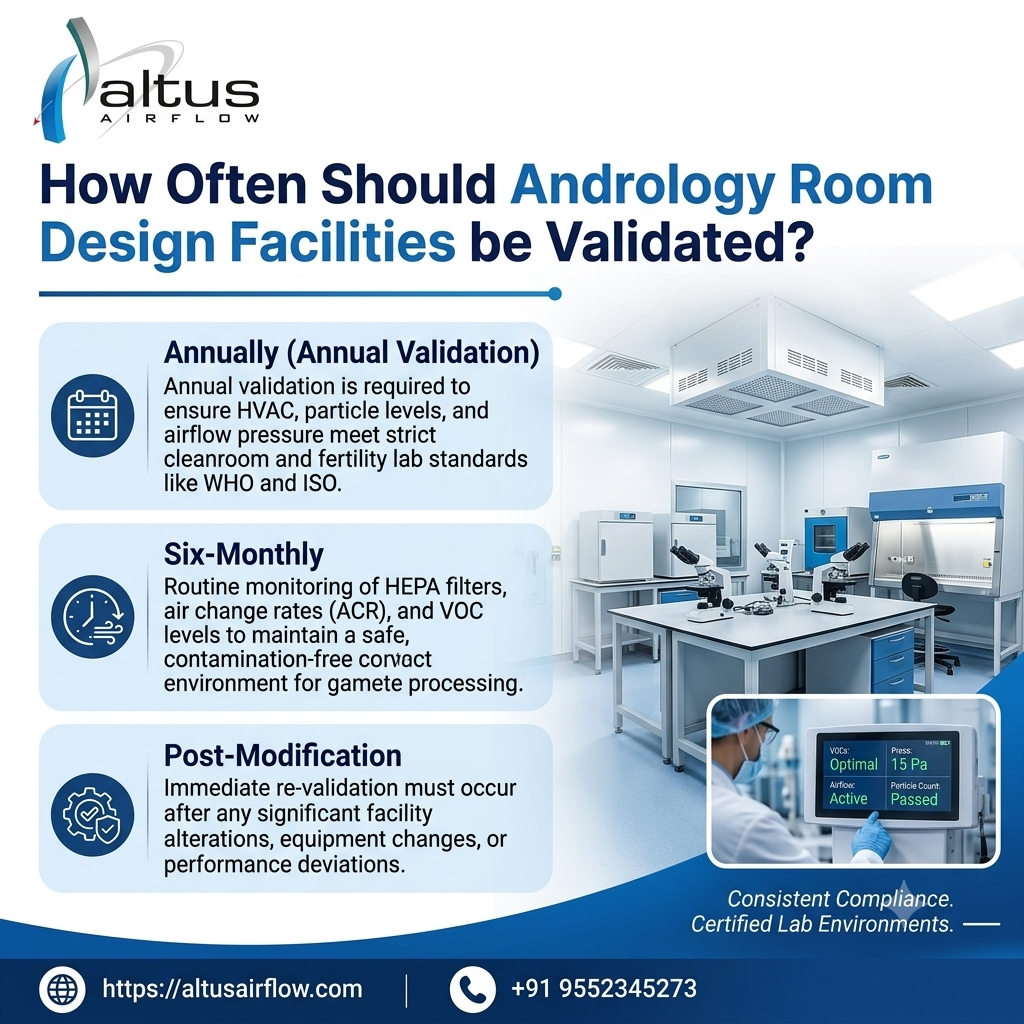
Altus Airflow focuses on developing specialised laboratory environments that support reproductive healthcare through carefully planned infrastructure and environmental control. Andrology Room Design facilities must be validated at appropriate intervals to confirm that ventilation, temperature, humidity, air quality, electrical systems, and other critical parameters continue to meet established requirements. Validation helps identify performance deviations, maintain reliable laboratory conditions, and support consistent operational practices. The frequency depends on the facility's activities, equipment, risk assessment, applicable standards, and changes made to the laboratory.
1. Understanding Validation in an Andrology Laboratory
Validation is a documented process used to confirm that a laboratory's infrastructure, equipment, and environmental systems perform according to predefined requirements. In an andrology laboratory, this may include checking ventilation, temperature control, humidity, filtration, electrical systems, monitoring devices, and other critical utilities.
The purpose is to establish that the room continues to provide suitable conditions for its intended activities. Validation also helps identify problems such as inconsistent environmental readings, ventilation deficiencies, equipment malfunctions, or failures in monitoring systems.
It is important to distinguish validation from routine monitoring. Monitoring involves regular observation and recording of operating conditions, while validation involves a more structured assessment to demonstrate that systems perform as intended. Both activities are necessary for effective laboratory quality management.
2. Is There a Fixed Validation Schedule?
There is no single universal validation interval that applies to every andrology laboratory. The appropriate schedule depends on the laboratory's activities, equipment, environmental risks, quality management procedures, and applicable regulatory or accreditation requirements.
Some parameters may require continuous monitoring, while others may be checked daily, periodically, or during scheduled technical assessments. For example, temperature and humidity may be recorded routinely, whereas detailed HVAC performance testing may be conducted at defined maintenance or requalification intervals.
Laboratories should establish a written validation plan based on risk assessment and manufacturer recommendations. The plan should identify what needs to be validated, how frequently it should be checked, who is responsible, and what action is required when results fall outside approved limits.
3. Validating HVAC and Ventilation Systems
Ventilation is one of the most important infrastructure elements in an andrology laboratory. HVAC systems help maintain the environmental conditions required for laboratory activities and support appropriate indoor air quality.
Validation should confirm that the ventilation system operates according to its approved design specifications. Depending on the laboratory's requirements, this may include checking airflow rates, air distribution, temperature, humidity, pressure relationships, filtration, and system controls.
A detailed assessment may be necessary during initial commissioning, after significant HVAC modifications, or when monitoring indicates a possible performance issue. Periodic requalification should follow the laboratory's documented risk-based schedule and applicable technical requirements.
Routine maintenance alone does not replace performance validation. A system may appear to be operating normally while still experiencing airflow imbalance, filter leakage, or inaccurate sensor readings.
4. Monitoring Temperature and Humidity
Temperature and relative humidity can influence laboratory conditions, equipment operation, and the handling of sensitive biological materials. Therefore, these parameters should be monitored according to the laboratory's validated operating requirements.
Routine records help staff identify fluctuations and recurring environmental problems. Monitoring frequency may vary depending on the sensitivity of the laboratory's activities and the reliability of the installed control system.
Validation should confirm that sensors are accurate, correctly positioned, and capable of detecting relevant changes. Calibration should be performed at intervals recommended by the instrument manufacturer and the laboratory's quality procedures.
If readings repeatedly exceed approved limits, the facility team should investigate possible causes such as HVAC malfunction, sensor drift, door-opening patterns, or equipment-generated heat.
5. Checking Air Filtration and Indoor Air Quality
Air filtration contributes to environmental control by reducing airborne particles in the laboratory. The required filtration arrangement depends on the room's intended use, risk assessment, and applicable technical specifications.
Validation may include checking filter installation, housing seals, pressure drop, airflow performance, and filter integrity where required. The laboratory should maintain records of filter inspection, replacement, and relevant testing.
Filter replacement intervals should not be determined only by a fixed calendar schedule. They should also consider manufacturer recommendations, operating conditions, pressure readings, and performance assessments.
If the laboratory experiences unusual dust levels, airflow problems, or repeated environmental deviations, an additional investigation may be necessary. Maintaining proper filtration helps support the intended indoor environment but does not replace cleaning and other contamination-control procedures.
6. Validating Electrical Systems and Backup Power
Electrical infrastructure supports laboratory equipment, environmental monitoring, lighting, and other essential services. An electrical failure can interrupt operations and affect equipment that requires continuous power.
Validation and inspection activities should confirm that electrical installations meet approved specifications and relevant safety requirements. This may include reviewing distribution boards, circuit protection, earthing, equipment connections, and backup power arrangements.
Where uninterrupted operation is essential, backup systems such as UPS units or generators should be tested according to their operating procedures and manufacturer recommendations.
The laboratory should maintain records of electrical inspections, backup power tests, equipment servicing, and corrective actions. Any electrical modification should trigger an appropriate review to confirm that the revised installation remains suitable.
7. Calibration of Monitoring Instruments
Environmental validation depends on accurate measurement. Temperature sensors, humidity meters, differential pressure gauges, airflow instruments, and other monitoring devices must provide reliable readings.
Calibration helps establish whether an instrument measures within its specified accuracy range. The calibration interval should be based on manufacturer recommendations, instrument usage, performance history, and the laboratory's quality management system.
If a device fails calibration, the laboratory should assess the impact of potentially inaccurate readings. This may require checking previous records, reviewing affected operations, and arranging corrective action.
A calibration register should identify each instrument, its location, unique identification number, calibration date, next due date, and relevant results. Proper records make it easier to demonstrate control during audits and inspections.
8. When Should Additional Validation Be Performed?
Apart from scheduled validation, certain events should trigger an additional assessment. Waiting for the next routine validation date may be inappropriate when a significant change could affect laboratory performance.
Additional validation or requalification may be required after:
-
Major HVAC repairs or replacement.
-
Changes to room layout or wall and ceiling systems.
-
Installation of new equipment that affects heat or airflow.
-
Changes to ventilation settings or filtration arrangements.
-
Relocation or replacement of environmental sensors.
-
Electrical modifications affecting critical equipment.
-
Water leakage, construction activity, or contamination incidents.
-
Repeated deviations in temperature, humidity, or other critical parameters.
The scope of reassessment should match the nature of the change. For example, replacing a sensor may require calibration and functional checks, while a major HVAC modification may require more extensive airflow and environmental performance testing.
9. Validation During Initial Commissioning
Before a newly constructed or significantly upgraded laboratory begins routine operations, its infrastructure should undergo appropriate commissioning and validation.
This process establishes baseline performance and confirms that installed systems meet the approved design requirements. It may cover HVAC operation, environmental monitoring, filtration, electrical safety, equipment functionality, and other critical services.
The project team should prepare a validation protocol that defines the tests, acceptance criteria, instruments, responsibilities, and documentation requirements.
Any deviation identified during testing should be investigated and corrected before the relevant system is accepted for its intended use. Baseline readings from commissioning also provide useful reference data for future performance comparisons.
10. Creating a Risk-Based Validation Schedule
A risk-based approach helps laboratories determine which systems require more frequent attention. Not every component has the same impact on laboratory operations.
For example, systems responsible for maintaining critical environmental conditions may require continuous monitoring and more frequent performance reviews. Less critical building components may be assessed through routine inspections and scheduled maintenance.
A validation schedule should consider:
-
The sensitivity of laboratory activities.
-
The consequences of environmental deviations.
-
Equipment reliability and operating history.
-
Manufacturer maintenance recommendations.
-
Applicable regulatory and accreditation requirements.
-
Previous validation results and recurring faults.
-
The extent of recent changes or modifications.
A documented risk assessment provides a clear reason for the selected frequency. The schedule should also be reviewed when the laboratory's activities, equipment, or operating conditions change.
11. Maintaining Validation Records and Documentation
Documentation is essential for demonstrating that laboratory systems are controlled and maintained. Validation records should provide clear evidence of the tests performed, results obtained, acceptance criteria, and any corrective actions taken.
Important documents may include:
-
Initial commissioning and validation reports.
-
HVAC testing and balancing records.
-
Environmental monitoring logs.
-
Temperature and humidity records.
-
Instrument calibration certificates.
-
Filter inspection and replacement records.
-
Electrical and backup power test reports.
-
Preventive maintenance records.
-
Deviation and corrective action reports.
Records should be organised, traceable, and accessible to authorised personnel. Any failure to meet an acceptance criterion should be documented, investigated, and resolved through the laboratory's quality management process.
12. What Happens When Validation Results Fail?
A failed validation result indicates that a system or parameter has not met its defined acceptance criteria. The laboratory should not ignore the result or rely on assumptions that the deviation is temporary.
The first step is to assess the potential impact on laboratory operations. Depending on the severity and nature of the issue, affected activities may need to be restricted until the problem is investigated.
The facility team should identify the root cause, which may involve equipment malfunction, incorrect settings, damaged filters, sensor problems, or inadequate maintenance.
Corrective action should address the underlying issue rather than only the observed reading. After repairs or adjustments, the relevant system should be retested to confirm that acceptable performance has been restored.
The laboratory should document the investigation, impact assessment, corrective action, and final verification.
13. Responsibilities of an Andrology Laboratory Setup Partner
A laboratory setup partner can contribute to validation by designing infrastructure that supports inspection, testing, maintenance, and future requalification.
An experienced Andrology Room Design team should consider access to HVAC components, filter housings, electrical panels, monitoring sensors, and service connections during the planning stage. Accessible installations make it easier for facility teams to conduct inspections and maintenance.
The setup partner may also coordinate with HVAC specialists, equipment suppliers, calibration agencies, and hospital quality teams to support commissioning and documentation.
However, responsibility for ongoing validation does not end with project handover. The laboratory operator must maintain a suitable quality system, follow the approved validation schedule, and ensure that qualified personnel perform required assessments.
14. Building a Long-Term Validation and Maintenance Strategy
Validation should be treated as an ongoing part of laboratory management rather than a one-time activity. A long-term strategy combines routine monitoring, preventive maintenance, calibration, periodic validation, and event-based reassessment.
The laboratory should assign clear responsibilities to facility managers, quality personnel, technical staff, and equipment operators. Regular reviews of monitoring records can help identify trends before they develop into significant problems.
Maintenance and validation schedules should be coordinated to avoid unnecessary duplication while ensuring that critical checks are not missed. The strategy should also be updated when new equipment is installed or laboratory activities change.
A structured approach helps maintain infrastructure reliability, improve audit readiness, and support consistent laboratory operations.
Conclusion
The frequency of validation in an andrology laboratory depends on its activities, environmental risks, equipment, applicable standards, and history of system performance. Routine monitoring, calibration, preventive maintenance, periodic assessments, and additional validation after significant changes all contribute to maintaining suitable laboratory conditions.
Andrology Room Design facilities should have a documented, risk-based validation programme covering ventilation, temperature, humidity, filtration, electrical systems, and monitoring equipment. Altus Airflow focuses on specialised laboratory infrastructure with attention to environmental control and coordinated system planning. By combining suitable design with structured validation and maintenance, Altus Airflow supports laboratories in maintaining reliable and well-managed working environments.
Frequently Asked Questions
1. How often should Andrology Room Design facilities be validated?
Andrology Room Design facilities should follow a documented, risk-based validation schedule based on laboratory activities, equipment, applicable standards, and system performance. Additional validation may be needed after significant changes.
2. Is HVAC validation necessary in an andrology laboratory?
Yes. HVAC validation helps confirm that ventilation, airflow, filtration, and environmental controls perform according to approved specifications.
3. Should temperature and humidity be monitored daily?
Monitoring frequency should follow the laboratory's validated procedures. Critical environmental parameters may require continuous monitoring with regular record reviews.
4. When is revalidation required?
Revalidation may be required after major HVAC changes, equipment installation, room modifications, or significant environmental deviations.
5. Why is instrument calibration important?
Calibration helps ensure that environmental monitoring devices provide accurate and reliable readings.
Read Our Previous Blog ---------------> How does a Modular Cardiac OT Setup Company support healthcare infrastructure development?

 English
 Arabic
 French
 Spanish
 Portuguese
 Deutsch
 Turkish
 Dutch
 Italiano
 Romaian
 Portuguese (Brazil)
 Greek