


Soy Sauce Market Forecast to Reach USD 103.9 Billion by 2036 Amid Rising Global Demand for Asian Cuisine
NEWARK, Del., November 23, 2026 — The global soy sauce market is witnessing steady expansion as increasing consumption of Asian cuisine, growing demand for fermented seasonings and expanding applications across household cooking and food manufacturing reshape the global condiments industry. Rising consumer interest in naturally brewed products, reduced-sodium formulations and premium soy sauce varieties is encouraging manufacturers to strengthen production capabilities, introduce differentiated product offerings and expand international distribution networks. Increasing use of soy sauce in marinades, packaged foods, sauces and foodservice applications is further supporting market development.
According to the latest market intelligence report published by Future Market Insights (FMI), the global soy sauce market is estimated at USD 65.0 billion in 2026 and is projected to reach USD 103.9 billion by 2036, registering a compound annual growth rate (CAGR) of 4.8% during the forecast period. The market is expected to create an incremental opportunity of approximately USD 38.9 billion between 2026 and 2036.
The expansion reflects recurring household demand, increasing adoption of Asian-inspired food products and growing procurement by commercial food manufacturers. Producers are also investing in fermentation technologies, premium product development, freshness-preserving packaging and localized manufacturing facilities to improve product quality and strengthen international competitiveness.
Get Detailed Market Forecasts, Competitive Benchmarking & Industry Insights: Request a Sample Report https://www.futuremarketinsights.com/reports/sample/rep-gb-36239
Market Size & Growth Forecasts
The soy sauce market is projected to expand steadily through 2036 as demand for fermented seasonings, household condiments and industrial food ingredients supports industry revenues.
- Market Size (2026): USD 65.0 Billion
- Forecast Value (2036): USD 103.9 Billion
- CAGR (2026–2036): 4.8%
- Incremental Opportunity: Approximately USD 38.9 Billion
- Leading Type Segment: Brewed
- Leading Application Segment: Household
- Leading Country Market by Growth: China
FMI's report identifies brewed soy sauce as the dominant product category, accounting for approximately 63.0% of 2026 type-segment revenue. The household application segment also represents approximately 63.0% of market revenue, supported by frequent home cooking and recurring retail purchases.
Key Market Takeaways
- Market Valuation: The soy sauce market is estimated at USD 65.0 billion in 2026.
- Future Opportunity: The market is forecast to reach USD 103.9 billion by 2036.
- Growth Rate: The industry is projected to expand at a 4.8% CAGR from 2026 to 2036.
- Incremental Revenue: The market is expected to generate approximately USD 38.9 billion in additional revenue.
- Leading Type Segment: Brewed soy sauce accounts for approximately 63.0% of 2026 segment revenue.
- Leading Application: Household consumption represents approximately 63.0% of application revenue.
- Fastest-Growing Country: China is projected to record a 6.7% CAGR through 2036.
- North American Growth: The United States is expected to expand at a 6.1% CAGR.
- European Growth: The United Kingdom and Germany are projected to grow at 5.7% and 5.4%, respectively.
What Is Driving Growth in the Soy Sauce Market?
- Increasing Global Consumption of Asian Cuisine
Growing international popularity of Chinese, Japanese, Korean and Southeast Asian cuisines is supporting demand for soy sauce across household and commercial food applications. Consumers are increasingly incorporating soy sauce into stir-fries, marinades, noodles, rice dishes and dipping sauces. Restaurant expansion and the availability of international food products through supermarkets are further strengthening global consumption.
- Rising Preference for Naturally Brewed and Fermented Products
Consumers and food manufacturers are showing increasing interest in traditionally fermented soy sauce varieties. Naturally brewed products offer distinctive flavor characteristics and are widely used in household cooking and commercial food preparation. Manufacturers are strengthening fermentation processes and product quality controls to differentiate their offerings from blended alternatives.
- Expanding Applications Across the Food Processing Industry
Soy sauce is an important ingredient in packaged meals, sauces, marinades, snacks and ready-to-eat food products. Food manufacturers use it to deliver consistent umami flavor, seasoning and color across different applications. Growing demand for processed foods and international flavor profiles is creating recurring procurement opportunities for industrial soy sauce suppliers.
- Innovation in Reduced-Sodium and Premium Soy Sauce Products
Increasing consumer awareness of sodium consumption is encouraging manufacturers to explore reduced-sodium formulations and alternative seasoning blends. Premium products, including organic soy sauce, gluten-free tamari, specialty light soy sauce and dashi-infused varieties, are creating additional opportunities for product differentiation and higher-value positioning.
- Advances in Fermentation and Packaging Technologies
Manufacturers are investing in automated fermentation, quality monitoring and improved bottling technologies. Freshness-preserving bottles and oxygen-resistant packaging can help maintain product quality after opening. These developments are supporting product innovation, manufacturing efficiency and improved retail presentation.
Segment Analysis: Type and Application
By Type: Brewed Soy Sauce Maintains a Dominant Position
Brewed soy sauce accounts for approximately 63.0% of the type segment in 2026. Its market leadership reflects established consumer familiarity with naturally fermented seasonings and demand from household and commercial food manufacturers.
The type segment includes:
- Brewed Soy Sauce
- Blended Soy Sauce
Brewed soy sauce is produced through fermentation processes involving soybeans, wheat and other ingredients. Its distinctive flavor profile and established culinary applications support demand across retail and foodservice channels.
Blended soy sauce provides additional opportunities through alternative formulations, competitive pricing and applications requiring specific seasoning characteristics.
By Application: Household Consumption Leads Market Demand
The household segment represents approximately 63.0% of application revenue in 2026. Frequent use in home cooking, marinades, dipping sauces and everyday meal preparation supports its leading position.
Key application categories include:
- Household
- Food Industry
Household consumers purchase soy sauce through supermarkets, grocery stores and online retail platforms. Product preferences include light soy sauce, dark soy sauce, naturally brewed varieties and reduced-sodium formulations.
The food industry segment includes packaged food manufacturers, restaurants, catering businesses and industrial food processors. These buyers use soy sauce in marinades, sauces, ready-to-eat meals and other processed food applications.
Regional Growth Outlook
East Asia remains a major center of soy sauce consumption and production, supported by established culinary traditions and large-scale domestic manufacturing. North America offers opportunities through international cuisine adoption, industrial foodservice procurement and localized production investments.
Europe is also witnessing demand expansion as consumers increasingly explore Asian-inspired cooking and specialty fermented condiments. Latin American markets provide additional opportunities through restaurant development, food processing and growing familiarity with international seasonings.
Country-Level Growth Forecasts (2026–2036)
China: China is projected to record the fastest growth among the profiled countries, with a 6.7% CAGR through 2036. Established soy sauce consumption, expanding premium product demand and investments in fermentation technologies support market development. Naturally brewed, organic and specialty light soy sauce varieties are creating opportunities for domestic producers.
United States: The United States is expected to expand at a 6.1% CAGR through 2036. Growing demand for Asian-inspired food, industrial seasoning ingredients and naturally brewed soy sauce is supporting market development. Localized manufacturing and expanded foodservice distribution are creating opportunities for international producers.
Japan: Japan is projected to grow at a 6.1% CAGR through 2036. Established soy sauce consumption and demand for premium seasoning products support market expansion. Freshness-preserving bottles, specialty dashi-infused varieties and innovative packaging formats are creating additional opportunities.
United Kingdom: The United Kingdom is expected to register a 5.7% CAGR through 2036. Increasing popularity of Asian cuisine, expansion of pan-Asian restaurants and growing availability of specialty condiments through supermarkets are supporting category development. Reduced-sodium and gluten-free varieties offer additional growth opportunities.
Germany: Germany is projected to expand at a 5.4% CAGR through 2036. Demand from prepared-food manufacturers, restaurants and retail consumers is supporting market development. Naturally brewed soy sauce, organic formulations and specialty Asian condiments are creating opportunities for suppliers.
Canada: Canada is expected to record a 5.3% CAGR through 2036. Multicultural food consumption, growing Asian grocery retail and demand for marinades and packaged food ingredients are supporting market growth. Reduced-sodium products and naturally brewed varieties offer opportunities for manufacturers.
Brazil: Brazil is projected to expand at a 4.5% CAGR through 2036. Demand from food processors, restaurants and consumers interested in international cuisines is supporting category development. Domestic food manufacturing and Japanese-Brazilian culinary influences provide additional opportunities for soy sauce suppliers.
Key Companies in the Soy Sauce Market
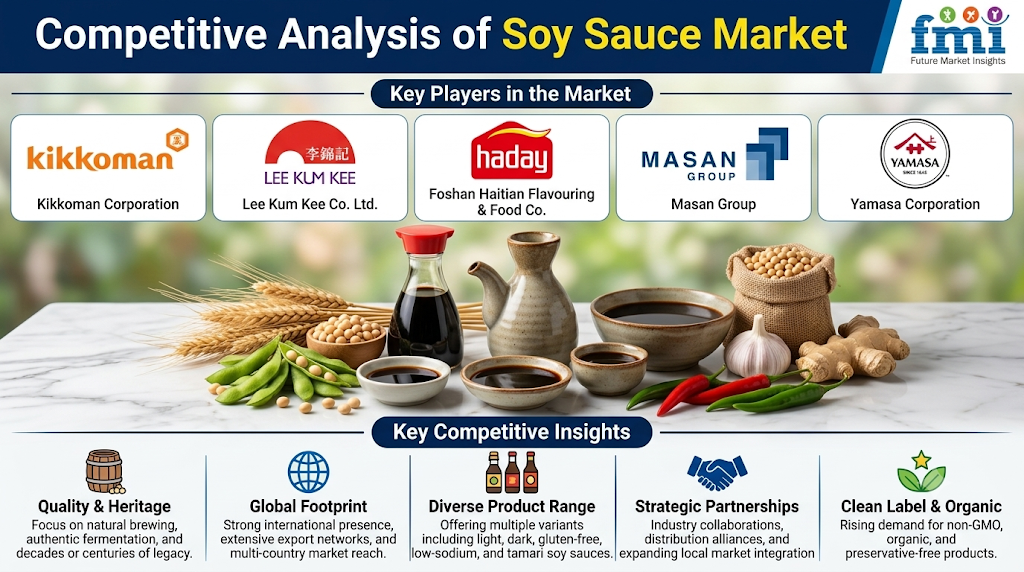
The competitive landscape includes major Asian fermentation specialists, international condiment manufacturers and regional food companies. Market participants compete through product quality, fermentation expertise, brand positioning, manufacturing expansion and international distribution partnerships.
Key companies profiled include:
- Foshan Haitian Flavouring & Food Co., Ltd.
- Kikkoman Corporation
- Lee Kum Kee
- Masan Group
- YAMASA CORPORATION
- Guangdong Meiweixian Flavoring Foods Co., Ltd.
- Pearl River Bridge
- BOURBON BARREL FOODS
- Nestlé Professional (MAGGI)
These companies participate across traditional brewed soy sauce, blended varieties, premium seasonings, specialty formulations and commercial foodservice products. Their competitive strategies increasingly emphasize production efficiency, international market penetration, product differentiation and quality assurance.
Growth Opportunities and Industry Challenges
Opportunities
- Premium Product Development: Increasing demand for naturally brewed, organic and specialty soy sauce creates opportunities for higher-value product portfolios.
- Reduced-Sodium Formulations: Growing interest in sodium-conscious food products encourages manufacturers to develop alternative seasoning formulations.
- Industrial Food Applications: Expanding packaged food, snack, marinade and ready-meal manufacturing creates recurring B2B procurement opportunities.
- Emerging Market Penetration: Growing international interest in Asian cuisine provides opportunities for expansion across Europe and Latin America.
- Packaging Innovation: Freshness-preserving bottles, lightweight materials and improved dispensing formats can strengthen product differentiation.
- Fermentation Technology: Automated production and improved fermentation controls can enhance consistency, operational efficiency and product quality.
Challenges
- Sodium-Related Regulatory Requirements: Nutritional labeling and sodium reduction requirements can increase reformulation and compliance costs.
- Raw Material Price Volatility: Changes in soybean, wheat, salt and packaging costs can affect production margins.
- Quality and Contaminant Controls: Manufacturers must maintain appropriate fermentation standards and comply with food-safety requirements across export markets.
- Intense Competitive Pressure: Established international brands and regional manufacturers compete for retail shelf space and industrial supply contracts.
- Packaging Sustainability: Producers face increasing pressure to improve packaging recyclability and reduce material consumption.
- International Regulatory Complexity: Differences in labeling, allergen declarations and food-quality standards can complicate cross-border distribution.
Recent Developments in the Soy Sauce Market
- May 2025: China's State Administration for Market Regulation promulgated the revised national standard GB/T 18186-2025 for soy sauce quality, with implementation scheduled for December 2026. The updated standard is expected to influence product quality requirements and supplier compliance.
- January 2026: Lee Kum Kee introduced its global Forever Flavors Project in collaboration with UNESCO, highlighting culinary heritage and international food culture.
- July 2026: YAMASA CORPORATION announced the nationwide rollout of a 450 mL freshness-preserving bottle for its Shin Aji soy sauce, reflecting increasing emphasis on packaging innovation and product freshness.
- September 2026: Kikkoman Corporation held the grand opening of its third United States soy sauce production facility in Jefferson, Wisconsin, representing an investment of approximately USD 560 million and strengthening its North American manufacturing presence.
These developments highlight the industry's growing focus on fermentation quality, international production capacity, product innovation and packaging differentiation.
Explore the Full Soy Sauce Market Report: https://www.futuremarketinsights.com/reports/soy-sauce-market
Future Market Outlook
The soy sauce market is expected to maintain a positive growth trajectory through 2036 as international cuisine adoption, household consumption and industrial food processing support global demand.
Brewed soy sauce is likely to maintain its leading position, while premium fermented varieties, reduced-sodium products and specialty formulations can provide additional avenues for market differentiation. Growing demand from packaged food manufacturers and foodservice operators is also expected to support recurring commercial procurement.
Companies that prioritize fermentation quality, manufacturing efficiency, innovative packaging and international distribution may be better positioned to capture future opportunities.
With the global soy sauce market forecast to reach USD 103.9 billion by 2036, the next decade is expected to bring continued competition around product authenticity, flavor innovation, regulatory compliance and international expansion.
Related Food & Beverage Industry Reports
Coconut Cream Market https://www.futuremarketinsights.com/reports/coconut-cream-market
Carotenoids Pigment Market https://www.futuremarketinsights.com/reports/carotenoids-pigment-market
Canned Vegetable Market https://www.futuremarketinsights.com/reports/canned-vegetables-market
Bovine Gelatin Market https://www.futuremarketinsights.com/reports/bovine-gelatin-market
Barley Protein Market https://www.futuremarketinsights.com/reports/barley-protein-market
About Future Market Insights (FMI)
Future Market Insights (FMI) is a market research and consulting organization providing industry intelligence, market forecasts and strategic insights to businesses across global markets. FMI's research supports manufacturers, investors, suppliers and decision-makers in evaluating market opportunities, understanding competitive environments and developing informed business strategies.
Media Contact
Rahul Singh
AVP – Marketing and Growth Strategy
Future Market Insights (FMI)
Phone: +91 8600020075
Sales: sales@futuremarketinsights.com
Media: Rahul.singh@futuremarketinsights.com
Website: https://www.futuremarketinsights.com

 English
 Arabic
 French
 Spanish
 Portuguese
 Deutsch
 Turkish
 Dutch
 Italiano
 Romaian
 Portuguese (Brazil)
 Greek