


Metal Wire Bands for Industrial Staple Production
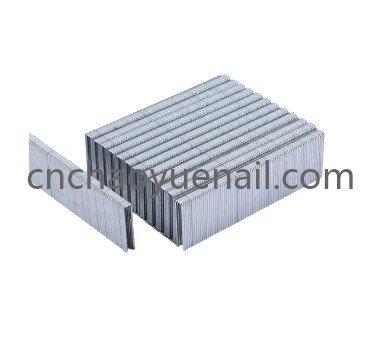
In industrial fastening production, the quality of raw materials has a direct influence on the consistency and reliability of finished products. Staple Wire Band refers to wire material or an arranged wire strip format associated with staple manufacturing and fastening production processes. Depending on the supplier's product definition, it may describe prepared metal wire supplied in a continuous form or wire components arranged for subsequent processing. Understanding the intended product format is essential because raw wire and assembled staple strips serve different production purposes.
Metal wire used for staple production needs to meet specific dimensional and processing requirements. Its diameter determines the cross-section of the finished fastener, while material properties influence forming behavior and mechanical characteristics. Wire consistency is particularly important in automated production lines, where irregular thickness or surface defects may affect feeding, cutting, and forming operations. Manufacturers therefore need to establish appropriate raw material specifications before beginning production.
Steel is commonly used in fastening wire applications because it offers useful mechanical properties and can be processed through drawing and forming operations. Depending on the required product, manufacturers may consider different steel grades and material conditions. The selected material should provide suitable ductility for bending while maintaining the characteristics required by the finished staple. Excessively brittle wire may crack during forming, whereas unsuitable mechanical properties can make it difficult to achieve consistent staple geometry.
Wire drawing is a fundamental manufacturing process. During this operation, metal wire passes through drawing dies that progressively reduce its diameter. The process helps achieve the required dimensional range and surface condition. Lubrication and process control are important because friction, drawing speed, and die condition can influence the final wire quality. Multiple drawing stages may be used when a substantial reduction in diameter is required.
After drawing, the wire may undergo straightening and other preparation processes. Straightness is important for stable feeding into automated manufacturing equipment. If wire is excessively curved or inconsistent, it can cause feeding interruptions and inaccurate cutting. Depending on the final application, surface cleaning or treatment may also be required to prepare the wire for forming or subsequent processing.
For staple production, prepared wire is typically fed into specialized machinery that cuts it into defined lengths and bends each piece into a U-shaped fastener. The process establishes the crown width and leg length according to the required product dimensions. In high-volume production, automated equipment can maintain repeated forming cycles, although performance depends on the consistency of the incoming wire and the condition of the machinery.
Some fastening products are supplied in strip form rather than as loose individual pieces. In this arrangement, multiple staples are aligned and connected through a bonding method suitable for the intended fastening equipment. The finished strips are designed to support loading and feeding in compatible pneumatic or mechanical staplers. Bonding consistency and dimensional alignment are important because damaged or irregular strips may interfere with tool operation.
Quality inspection should cover several stages of the production process. Incoming wire can be checked for diameter, surface defects, material condition, and packaging integrity. During processing, manufacturers may monitor straightness, cutting accuracy, and forming consistency. For assembled staple strips, alignment and bonding quality are additional considerations. These checks help identify irregularities before finished products move into storage or distribution.
The surface condition of metal wire can affect both processing and final product appearance. Depending on the application, wire may be supplied with different surface finishes or protective treatments. Some products require a smooth surface to support consistent feeding and forming, while others may need a coating that provides additional protection against environmental exposure. The required finish should be determined by the final fastener application rather than by appearance alone.
Furniture and upholstery manufacturing are important downstream markets for staple products made from prepared wire. Furniture factories use staples to attach fabrics, backing materials, and selected components to wooden frames. Different production tasks require different wire dimensions and staple profiles. A narrow wire design may be appropriate for delicate upholstery work, while stronger fastening applications may require a larger cross-section. Raw material selection therefore needs to correspond to the intended staple category.
Packaging and woodworking industries also create demand for fastening products manufactured from metal wire. Staple-based connections can be used in selected wooden assemblies, protective packaging, decorative components, and lightweight construction operations. The required fastener dimensions depend on the substrate, the thickness of the attached material, and the expected service conditions. Manufacturers should communicate these requirements clearly when sourcing wire materials.
For industrial buyers, the distinction between continuous wire and assembled staple strips should be clarified before procurement. Purchasing specifications should identify the material, wire diameter, surface condition, coil or strip format, dimensions, packaging method, and intended production process. Where the wire will be used in automated equipment, buyers should also consider feeding characteristics and compatibility with existing machinery.
International sourcing requires attention to more than the quoted unit price. Raw material consistency, shipment protection, order quantities, production scheduling, and supplier communication can influence manufacturing efficiency. Buyers should establish acceptance criteria for dimensions and surface condition, particularly when ordering materials for repeated production batches. Sample evaluation can help determine whether a material is suitable for the buyer's forming equipment and manufacturing process.
Storage conditions should protect metal wire from moisture, contamination, and physical deformation. Coils and prepared strips should be handled carefully to avoid damage that could interfere with automated feeding. Warehouses should maintain suitable storage practices, while production facilities should inspect material before introducing it into manufacturing equipment.
When evaluating Staple Wire Band for an industrial supply program, buyers should first clarify the required format and intended use. Material composition, dimensional consistency, surface finish, processing suitability, and packaging specifications all contribute to effective procurement. Businesses seeking information about fastening materials and related product categories can explore https://www.cnchaoyuenail.com/product.

 English
 Arabic
 French
 Spanish
 Portuguese
 Deutsch
 Turkish
 Italiano
 Russian
 Romaian
 Portuguese (Brazil)
 Greek