


Rising Demand for Secondary Raw Materials Supports U.S. Recycling Industry
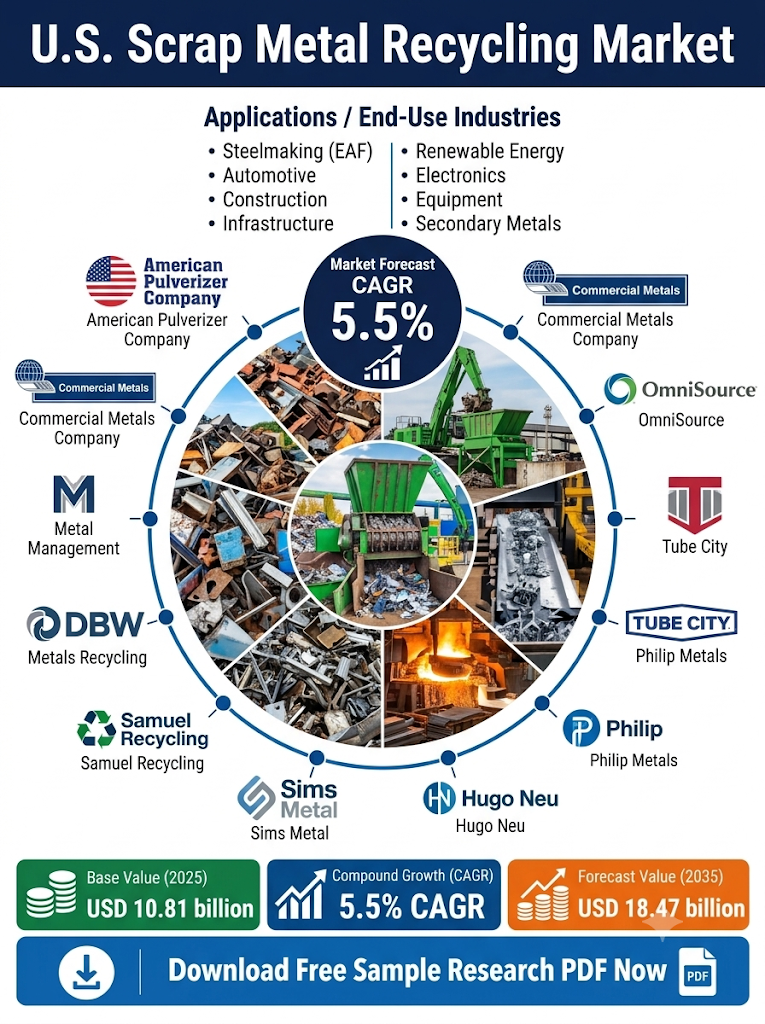
Rockville, MD, November 24, 2026 — The U.S. scrap metal recycling market is projected to reach USD 18,472 million by 2035, increasing from USD 10,814 million in 2025 at a compound annual growth rate (CAGR) of 5.5% during the forecast period. According to Fact.MR, rising industrial demand for secondary raw materials, expanding electric arc furnace (EAF) steelmaking, and sustainability requirements across automotive and construction industries are supporting market expansion.
Request for PDF Report Sample Pages: https://www.factmr.com/connectus/sample?flag=S&rep_id=7418
The shift toward recycled materials is becoming more pronounced. Manufacturers are seeking alternatives to virgin metals to manage raw material expenses and meet environmental objectives. Recycled steel and aluminum are gaining attention as industries pursue lower-emission production processes. Federal and state incentives supporting recycling infrastructure are also encouraging investment in material recovery and processing capabilities.
Electric Arc Furnace Adoption Strengthens the U.S. Scrap Metal Recycling Market
Steelmaking electrification is creating new demand opportunities. Electric arc furnaces rely heavily on ferrous scrap as a primary feedstock, making the availability and quality of recycled steel important to domestic steel production. Compared with traditional blast furnace operations, EAF-based production offers opportunities to reduce carbon emissions, strengthening the position of recycled ferrous materials in industrial supply chains.
Manufacturers are responding to this transition. Improvements in magnetic separation and sensor-based sorting are helping recycling facilities improve material purity and recovery yields. Domestic mills also benefit from the availability of locally processed ferrous scrap, which can reduce transportation expenses while supporting emissions-related production objectives.
The automotive industry is another important demand contributor. Vehicle manufacturers are incorporating recycled steel and aluminum into production as lightweighting and electrification influence material requirements. Electric vehicle (EV) platforms require carefully selected materials for body structures, chassis, and other components. Partnerships between automakers and recycling companies are also supporting the recovery of manufacturing waste and end-of-life vehicle components.
Construction activity is reinforcing demand. Recycled metals are increasingly relevant to infrastructure development and green building initiatives, where manufacturers and contractors seek materials that support resource efficiency.
Southwest U.S. Leads Regional Market Expansion
The Southwest U.S. is projected to register the fastest regional growth, with a CAGR of 6.6% through 2035. Urban development, renewable energy investments, and infrastructure construction are increasing the availability of recyclable materials. Solar and wind energy projects are also generating demand for secondary copper and aluminum used in clean energy installations.
The West U.S. follows with a projected CAGR of 6.2%. Environmental regulations and investments in advanced recycling technologies are influencing regional operations. Facilities are adopting AI-enhanced sorting systems, robotic separation equipment, and low-emission processing lines to improve recovery performance and meet environmental requirements.
The Midwest U.S. is expected to expand at a CAGR of 5.0%. Its established manufacturing base and connections with domestic steel and automotive industries support consistent scrap generation and consumption. Infrastructure modernization is adding to regional activity through road, bridge, and utility improvement projects.
Shredding and Ferrous Metals Shape Processing Demand
Ferrous metals remain an important category within the U.S. scrap metal recycling industry. Carbon steel, stainless steel, mild steel, and cast iron provide essential feedstock for manufacturing and infrastructure applications. Their availability and compatibility with EAF operations support continued industrial consumption.
Shredding is also becoming a central processing method. Recycling facilities use shredders to process end-of-life vehicles, household appliances, and construction waste into smaller fragments suitable for downstream separation. Magnetic separators, eddy current systems, and air classifiers help recover different metal categories while improving material quality.
Automation is changing processing operations. Digital controls and real-time monitoring systems allow facilities to track equipment performance, manage downtime, and improve throughput.
Commodity Price Volatility and Technology Gaps Challenge Operators
Despite favorable demand conditions, recyclers face several operational constraints. Fluctuating steel, copper, and aluminum prices can disrupt purchasing decisions and investment planning. Mid-sized operators are particularly exposed when they have limited financial capacity to manage commodity price movements.
Technology differences across facilities create another challenge. Advanced sorting and shredding equipment can improve recovery rates, but smaller operators may struggle to finance modernization. Labor shortages affecting dismantling, material separation, and machinery operation add further pressure.
Regulatory compliance also requires continued attention. Facilities must manage emissions, noise, runoff, and material handling requirements, while differences between state-level policies can complicate operational planning. Increasingly complex electronic products and hybrid material compositions are making metal recovery more technically demanding.
Technology Innovation Creates New Opportunities
Technology providers are responding to these requirements. In March 2025, TOMRA introduced a deep learning-based solution designed to improve sorting accuracy in wrought aluminum scrap recycling. The technology uses AI-driven object recognition to improve material purity and recovery, supporting the production of lower-carbon secondary aluminum.
This development highlights an important operational priority. Recyclers need to recover higher-quality materials from increasingly complex scrap streams. Investments in automated identification, separation, and processing systems are expected to remain relevant as industrial buyers place greater emphasis on recycled metal quality.
Key companies operating in the U.S. scrap metal recycling market include American Pulverizer Company, Commercial Metals Company (CMC), OmniSource, Metal Management Inc., Tube City Inc., Philip Metals, Hugo Neu, Sims Metal, Samuel Recycling, and DBW Metals Recycling.
Research Methodology and Market Intelligence
Fact.MR's 2025 U.S. scrap metal recycling market analysis incorporates insights from 10,200 stakeholders across 30 countries, with at least 280 participants per market. Producers and end-users, including scrap yard operators, smelters, and secondary metal manufacturers, accounted for 58% of responses. The remaining 42% came from industry professionals such as sustainability advisors, regulatory officers, and supply chain managers.
The research was conducted between June 2024 and May 2025 and examined demand patterns, recycling efficiency, capital investment, regulatory developments, and value chain risks. The analysis also considered more than 270 information sources, including regulatory documents, technical journals, financial statements, and environmental filings.
Fact.MR is a market research and consulting firm that provides industry intelligence, market forecasts, and strategic analysis to businesses and decision-makers. The research firm has tracked recycling industry trends since 2018.
View Related Reports :
Marine Horns Market : https://www.factmr.com/report/marine-horns-market
Marine Alarm Systems Market : https://www.factmr.com/report/marine-alarm-systems-market
Marine Annunciator Panels Market : https://www.factmr.com/report/marine-annunciator-panels-market
Marine Water Removal Equipment Market : https://www.factmr.com/report/marine-water-removal-equipment-market
About Fact.MR
Fact.MR is a market research and consulting firm delivering actionable intelligence, industry analysis, and strategic insights across diverse sectors. The company supports business leaders, investors, and industry participants through market sizing, demand forecasting, competitive assessments, and research-driven consulting services. Its reports examine emerging technologies, changing consumer preferences, regulatory developments, and regional market opportunities to help organizations make informed business decisions.

 English
 Arabic
 French
 Spanish
 Portuguese
 Deutsch
 Turkish
 Dutch
 Italiano
 Romaian
 Portuguese (Brazil)
 Greek