


Ceramic Kiln Market Size, Share, Competitive Landscape, and Future Outlook
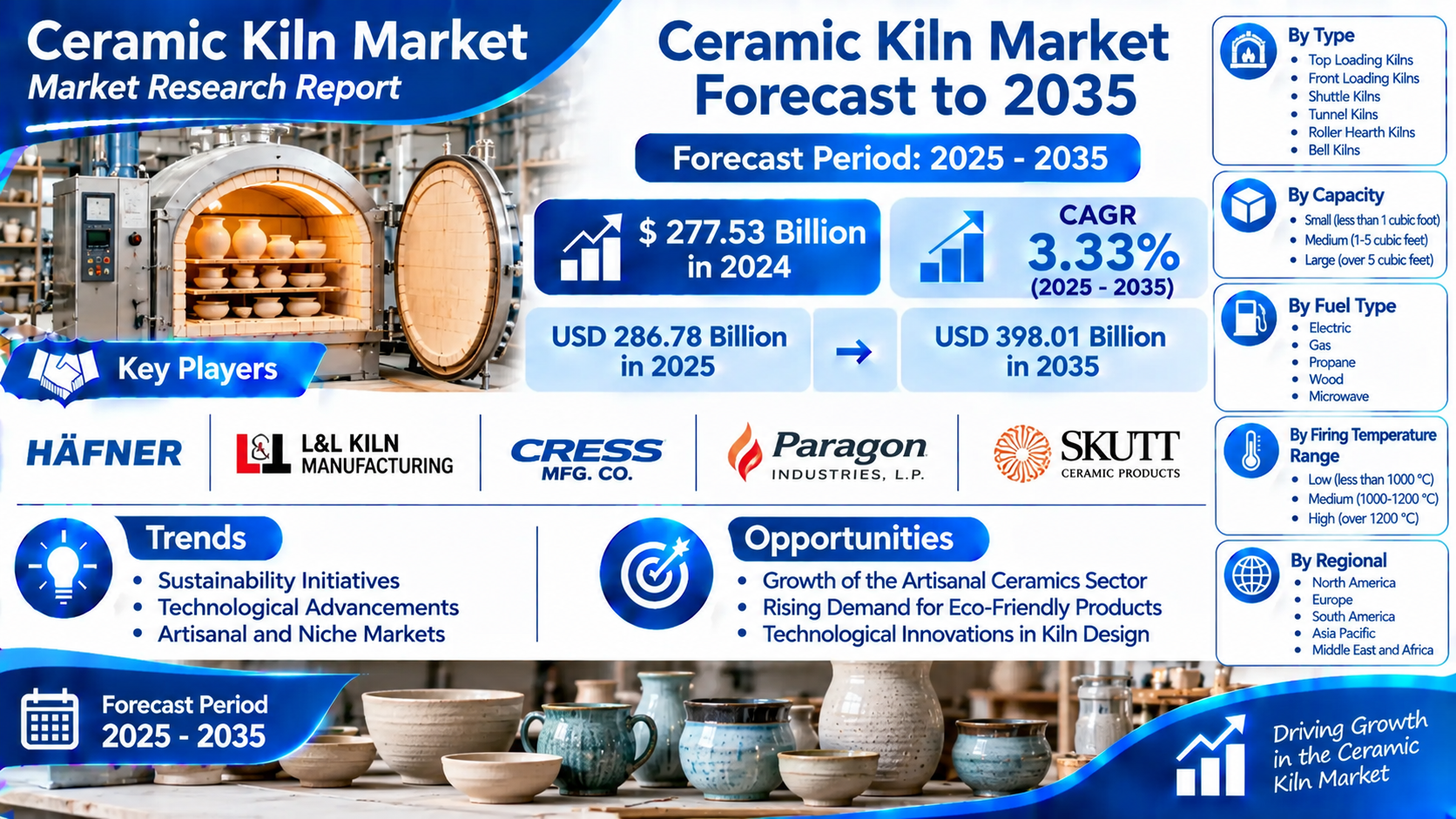
According to Market Research Future® (MRFR), the Ceramic Kiln Market is expected to record steady expansion over the 2025–2035 forecast period, with its value rising from USD 286.78 billion in 2025 to USD 398.01 billion in 2035. The market recorded a valuation of USD 277.53 billion in 2024 and is projected to advance at a CAGR of 3.33%. Demand is supported by the varied requirements of ceramic producers, the continued activity of artisanal and niche markets, and the need for kiln equipment that accommodates different firing conditions. Sustainability priorities and innovations in kiln design are adding further dimensions to the industry's growth outlook.
Market Development and Industry Requirements
Kilns are essential equipment in ceramic production because they provide the controlled heating environment required for firing ceramic materials. Their specifications vary according to the volume of material being processed, the fuel used, the desired firing temperature, and the configuration of the production operation. As a result, the market includes equipment designed for a wide range of production settings rather than a single standardized customer requirement.
The market's growth trajectory reflects the importance of matching kiln capabilities with the needs of individual users. A producer selecting equipment may consider loading arrangements, available space, capacity, fuel options, and the temperature range required for a particular process. These considerations create demand for differentiated products and give manufacturers opportunities to serve customers through varied equipment designs.
Different Kiln Configurations Serve Diverse Needs
Type-based segmentation includes Top Loading Kilns, Front Loading Kilns, Shuttle Kilns, Tunnel Kilns, Roller Hearth Kilns, and Bell Kilns. The presence of these categories highlights the diversity of kiln configurations available to the market. Loading design and equipment arrangement can influence how a kiln fits into a producer's workflow, making the choice of configuration an important part of equipment planning.
Rather than relying on one type of kiln for every setting, buyers can evaluate the available configurations against their production requirements. Suppliers must therefore maintain product offerings that address different operating environments. The range of kiln types also creates scope for design innovation, as manufacturers seek to improve equipment suitability for the customers and production processes they serve.
Capacity Segmentation Reflects Production Scale
Capacity divides the market into Small (less than 1 cubic foot), Medium (1-5 cubic feet), and Large (over 5 cubic feet) categories. These groupings provide a straightforward way to distinguish equipment according to firing volume. Small-capacity products can meet requirements where limited quantities are processed, while medium and large kilns address settings that require greater capacity.
The availability of multiple sizes is relevant to both established producers and businesses operating in artisanal or niche markets. Buyers can consider the amount of material they need to fire and select equipment accordingly. For manufacturers, capacity-based segmentation supports product differentiation and makes it possible to serve customers with distinct operational scales.
Fuel Choices and Firing Temperature Ranges
Fuel type is a further point of differentiation. The Ceramic Kiln Market includes Electric, Gas, Propane, Wood, and Microwave options. The choice among these alternatives can depend on the buyer's operating environment, fuel availability, equipment preferences, and production requirements. Offering different fuel configurations allows manufacturers to address a broader range of customer circumstances.
Firing temperature is equally important. The report classifies kilns into Low (less than 1000 degrees Celsius), Medium (1000-1200 degrees Celsius), and High (over 1200 degrees Celsius) ranges. These categories reflect the varying temperature requirements associated with ceramic firing. Buyers need to select equipment that corresponds to their intended processes, while manufacturers must provide products with suitable temperature capabilities.
The combination of fuel and temperature considerations makes product specification a central part of purchasing decisions. A kiln must be appropriate not only for the desired capacity and configuration but also for the firing conditions required by the user. This creates opportunities for suppliers to differentiate their offerings through design and technical development.
Sustainability Initiatives and Design Innovation
Sustainability initiatives are influencing the direction of the market as demand for eco-friendly products rises. This trend creates an opportunity for kiln manufacturers to consider how equipment design can respond to environmental priorities. Buyers increasingly have reasons to assess the wider operating characteristics of equipment alongside its basic firing function.
Technological advancements are also shaping market development. Innovations in kiln design can help suppliers address changing customer expectations and refine the capabilities of their product ranges. Improvements that support practical operation, appropriate temperature management, and equipment suitability can strengthen a manufacturer's position in a competitive market.
A third notable trend is the development of artisanal and niche markets. These segments contribute to demand for equipment that can accommodate specialized production requirements. Their presence reinforces the importance of product variety, particularly in terms of kiln type and capacity. Manufacturers that recognize differences between specialized users and other buyers can develop offerings that more closely match distinct requirements.
Regional Coverage and Market Potential
The report examines the Ceramic Kiln Market across North America, Europe, South America, Asia Pacific, and the Middle East and Africa. This geographic scope reflects the market's presence across several major regions and provides a framework for understanding demand in different operating environments.
Regional market conditions can vary according to ceramic production activity, the scale of local businesses, and the preferences of equipment buyers. The importance of artisanal ceramics and interest in eco-friendly products may also shape demand differently across locations. For manufacturers, regional coverage creates opportunities to adapt product positioning to local requirements while offering equipment across the principal kiln, capacity, fuel, and temperature categories.
Key Companies and Competitive Considerations
The key players listed in the report are Häfner, L&L Kiln Manufacturing, Cress Mfg. Co., Paragon Industries, L.P., and Skutt Ceramic Products. Competition in this market is influenced by the ability to serve varied customer needs through suitable equipment configurations and product specifications.
A broad product range can be relevant in a market segmented by kiln type, capacity, fuel, and firing temperature. Manufacturers also have opportunities to distinguish their offerings through technological innovations and attention to sustainability. As customers evaluate equipment, the alignment between product capabilities and intended production requirements remains an important consideration.
Opportunities Supporting the Forecast
Three opportunities stand out in the market outlook. Growth of the artisanal ceramics sector can support demand from producers with specialized requirements. Rising demand for eco-friendly products can encourage further attention to sustainable kiln solutions. Technological innovations in kiln design can provide manufacturers with additional ways to improve and differentiate their equipment.
Together, these opportunities point to a market in which product development and customer-specific requirements remain important. Suppliers will need to consider the different needs associated with production scale, fuel choice, and firing conditions while responding to broader industry trends.
Outlook to 2035
The Ceramic Kiln Market is projected to increase from USD 286.78 billion in 2025 to USD 398.01 billion in 2035, representing a CAGR of 3.33%. The 2024 market size was USD 277.53 billion. Over the forecast period, demand is expected to be shaped by equipment requirements across ceramic production, the growth of artisanal and niche markets, sustainability initiatives, and technological advancements. Manufacturers offering differentiated kiln configurations and solutions aligned with varied capacity and firing needs will continue to play an important role in the market's development.

 English
 Arabic
 French
 Spanish
 Portuguese
 Deutsch
 Turkish
 Italiano
 Russian
 Romaian
 Portuguese (Brazil)
 Greek