


Diquat Market Analysis 2036: USA, China and Germany Emerge as Key Growth Markets
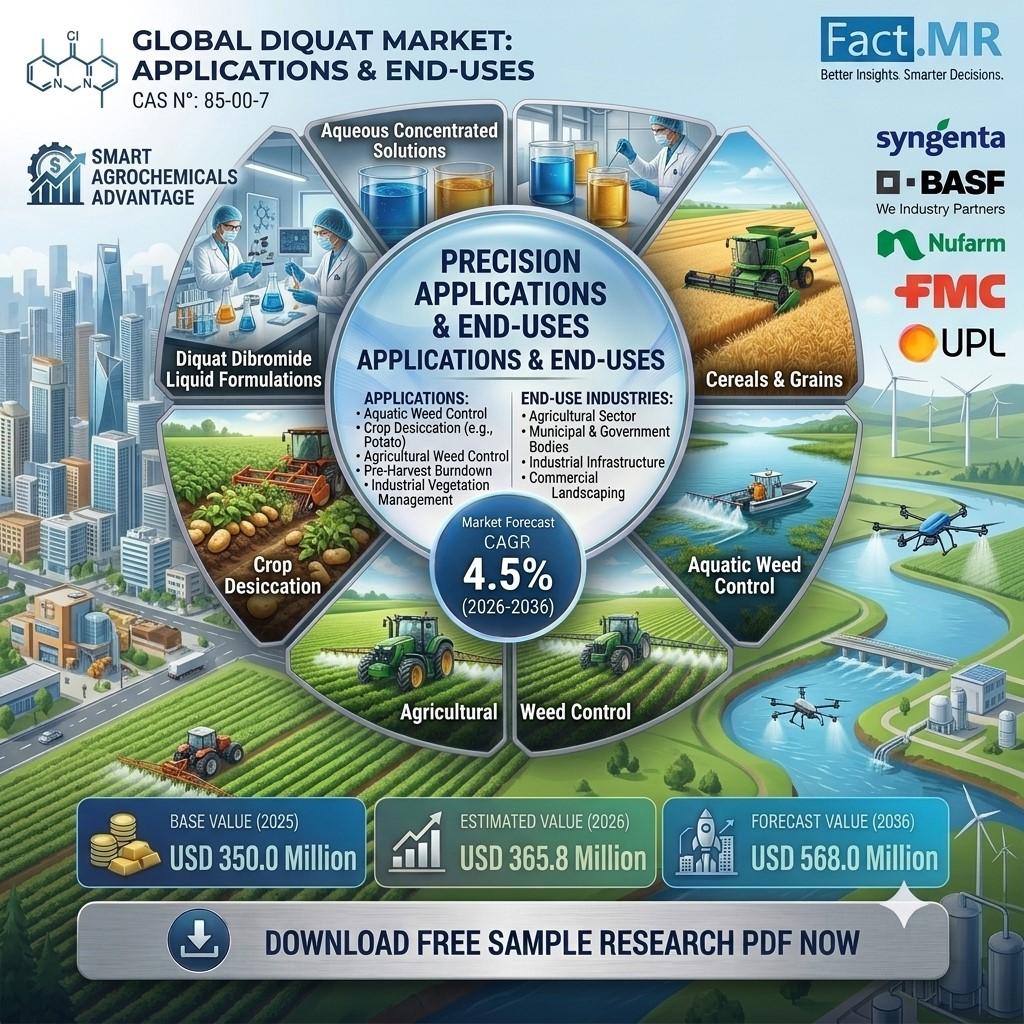
The global diquat market is expected to expand from USD 365.8 million in 2026 to USD 568.0 million by 2036, registering a CAGR of 4.5% over the forecast period. Fact.MR attributes this growth to sustained demand for contact herbicides in aquatic vegetation management, agricultural desiccation, and infrastructure maintenance. Increasing requirements for invasive weed control across lakes, reservoirs, irrigation channels, and industrial corridors are also supporting market development.
Demand is being influenced by the need for effective vegetation management across agricultural and non-agricultural environments. Municipal authorities require herbicide solutions for managing invasive aquatic vegetation, while agricultural users continue to seek crop protection products for pre-harvest desiccation and weed management. Infrastructure maintenance along railway tracks, highways, and utility corridors represents another source of demand.
Get detailed market forecasts, competitive benchmarking, and pricing trends:
https://www.factmr.com/connectus/sample?flag=S&rep_id=8180
Aquatic Weed Control Retains Dominant Position
By application, aquatic weed control is expected to account for 71.9% of the diquat market in 2026. Its leading position reflects the established use of diquat-based formulations in managing unwanted vegetation across lakes, ponds, reservoirs, and irrigation channels. Municipal water management programs and agricultural irrigation requirements are supporting demand for registered aquatic vegetation management solutions.
By product type, diquat dibromide liquid formulations are projected to capture 38.6% of the market in 2026. Their established application protocols, formulation familiarity, and compatibility with conventional spray equipment support their continued adoption across agricultural and aquatic applications.
Contact herbicide technology represents another significant segment, accounting for 64.3% of the market in 2026. Its position reflects demand for fast-acting, non-selective vegetation control across agricultural and infrastructure applications. Liquid concentrate formulations are also gaining importance, accounting for 57.8% of formulation demand due to their established dilution and application practices.
USA, China, and Germany Show Growth Potential
The United States is projected to register a CAGR of 5.5% through 2036, making it the fastest-growing country market covered in the report. Demand is supported by municipal aquatic vegetation management programs, agricultural desiccation requirements, and infrastructure maintenance activities. Regulatory developments surrounding alternative contact herbicides are also influencing product selection among professional applicators.
China is expected to record a CAGR of 5.1% during the forecast period. Expanding domestic agrochemical production capacity, agricultural application requirements, and investment in rural water management infrastructure are supporting market development. Chinese manufacturers are also strengthening their position in global diquat supply through active ingredient production and formulated product exports.
Germany is projected to advance at a CAGR of 3.8% through 2036. Demand is concentrated in authorized agricultural and infrastructure vegetation management applications. Regulatory scrutiny across European markets is influencing product registrations, application requirements, and procurement decisions. These conditions are encouraging suppliers to emphasize regulatory compliance and established distribution networks.
South Korea is expected to register a CAGR of 4.3%, supported by agricultural modernization and irrigation system vegetation management. The United Kingdom is projected to grow at 4.0%, with agricultural desiccation and infrastructure maintenance contributing to demand.
Competitive Landscape
Competition in the diquat market includes established agrochemical manufacturers and regional formulation suppliers with diverse product portfolios and distribution networks. Key companies profiled by Fact.MR include Syngenta, Nufarm Limited, ADAMA Ltd., UPL Limited, Drexel Chemical Company, Albaugh LLC, Helm AG, Zhejiang Yongnong Technology, and Jiangsu Huifeng Agrochemical.
Syngenta maintains a strong market presence through its established product portfolio and registration network. Nufarm and ADAMA compete through agricultural distribution capabilities and formulation offerings, while Chinese producers Zhejiang Yongnong Technology and Jiangsu Huifeng Agrochemical contribute to global supply through production scale and export activities.
Competitive positioning is influenced by product registration coverage, formulation quality, distribution reach, pricing, and regulatory compliance. Manufacturers are also focusing on maintaining supply reliability as agricultural and institutional buyers evaluate procurement requirements across different application markets.
Regulatory Developments and Product Substitution Shape Market Trends
Changes in the global contact herbicide landscape are creating new opportunities for diquat manufacturers. Fact.MR identifies the withdrawal of paraquat production by Syngenta as an important market development, with potential implications for demand across agricultural burndown, desiccation, and vegetation management applications.
At the same time, regulatory re-evaluation in North America and Europe is influencing market conditions. Updated application requirements, environmental considerations, and operator exposure standards are increasing the importance of compliance among manufacturers and end users.
Product development is also focusing on improved application efficiency and precision. GPS-guided spraying and drone-based aquatic treatment are emerging as opportunities for more targeted vegetation management. Continued development of formulation technologies and registration expansion could support additional market access across emerging agricultural regions.
As demand for aquatic weed control, agricultural vegetation management, and infrastructure maintenance continues, the diquat market is expected to experience steady development through 2036. The full Fact.MR report provides detailed market forecasts, country-level analysis, segment assessments, and competitive benchmarking.
To View Top Reports
Water Treatment Membrane Market: https://www.factmr.com/report/3709/water-treatment-membrane-market
PPO Herbicide Market: https://www.factmr.com/report/ppo-herbicide-market
Water and Wastewater Treatment Chemical Market: https://www.factmr.com/report/water-and-wastewater-treatment-chemical-market
About Fact.MR
Fact.MR is a market research and consulting company providing market intelligence, competitive analysis, and forecasting across global industries. Its research supports businesses with data-driven insights into emerging markets, technology trends, competitive dynamics, regional opportunities, and changing demand patterns.

 English
 Arabic
 French
 Spanish
 Portuguese
 Deutsch
 Turkish
 Dutch
 Italiano
 Russian
 Romaian
 Portuguese (Brazil)