


Allergic Rhinitis Market Growth: Treatment Formats, Immunotherapy, and Access
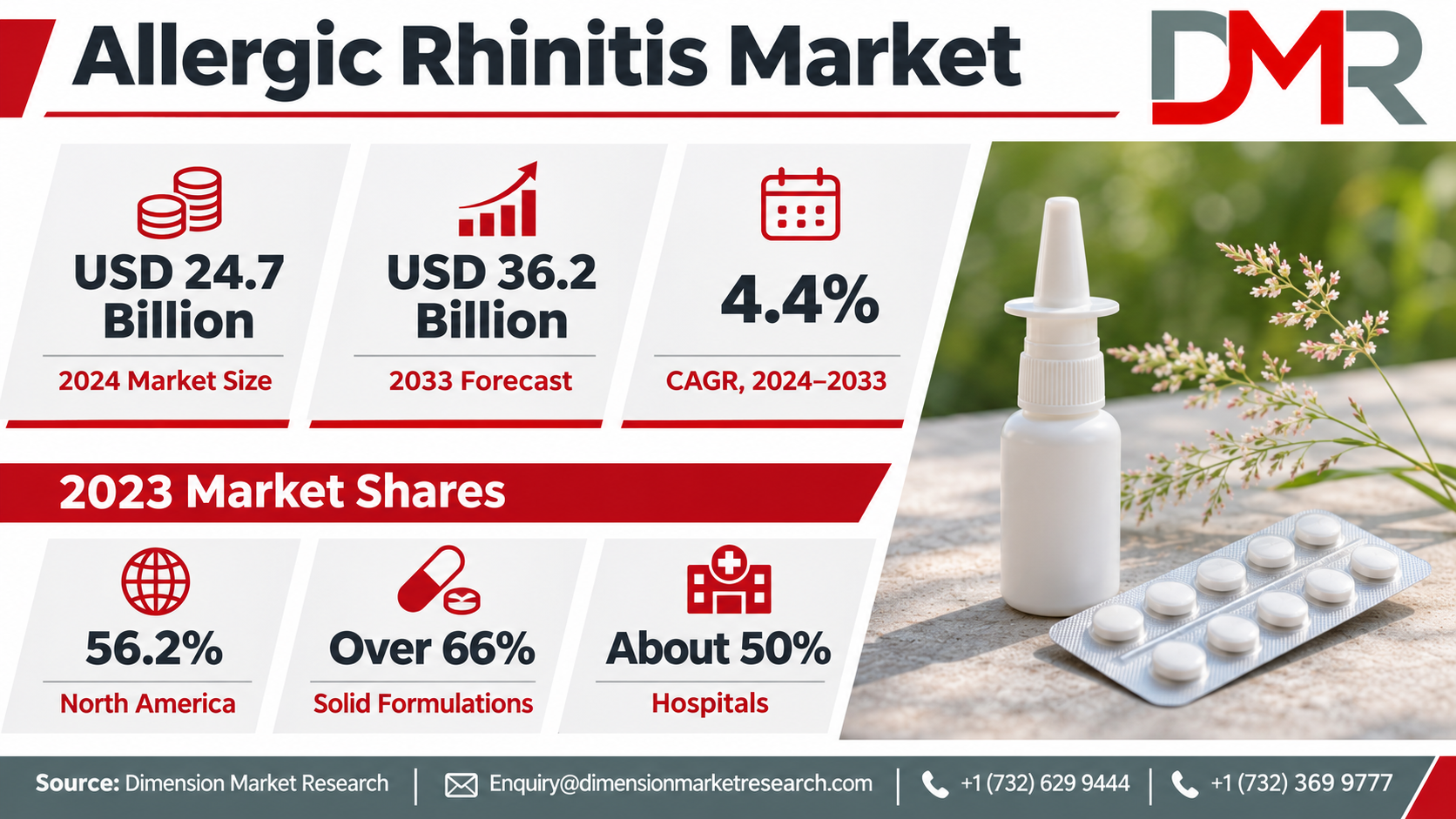
The Allergic Rhinitis Market Size was estimated at USD 24.7 billion in 2024, according to Dimension Market Research. The report’s Key Takeaways and Report Details project that the market will reach USD 36.2 billion by 2033, with a compound annual growth rate of 4.4% from 2024 to 2033. The report links this outlook to rising awareness of allergic conditions, greater demand for convenient treatments, and interest in more individualized care.
For pharmaceutical companies, growth raises two separate portfolio questions. Which treatment formats can serve a broad patient population, and where can specialized options find demand? Solid formulations account for the largest share by type, while affordability and access influence the adoption of advanced therapies such as allergen immunotherapy.
What Does the Allergic Rhinitis Market Cover?
Allergic rhinitis, often called hay fever, is an allergic response to environmental triggers such as pollen, dust mites, and pet dander. DMR discusses both seasonal and year-round allergic rhinitis. Its market analysis groups products into solid and liquid formulations and examines the roles of hospitals, clinics, and research institutes. The report also discusses symptom management, allergy testing, and allergen immunotherapy as parts of the broader care landscape.
The distinction between seasonal and year-round symptoms helps explain why the market supports multiple products and care settings. Some demand centers on convenient formulations for symptom management, while other demand is tied to diagnostic evaluation or ongoing specialist care. For portfolio teams, the patient needs a product addresses can help determine which care settings to prioritize.
Get a Free Customized Sample of This or Any Other Market Research Report
https://dimensionmarketresearch.com/request-sample/allergic-rhinitis-market/
Solid Allergy Medications and Hospitals Lead Their Segments
● Solid formulations accounted for over 66% of market revenue in 2023. DMR attributes this position to factors such as ease of administration, portability, and shelf life. Tablets, capsules, and powders are included in the solid category.
● Hospitals held roughly 50% of the market by end user in 2023. The report connects their share to access to diagnostic services and specialized care, including immunotherapy.
● Clinics support routine and ongoing care. DMR identifies convenience and local access as reasons clinics serve patients with mild to moderate symptoms and those who need follow-up.
Liquid formulations include syrups, drops, and nasal sprays. DMR notes that liquid options can serve people who have difficulty swallowing pills. For product planning, this makes format choice a question of patient fit as well as market share. A smaller formulation category can address a specific need across an otherwise broad allergy portfolio.
Allergen Immunotherapy and Personalized Allergy Care
DMR identifies sublingual tablets and drops as developments in allergen immunotherapy. These formats offer another route of administration alongside traditional allergy shots. The report also identifies cost as a barrier to advanced therapies, particularly in lower-income markets. For manufacturers, demand for convenient administration and the ability to afford therapy are distinct considerations when assessing adoption.
Digital tools are another area of interest. The report discusses symptom tracking and treatment reminders as examples of how mobile apps and wearables may support ongoing management. Telemedicine can also broaden access to consultations. For companies evaluating digital services, a practical question is whether they address a recurring need, such as symptom tracking between appointments or access to follow-up care.
North America Leads Allergic Rhinitis Market Share
● North America held 56.2% of the global market in 2023. DMR links its position to established healthcare infrastructure and the presence of pharmaceutical companies developing treatments and delivery formats.
● Emerging markets offer opportunities for affordable formulations. DMR highlights improving healthcare infrastructure and greater awareness of allergic conditions. Its competitive analysis identifies China and India as markets attracting supplier interest.
These findings suggest different priorities for geographic expansion. In an established market, a supplier may assess how a new formulation fits an existing portfolio and care pathway. In an emerging market, pricing and access to clinics or specialists may shape which products can reach patients at scale.
Allergy Treatment Companies Compete on Formulation and Reach
The report covers companies including GlaxoSmithKline, Sanofi, Merck, AstraZeneca, and Teva. It describes a fragmented competitive landscape and highlights branding, research and development, and expansion into emerging markets. For strategy teams, a useful comparison is how each company balances broadly used symptom-management products with investment in specialized therapies and new delivery formats.
Explore the Complete Allergic Rhinitis Market Analysis
https://dimensionmarketresearch.com/checkout/allergic-rhinitis-market/
Frequently Asked Questions
What is the size of the Allergic Rhinitis Market?
DMR’s Report Details estimates USD 24.7 billion in 2024 and forecasts USD 36.2 billion by 2033.
What is the projected Allergic Rhinitis Market growth rate?
DMR’s Key Takeaways lists a CAGR of 4.4% from 2024 to 2033.
Which treatment format held the largest market share?
Solid formulations led by type, accounting for over 66% of market revenue in 2023.
Which region led the Allergic Rhinitis Market?
North America held the largest regional share at 56.2% in 2023.
What factors are driving demand for allergic rhinitis treatments?
DMR identifies rising awareness of allergic conditions, environmental exposures, and demand for convenient treatment options as growth drivers.
Conclusion
Through 2033, DMR expects demand for convenient allergy treatments and interest in personalized care to support market growth. Solid formulations remain central to the product mix, while allergen immunotherapy offers room for innovation in delivery formats. In emerging markets, affordable formulations present an opportunity where awareness and healthcare access are expanding.

 English
 Arabic
 French
 Spanish
 Portuguese
 Deutsch
 Dutch
 Italiano
 Russian
 Romaian
 Portuguese (Brazil)
 Greek