


Aerospace 3D Printing Market Revenue to Reach US$ 17.54 Billion by 2034
Aerospace 3D Printing offers significant advantages in aerospace prototyping and product development. Engineers can quickly produce design models and test component performance. Faster prototyping helps accelerate innovation and reduce development costs. Increasing aircraft research activities are encouraging wider technology utilization.
Aerospace 3D Printing Market Overview
The Global Aerospace 3D Printing Market is witnessing significant growth due to increasing adoption of advanced manufacturing technologies, rising demand for lightweight aircraft components, and continuous innovation in aerospace engineering. Aerospace 3D printing, also known as additive manufacturing, is a process that creates complex components by building materials layer by layer using digital designs. This technology enables manufacturers to produce customized, lightweight, and high-performance parts while reducing material waste and production time.
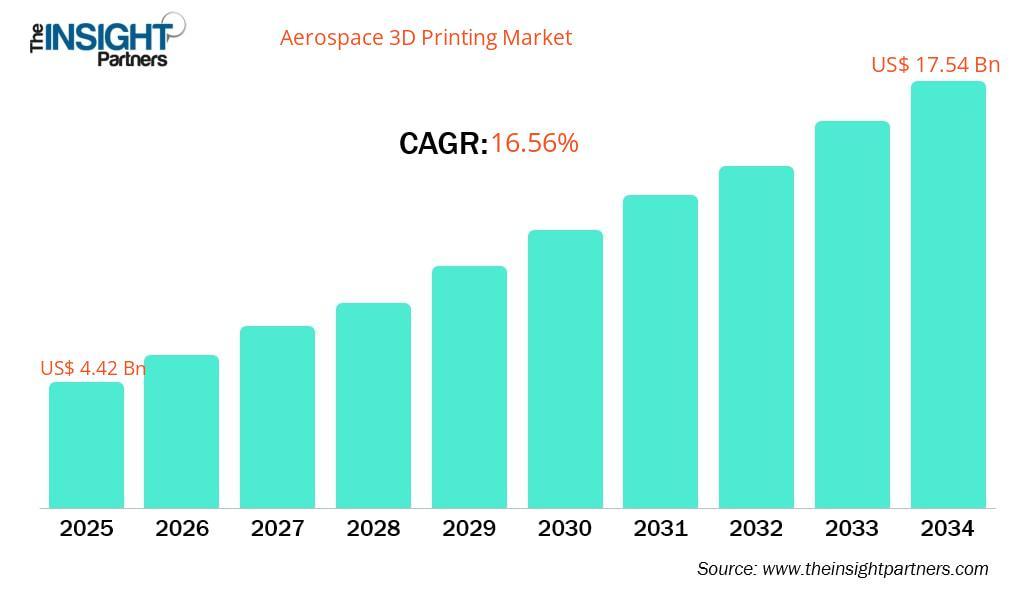
The Aerospace 3D Printing market is expected to register a CAGR of 16.56% from 2026 to 2034, with the market size expanding from US$ 4.42 Billion in 2025 to US$ 17.54 Billion by 2034. The growing demand for fuel-efficient aircraft, increasing investments in space exploration, and the adoption of advanced manufacturing solutions are among the major factors driving market expansion.
Get a PDF Sample: https://www.theinsightpartners.com/sample/TIPRE00008387
Aerospace manufacturers are increasingly utilizing 3D printing to manufacture engine components, structural parts, brackets, ducts, and other complex aircraft components. The technology offers several advantages, including reduced component weight, design flexibility, improved production efficiency, and lower material consumption. Furthermore, the growing use of additive manufacturing in satellite production, spacecraft development, and unmanned aerial vehicles (UAVs) is creating new opportunities for market participants.
Key Market Drivers and Emerging Trends
One of the major factors driving the Aerospace 3D Printing Market is the increasing demand for lightweight aircraft components. Reducing aircraft weight helps improve fuel efficiency, lower operating costs, and enhance overall performance. Additive manufacturing allows aerospace companies to develop complex geometries and lightweight structures that are difficult to manufacture using conventional production methods.
Technological advancements in metal 3D printing are also supporting market growth. Direct Metal Laser Sintering (DMLS), Selective Laser Sintering (SLS), and other advanced printing technologies enable manufacturers to produce durable components with high precision and performance. These technologies are increasingly being used for aerospace engine parts and critical structural applications.
Additionally, the expansion of commercial aviation and growing investments in defense and space programs are increasing the demand for innovative manufacturing solutions. Aerospace companies are also focusing on digital manufacturing, rapid prototyping, and localized production to improve supply chain efficiency.
Aerospace 3D Printing Market Segmentation
The Aerospace 3D Printing Market is segmented based on product, printer technology, application, and end use.
By Product
-
Material
-
Printer
By Printer Technology
-
SLA
-
SLS
-
DMLS
-
FDM
-
CLIP
By Application
-
Engine
-
Structural
-
Components
By End Use
-
Aircraft
-
Helicopters
-
UAV
-
Spacecraft
Based on product, the material segment plays an important role in the market, as specialized polymers, metal powders, and advanced materials are essential for manufacturing aerospace-grade components. The printer segment is also expected to experience growth with increasing investments in industrial additive manufacturing equipment.
By printer technology, DMLS and SLS are gaining attention due to their ability to produce complex and high-performance aerospace components. In terms of application, engine and structural components represent important areas of adoption because of the benefits of weight reduction and design optimization. Meanwhile, aircraft and spacecraft applications are expected to create significant opportunities as aerospace manufacturers expand their use of additive manufacturing.
Leading Companies in the Aerospace 3D Printing Market
The global Aerospace 3D Printing Market includes several prominent technology providers, material manufacturers, and aerospace engineering companies. These companies are focusing on research and development, strategic partnerships, product innovation, and advanced manufacturing capabilities to strengthen their competitive positions.
Key players operating in the market include:
- 3D Systems Corporation
- Aerojet Rocketdyne
- Arcam AB
- Envisiontec GmbH
- EOS GmbH
- Höganäs AB
- Materialise NV
- MTU Aero Engines AG
- Norsk Titanium AS
- Stratasys Ltd.
These market participants are investing in advanced printing technologies, aerospace-grade materials, and innovative manufacturing processes to meet the increasing demand for precision-engineered components. Their focus on production scalability, quality assurance, and technological development is expected to support market growth.
Future Outlook of the Aerospace 3D Printing Market
The future of the Aerospace 3D Printing Market looks promising, driven by the increasing adoption of additive manufacturing across commercial aviation, defense, and space exploration industries. The growing focus on fuel efficiency, lightweight structures, and cost-effective production will encourage aerospace manufacturers to integrate 3D printing into their manufacturing operations.
Furthermore, advancements in metal additive manufacturing, high-performance polymers, and multi-material printing are expected to expand the range of aerospace applications. The development of next-generation aircraft, electric aviation platforms, reusable launch vehicles, and advanced satellites will also create new growth opportunities.
The increasing adoption of digital manufacturing and automated production technologies is likely to improve manufacturing accuracy, reduce lead times, and strengthen supply chain resilience. Overall, technological innovation, expanding aerospace investments, and the demand for lightweight, high-performance components are expected to drive the global Aerospace 3D Printing Market throughout the 2026–2034 forecast period.
Related Reports:
3D Printing in Aerospace and Defence Market
About Us
The Insight Partners is a leading market research and consulting firm delivering actionable insights through in-depth industry analysis and strategic intelligence. The firm supports clients across various industries in making informed decisions by providing comprehensive market forecasts, competitive assessments, and growth opportunities.
Contact Us:
If you have any queries about this report or if you would like further information, please contact us:
Contact Person: Ankit Mathur
E-mail: sales@theinsightpartners.com
Also Available in : Korean | German | Japanese | French | Chinese | Italian | Spanish

 English
 Arabic
 Spanish
 Portuguese
 Deutsch
 Turkish
 Dutch
 Italiano
 Russian
 Romaian
 Portuguese (Brazil)
 Greek