


Second-Hand or New Commercial Laundry Machines: Which Is the Smarter Investment for Your First Laundry Plant?
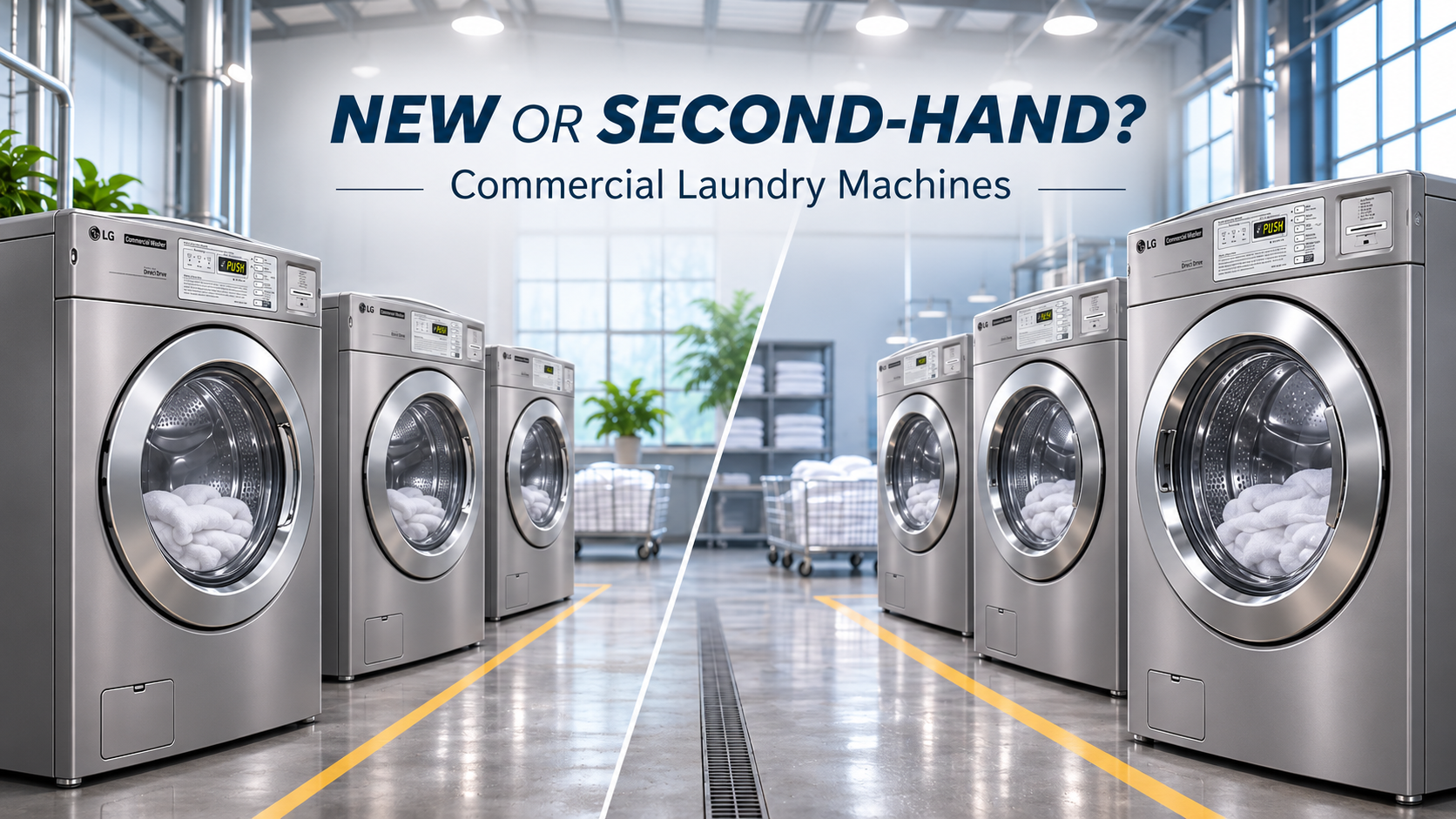
Planning to start your first commercial laundry plant but confused about whether to buy new or second-hand machines?
When setting up a laundry business, equipment is one of the major investments. You need washing machines, tumble dryers, finishing equipment, and supporting infrastructure before accepting regular customer orders.
Buying used commercial laundry machines may appear attractive because of the lower purchase price. However, older equipment can involve hidden repair expenses, maintenance requirements, and operational risks.
New machines generally require a higher initial investment but may offer warranty coverage, updated controls, and more predictable servicing arrangements.
So, which option makes better financial sense for a new laundry entrepreneur?
The answer depends on your budget, expected daily workload, equipment condition, and long-term business plans.
Why Is Equipment Selection Important for a New Laundry Plant?
A commercial laundry plant must process garments or linen consistently to meet customer requirements.
Whether you plan to serve hotels, restaurants, hospitals, laundromats, or other commercial customers, machine performance directly affects processing capacity and delivery schedules.
A laundry plant may require:
-
Industrial tumble dryers.
-
Flatwork ironers.
-
Steam pressing equipment.
-
Laundry chemical dosing systems.
-
Sorting and garment-handling equipment.
Each machine performs an important function within the production process.
Choosing unsuitable equipment can create bottlenecks, additional handling, and unexpected operating expenses.
Before comparing new and used machines, calculate how much laundry you expect to process daily.
What Are Second-Hand Commercial Laundry Machines?
Second-hand commercial laundry machines are previously owned machines that have already been used in a commercial or industrial laundry environment.
They may come from businesses that have closed, upgraded their equipment, or changed their processing requirements.
Used equipment is not necessarily the same as professionally refurbished equipment.
A refurbished machine may have undergone inspections, repairs, and component replacements. However, the extent of refurbishment depends on the seller.
Advantages of Second-Hand Equipment
Lower Initial Purchase Price: Used machines may be available at a lower price than comparable new equipment.
Reduced Initial Capital Requirement: Entrepreneurs may retain more money for rent, marketing, utilities, and working capital.
Potential Availability: Some used machines may be available immediately, depending on the seller and location.
Limitations of Second-Hand Equipment
-
Previous operating conditions may be unknown.
-
Major components may already have significant wear.
-
Manufacturer warranty coverage may have expired.
-
Certain spare parts may be difficult to obtain.
-
Repairs could delay the business launch.
-
Installation and transportation expenses still apply.
A lower purchase price does not automatically mean a lower total investment.
What Are the Benefits of Buying New Commercial Laundry Machines?
New commercial laundry machines are supplied directly through manufacturers or equipment distributors.
They generally provide clearer technical specifications, current documentation, and manufacturer warranty terms.
Warranty and Service Support
New equipment typically includes warranty coverage according to the manufacturer's terms.
This can help reduce uncertainty around eligible defects during the warranty period.
Updated Equipment Technology
Depending on the model, modern commercial washers may offer programmable washing cycles, extraction controls, and compatible chemical dosing features.
Predictable Equipment Condition
A new machine does not have an unknown history of commercial use.
This simplifies the initial assessment of mechanical condition, although regular maintenance remains necessary.
Installation and Operator Training
Professional suppliers may offer installation guidance, commissioning, and operator training.
These services should be confirmed in the quotation.
Long-Term Planning
New machinery can make it easier to estimate planned maintenance and compare equipment performance against manufacturer specifications.
However, purchasing new machines requires sufficient capital and does not eliminate future maintenance expenses.
New vs Second-Hand Commercial Laundry Machines: Key Differences
|
Factor |
New Machines |
Second-Hand Machines |
|
Initial purchase cost |
Generally higher |
Generally lower |
|
Previous usage |
No previous commercial operating history |
Depends on previous owner |
|
Warranty |
Manufacturer terms may apply |
Varies by seller |
|
Maintenance history |
Starts with new equipment |
Should be verified |
|
Spare parts |
Check manufacturer support |
Model availability is important |
|
Technology |
Current available features |
Depends on machine age |
|
Installation |
Must be planned |
May require additional modifications |
|
Investment risk |
Generally more predictable initially |
Higher uncertainty without inspection |
The comparison should focus on the complete cost of ownership, not only the purchase invoice.
How Much Can You Save With Second-Hand Machines?
Consider a hypothetical first-time laundry plant requiring two commercial washer extractors and two tumble dryers.
Suppose the estimated purchase price of new equipment is ₹12 lakh.
A comparable second-hand package is offered for ₹7 lakh.
The apparent purchase-price saving is:
₹12,00,000 − ₹7,00,000 = ₹5,00,000
However, suppose the used equipment requires:
-
Transportation and installation: ₹60,000.
-
Immediate repairs and replacement parts: ₹1,20,000.
-
Electrical and connection modifications: ₹40,000.
Additional expenses total ₹2,20,000.
The initial cost of the used setup becomes:
₹7,00,000 + ₹2,20,000 = ₹9,20,000
The difference compared with the new equipment purchase price is now ₹2,80,000, before accounting for installation costs on the new setup.
These figures are hypothetical, not verified equipment quotations.
They demonstrate why entrepreneurs should compare complete installed costs using equivalent assumptions for both options.
What Hidden Costs Should You Check Before Buying Used Equipment?
Maintenance and Repairs
Older machines may require replacement bearings, seals, motors, valves, controls, or other mechanical components.
Ask for service records and obtain a technical inspection.
Water and Electricity Consumption
Equipment operating costs depend on actual machine performance and washing programmes.
Compare manufacturers' consumption specifications where available.
Breakdown and Downtime
Unexpected breakdowns may interrupt customer orders.
If your startup depends on a single washer or dryer, even one unavailable machine can significantly reduce daily processing capacity.
Spare-Parts Availability
Before purchasing older equipment, confirm whether suitable replacement parts and qualified service technicians are available.
Installation Modifications
Used machinery may require changes to electrical connections, plumbing, ventilation, or mounting arrangements.
These costs should be included in the equipment budget.
How to Calculate the Long-Term Cost of Ownership
A practical comparison should evaluate total expenses over a defined period.
Use the following formula:
Total Ownership Cost = Purchase Price + Installation + Maintenance + Utilities + Repairs + Financing Costs − Estimated Resale Value
Consider this hypothetical five-year comparison:
|
Expense |
New Equipment |
Used Equipment |
|
Purchase and installation |
₹13,00,000 |
₹9,00,000 |
|
Five-year maintenance and repairs |
₹1,50,000 |
₹4,00,000 |
|
Five-year utilities |
₹7,50,000 |
₹9,00,000 |
|
Total before resale and financing |
₹22,00,000 |
₹22,00,000 |
In this example, both options produce the same five-year cost before financing and resale value.
However, the used setup also begins with greater uncertainty about equipment condition and remaining working life.
These figures are illustrative and should not be interpreted as typical savings, prices, or performance differences.
Actual results require model-specific quotations, consumption estimates, maintenance records, and realistic processing volumes.
What Should You Inspect Before Buying Second-Hand Laundry Equipment?
Before paying for used commercial laundry machines, arrange an inspection by a qualified commercial laundry technician.
The inspection should cover:
Machine Identification: Verify manufacturer, model, serial number, and available installation records.
Mechanical Condition: Inspect bearings, drum movement, seals, suspension, and other relevant components.
Electrical Systems: Check controls, wiring condition, sensors, and safety features.
Operating Test: Observe suitable washing, extraction, and drying cycles.
Leakage and Corrosion: Inspect for water leaks, rust, and damage.
Maintenance History: Review previous servicing and major repairs.
Parts Availability: Confirm that replacement components can still be sourced.
Written Terms: Obtain documentation covering equipment condition, included parts, and any seller warranty.
Avoid purchasing machinery solely from photographs without verifying its actual working condition.
Which Machines Should You Buy New First?
A mixed equipment strategy may suit some startup businesses.
Instead of purchasing everything new or everything used, entrepreneurs can prioritise machinery according to operational importance.
For example, a new washer extractor may be worth considering when washing and extraction are essential to meeting contracted daily volumes.
A suitable refurbished finishing machine may be considered when its condition, safety, performance, and support arrangements are verified.
However, equipment should never be selected solely according to its position in the processing line.
Evaluate each machine based on reliability, workload, safety, operating costs, and availability of servicing.
For critical production equipment, repeated breakdowns can cost more than the initial savings from buying second-hand machinery.
When Does Buying Second-Hand Equipment Make Sense?
Second-hand equipment may be suitable when:
-
Startup capital is limited.
-
Machine condition has been independently verified.
-
Service records are available.
-
Spare parts can be sourced.
-
The equipment meets expected processing requirements.
-
The seller provides clear written terms.
-
The business has sufficient contingency funds for repairs.
Used equipment can be a reasonable investment when the purchase price reflects its remaining usable life and associated risks.
However, buying an inexpensive machine with an unknown history may create greater expenses after installation.
When Should You Invest in New Commercial Laundry Machines?
New equipment may be more practical when:
-
You are establishing a laundry plant with regular commercial contracts.
-
Consistent daily production is essential.
-
You require specific capacity or technical features.
-
Equipment downtime would significantly affect revenue.
-
Warranty and after-sales service are important.
-
Your financial plan supports the higher initial investment.
The decision should reflect your business model rather than a general assumption that new equipment is always better.
How Orgaearth Can Help With Your First Commercial Laundry Plant
Selecting suitable machinery is an important step when starting a professional laundry business.
Orgaearth Laundry Solutions supplies commercial laundry machines and industrial laundry equipment in India for laundromats, hotels, hospitals, dry cleaners, and commercial laundry facilities.
Its equipment portfolio includes DOMUS industrial washer extractors, LG commercial washing machines, professional tumble dryers, flatwork ironers, and supporting laundry equipment.
Orgaearth assists businesses with machine selection, capacity planning, installation requirements, and after-sales support.
Entrepreneurs planning a new facility can evaluate machine capacities, technical specifications, and suitable equipment combinations before investing.
Conclusion
Choosing between new and second-hand commercial laundry machines is an important financial decision for a first-time laundry entrepreneur.
Used equipment can reduce initial spending, but repair costs, unknown operating history, and maintenance requirements may affect long-term expenses.
New equipment generally involves higher upfront investment while offering clearer warranty arrangements and predictable initial machinery condition.
Before purchasing, estimate daily processing requirements, compare total ownership costs, and review available technical support.
The smarter investment is the equipment that meets your laundry plant's workload, budget, and reliability requirements without creating unnecessary financial risk.
Frequently Asked Questions
1. Are second-hand commercial laundry machines worth buying?
They can be, provided the machines are properly inspected, suitable for your workload, and supported by available spare parts and service.
2. Is it better to buy new or used machines for a laundry startup?
New equipment may offer clearer warranty and service arrangements, while used equipment can reduce initial costs. Compare total ownership costs before deciding.
3. What should I inspect when buying used commercial laundry equipment?
Check mechanical components, controls, leakage, corrosion, maintenance records, operating performance, safety features, and spare-parts availability.
4. Do second-hand laundry machines consume more electricity?
Not necessarily. Consumption depends on the specific machine, technology, condition, programmes, and operating practices.
5. Can I start a commercial laundry with a combination of new and used equipment?
Yes. A mixed setup may be practical when each machine meets safety, performance, capacity, and maintenance requirements.
6. Where can I buy commercial laundry machines in India?
Orgaearth Laundry Solutions supplies professional commercial and industrial laundry equipment. Entrepreneurs can compare models, capacities, installation requirements, and support before purchasing.
Contact Us:
Orgaearth Laundry Solutions
Plot no. 774, Udyog Vihar, Phase 5, Gurugram, Haryana, India-122016
Email: marketing@orgaearth.com
Contact No. +91 7042912777

 English
 Arabic
 Spanish
 Portuguese
 Deutsch
 Turkish
 Dutch
 Italiano
 Russian
 Romaian
 Portuguese (Brazil)
 Greek