


Electronic Design Automation Market Growth, Trends and Forecast Report By Maximize Market Research
Electronic Design Automation (EDA) Market
Market Overview
The global Electronic Design Automation (EDA) Market is witnessing significant growth due to increasing demand for advanced semiconductor technologies, electronic devices, and integrated circuit designs. Electronic Design Automation refers to specialized software tools used for designing, simulating, verifying, and testing electronic systems, including integrated circuits (ICs), system-on-chips (SoCs), and printed circuit boards (PCBs). These tools help semiconductor manufacturers improve design accuracy, reduce development time, and minimize production costs.
EDA solutions are widely used in consumer electronics, automotive, telecommunications, aerospace and defense, healthcare, and industrial applications. The growing adoption of artificial intelligence, 5G connectivity, the Internet of Things (IoT), and autonomous vehicles is increasing the complexity of electronic systems. Consequently, semiconductor manufacturers are increasingly relying on advanced EDA software to develop high-performance and energy-efficient chips. Continuous advancements in cloud computing, machine learning, and semiconductor manufacturing are further supporting market expansion.
Download Free PDF Brochure-https://www.maximizemarketresearch.com/request-sample/34444/
Market Size and Growth
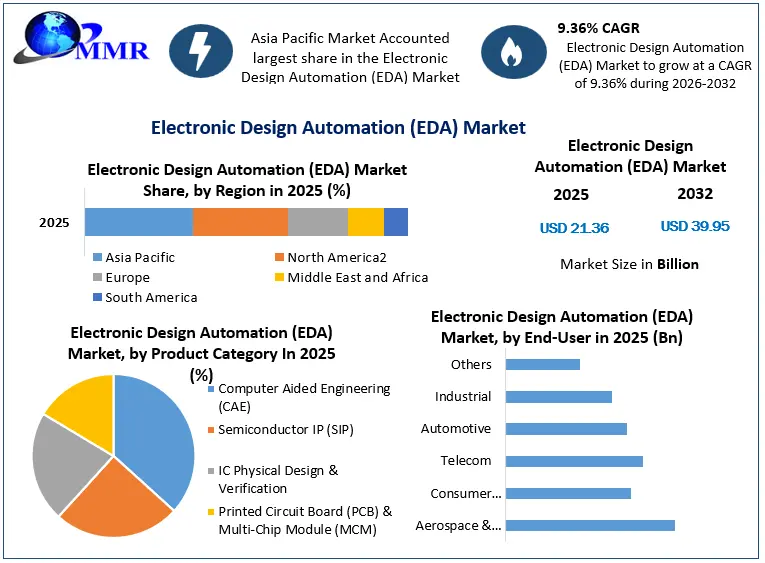
The global Electronic Design Automation (EDA) Market was valued at USD 21.36 billion in 2025 and is expected to reach approximately USD 39.95 billion by 2032, growing at a CAGR of 9.6% during the forecast period from 2026 to 2032.
The increasing complexity of semiconductor designs and rising demand for advanced electronic components are major factors driving market growth. Semiconductor companies require sophisticated software solutions to develop smaller, faster, and more energy-efficient integrated circuits. EDA tools support various design processes, including circuit simulation, physical verification, testing, and performance optimization.
Additionally, growing investments in semiconductor manufacturing facilities, increasing demand for AI-powered processors, and expanding connected device ecosystems are creating new opportunities for EDA software providers.
Key Market Segmentation
The Electronic Design Automation Market is segmented by product category, deployment mode, application, end user, and region.
By Product Category: The market includes Computer-Aided Engineering (CAE), Semiconductor Intellectual Property (SIP), IC Physical Design and Verification, and Printed Circuit Board (PCB) and Multi-Chip Module (MCM). Computer-Aided Engineering tools help engineers simulate and analyze electronic designs. Semiconductor IP provides reusable design components, while IC physical design and verification solutions support chip layout and performance testing. PCB and MCM tools are used to develop complex electronic circuit boards and multi-chip systems.
By Deployment Mode: The market is divided into on-premises and cloud-based solutions. On-premises deployment is preferred by organizations requiring greater control over sensitive design information and computing infrastructure. Cloud-based EDA solutions are gaining popularity because they offer scalability, remote collaboration, and flexible computing resources.
By Application: Major applications include microprocessors and microcontrollers, memory management units, and others. Increasing demand for advanced processors, semiconductor memory, and high-performance computing components is supporting application growth.
By End User: Major end-user industries include aerospace and defense, consumer electronics, telecommunications, automotive, industrial, and others. Consumer electronics and automotive applications are creating significant demand due to increasing electronic integration and advanced semiconductor requirements.
Growth Drivers
The increasing demand for advanced semiconductor components is one of the major factors driving the EDA Market. Modern electronic devices require smaller, faster, and more efficient chips to support advanced computing, connectivity, and processing capabilities. EDA software helps manufacturers manage complex circuit designs while improving accuracy and reducing development costs.
Another important growth driver is the rapid expansion of artificial intelligence and machine learning technologies. AI-powered applications require specialized processors, graphics processing units, and high-performance computing systems. These developments are increasing the need for advanced semiconductor design and verification tools.
Furthermore, the growing adoption of electric vehicles, autonomous driving technologies, 5G networks, and IoT devices is expanding the demand for semiconductor components. Government initiatives supporting domestic semiconductor manufacturing and increasing investments in research and development are also contributing to market expansion.
Emerging Trends
The integration of artificial intelligence and machine learning into EDA platforms is one of the significant emerging trends. AI-powered tools help engineers automate repetitive design activities, optimize chip layouts, identify design errors, and improve verification processes. These capabilities can reduce development time and improve overall productivity.
Cloud-based EDA platforms are also gaining popularity because they enable engineering teams to access advanced computing resources without maintaining extensive on-premises infrastructure. These platforms support collaboration between geographically distributed design teams.
Another important trend is the growing adoption of advanced packaging technologies, three-dimensional integrated circuits, and heterogeneous integration. These technologies allow manufacturers to combine multiple semiconductor components into compact and high-performance systems. Increasing demand for energy-efficient chip designs is further encouraging innovation in power optimization and thermal management tools.
Regional Analysis
North America dominates the global Electronic Design Automation Market due to the presence of leading semiconductor companies, established technology providers, and strong research and development infrastructure. The United States represents a major contributor, supported by significant investments in artificial intelligence, advanced computing, semiconductor innovation, and domestic chip manufacturing. Companies such as Synopsys, Cadence Design Systems, and Keysight Technologies strengthen the region's competitive position.
Asia Pacific is expected to register the fastest growth during the forecast period. Countries such as China, Taiwan, South Korea, Japan, and India are expanding their semiconductor manufacturing and electronic production capabilities. Government-backed semiconductor initiatives, increasing consumer electronics demand, and growing investments in chip design ecosystems are supporting regional market development.
Europe represents another important market, supported by automotive electronics, industrial automation, aerospace technologies, and semiconductor research activities. Germany, France, and the United Kingdom are important contributors.
Meanwhile, South America and the Middle East and Africa are gradually developing their semiconductor and electronics industries, creating future opportunities for EDA solution providers.
Competitive Landscape
The global Electronic Design Automation Market is highly competitive, with major companies focusing on technological innovation, strategic acquisitions, product development, and partnerships with semiconductor manufacturers.
Key players operating in the market include Synopsys Inc., Cadence Design Systems Inc., Siemens EDA, ANSYS Inc., Keysight Technologies, Altium Limited, Silvaco Inc., Agnisys Inc., Rambus Inc., Aldec Inc., Analog Devices Inc., AMD, Pulsic Limited, Zuken Inc., PDF Solutions Inc., Primarius Technologies, and Empyrean Technology.
These companies are investing in AI-powered design automation, cloud-based platforms, advanced verification solutions, and semiconductor intellectual property. Strategic collaborations with foundries and chip manufacturers are helping market participants improve product capabilities and strengthen their global presence.
Download Free PDF Brochure-https://www.maximizemarketresearch.com/request-sample/34444/
Recent Developments
The EDA industry has witnessed several important strategic developments and technological advancements.
In May 2025, Synopsys announced the completion of its acquisition of Ansys, strengthening its portfolio by combining semiconductor design software with engineering simulation capabilities.
In June 2025, Cadence Design Systems expanded its AI-driven design capabilities through advancements in its Cerebrus Intelligent Chip Explorer platform, supporting automated chip design optimization.
In October 2025, Siemens announced enhancements to its EDA software portfolio to support advanced semiconductor packaging and next-generation integrated circuit design requirements.
These developments highlight the increasing focus on AI integration, advanced simulation, and comprehensive semiconductor design solutions.
Future Outlook
The future of the Electronic Design Automation Market remains promising, supported by increasing semiconductor complexity, growing AI adoption, and continuous advancements in electronic technologies. The demand for advanced processors, high-performance computing systems, automotive electronics, and connected devices is expected to create substantial growth opportunities.
AI-powered automation, cloud-based design environments, advanced packaging, and three-dimensional chip architectures will play important roles in shaping the industry's future. However, high software licensing costs, complex design requirements, and the shortage of skilled semiconductor engineers may create challenges for market participants.
Companies investing in advanced design technologies, research and development, and strategic collaborations are expected to strengthen their competitive positions during the forecast period.
For full access to the comprehensive strategic report, visit:https://www.maximizemarketresearch.com/market-report/global-electronic-design-automation-eda-market/34444/
Conclusion
The global Electronic Design Automation (EDA) Market is playing an essential role in the development of next-generation semiconductor technologies and electronic systems. Valued at USD 21.36 billion in 2025, the market is projected to reach USD 39.95 billion by 2032, growing at a CAGR of 9.6%. Increasing demand for advanced chips, artificial intelligence, 5G connectivity, automotive electronics, and cloud-based design solutions will continue to support market expansion. Technological innovation and growing semiconductor investments are expected to create significant opportunities for EDA companies worldwide.
About Maximize Market Research
Maximize Market Research is a multifaceted market research and consulting company with professionals from several industries. Some of the industries we cover include medical devices, pharmaceutical manufacturers, science and engineering, electronic components, industrial equipment, technology and communication, cars and automobiles, chemical products and substances, general merchandise, beverages, personal care, and automated systems. To mention a few, we provide market-verified industry estimations, technical trend analysis, crucial market research, strategic advice, competition analysis, production and demand analysis, and client impact studies.
Contact Maximize Market Research
3rd Floor, Navale IT Park, Phase 2
Pune Bangalore Highway, Narhe,
Pune, Maharashtra 411041, India
sales@maximizemarketresearch.com
+91 96071 95908, +91 9607365656

 English
 Arabic
 French
 Spanish
 Portuguese
 Deutsch
 Turkish
 Dutch
 Italiano
 Russian
 Romaian
 Portuguese (Brazil)