


Methanol to Gasoline Market Growth Driven by Rising Oil Prices and Fuel Demand
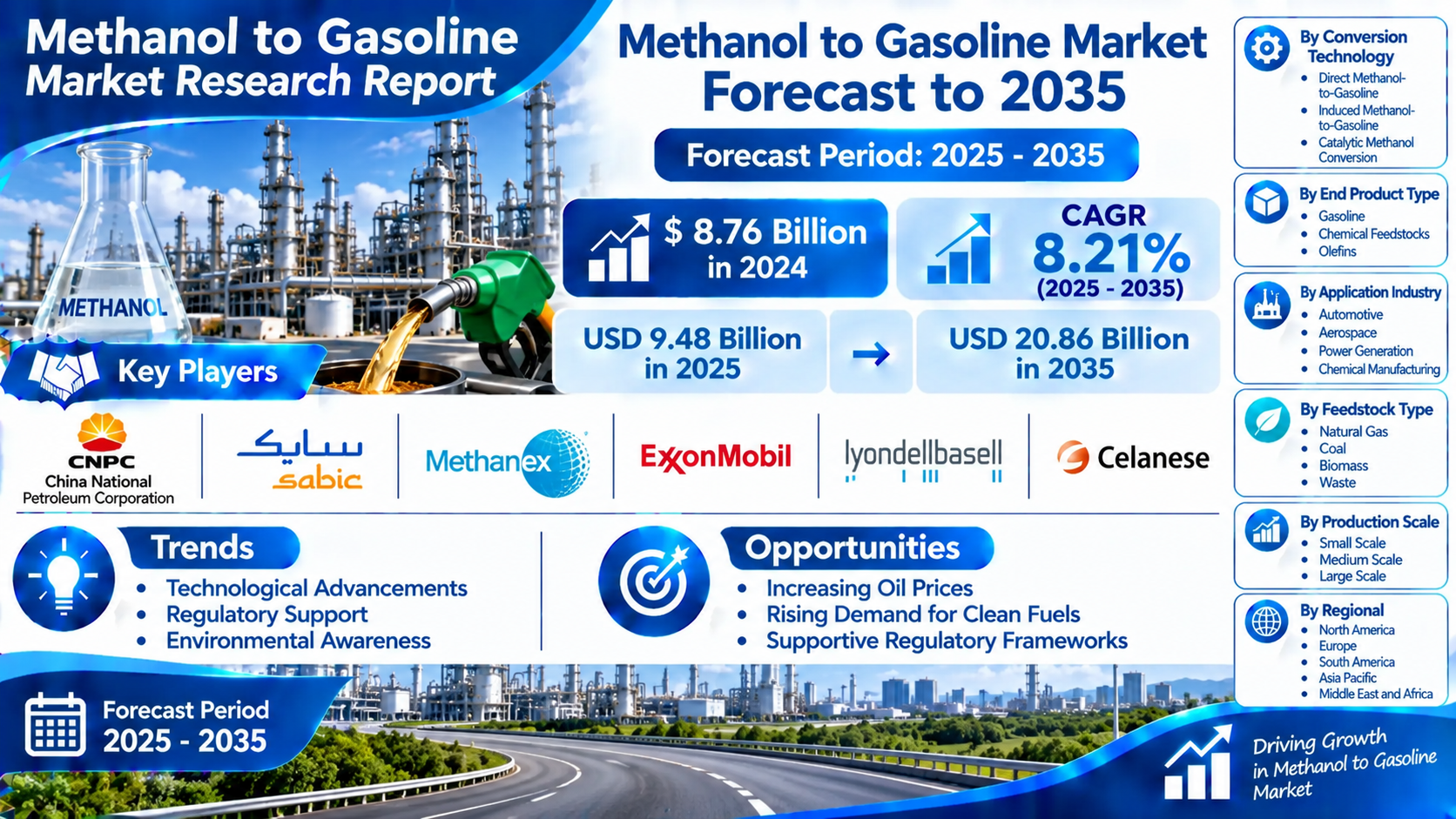
According to Market Research Future® (MRFR), the Methanol to Gasoline Market is expected to increase from USD 9.48 billion in 2025 to USD 20.86 billion by 2035, reflecting a CAGR of 8.21% over the 2025–2035 forecast period. The market recorded a valuation of USD 8.76 billion in 2024. This growth outlook places methanol-based gasoline production within the wider transition toward diversified fuel sources, where technology development, energy-market conditions, and regulatory support are important considerations. Rising demand for clean fuels and increasing oil prices are creating additional opportunities for the industry.
A Changing Landscape for Alternative Fuel Production
The methanol-to-gasoline pathway connects methanol processing with the production of gasoline and other hydrocarbon products. It provides an alternative production route that is relevant to fuel suppliers and chemical manufacturers. The market's projected expansion reflects interest in technologies that can broaden the range of available fuel-production options and support the use of multiple feedstock sources.
From its 2024 value of USD 8.76 billion, the market is projected to reach USD 9.48 billion in 2025. It is then expected to more than double in value by 2035, reaching USD 20.86 billion. The forecast CAGR of 8.21% indicates strong anticipated growth during the period. Commercial progress, however, will depend on the practical economics of conversion, the availability of suitable inputs, and the conditions affecting demand for gasoline and related products.
Technology Choices Shape Industry Direction
Three conversion technology categories define the market: Direct Methanol-to-Gasoline, Induced Methanol-to-Gasoline, and Catalytic Methanol Conversion. These approaches form the technological foundation of the industry. Their development and application are relevant to production efficiency, facility design, and the ability to meet different output requirements.
Technological Advancements are identified as a key market trend. Continued innovation can help improve conversion processes and strengthen the commercial position of methanol-based production. As companies assess new projects, technology selection is likely to remain closely connected to investment requirements, production capacity, and the characteristics of available feedstocks.
The market also distinguishes between Small Scale, Medium Scale, and Large Scale production. These categories reflect different operational capacities and potential project configurations. Smaller facilities may serve distinct production requirements, while medium- and large-scale facilities represent other capacity options for market participants. The suitability of each scale depends on project economics, supply arrangements, and intended markets.
Feedstock Diversity and Resource Availability
Feedstock selection is another defining feature of the methanol-to-gasoline industry. The report identifies Natural Gas, Coal, Biomass, and Waste as the principal feedstock categories. Their inclusion reflects the range of resources associated with methanol production and the broader interest in diversifying industrial inputs.
The availability and cost of these resources can influence project feasibility. Feedstock decisions may also be affected by regional supply conditions, infrastructure, and environmental requirements. Biomass and waste are relevant to discussions about resource utilization and alternative inputs, while natural gas and coal remain included in the market's defined feedstock segmentation.
The ability to access appropriate feedstocks will therefore be an important consideration for companies evaluating production opportunities. Regional differences in resource availability and regulation may influence where projects are developed and which production configurations are commercially attractive.
Product Mix Connects Fuel and Chemical Markets
The market's end product categories are Gasoline, Chemical Feedstocks, and Olefins. Gasoline connects the industry with transportation fuel demand, while chemical feedstocks and olefins provide links to downstream chemical manufacturing. This product mix gives methanol conversion relevance beyond a single end market.
The application industries identified in the report are Automotive, Aerospace, Power Generation, and Chemical Manufacturing. These sectors have different product requirements and demand patterns. Automotive is associated with gasoline consumption, while chemical manufacturing is relevant to the use of chemical outputs. Aerospace and power generation are also included in the market's application scope.
The diversity of these applications can broaden the potential customer base for producers. At the same time, demand across the segments will depend on industry-specific conditions and the role that methanol-derived products can play in each market.
Regulation and Environmental Awareness
Regulatory Support and Environmental Awareness are central trends identified for the market. Policy frameworks can influence the development of alternative fuel technologies by shaping investment conditions and the operating environment for producers. Environmental awareness also contributes to interest in fuel-production pathways that are considered alongside broader sustainability objectives.
Supportive Regulatory Frameworks are identified as a specific opportunity. Clear and supportive policies can help create a more favorable environment for project planning and technology adoption. The extent of this influence will vary across countries and regions, depending on energy policies, environmental requirements, and industrial priorities.
The clean-fuel opportunity is also important. Rising Demand for Clean Fuels may encourage interest in alternative production methods, while Increasing Oil Prices can improve the commercial attention given to other fuel pathways. Together, these factors create opportunities for companies involved in methanol conversion and related industrial activities.
Regional Coverage and Market Reach
The report evaluates the Methanol to Gasoline Market across five major regions: North America, Europe, South America, Asia Pacific, and the Middle East and Africa. This regional structure captures a broad range of energy and industrial markets.
Market conditions across these regions may differ according to fuel consumption, industrial development, feedstock access, infrastructure, and policy direction. The regional outlook will consequently depend on local conditions rather than a uniform pattern of adoption. The inclusion of established and emerging markets provides a framework for assessing how methanol-to-gasoline technologies may develop internationally.
Companies and Competitive Positioning
The competitive landscape includes China National Petroleum Corporation, SABIC, Methanex Corporation, ExxonMobil, LyondellBasell Industries, and Celanese Corporation. These companies are identified as key players in the market.
Competition in this sector is connected to technology capabilities, access to feedstocks, production scale, and participation in fuel and chemical value chains. Companies assessing the market will need to consider how their capabilities align with the different conversion technologies and end-product categories. Regulatory conditions and the pace of clean-fuel demand will also influence the commercial environment.
Outlook for the Methanol to Gasoline Market
The market's projected rise to USD 20.86 billion by 2035 reflects an expanding opportunity for methanol-based fuel production. An 8.21% CAGR over 2025–2035 is supported by the report's identified trends of technological advancements, regulatory support, and environmental awareness. Increasing oil prices, rising demand for clean fuels, and supportive regulatory frameworks provide additional growth opportunities. The industry's longer-term development will depend on how effectively producers address technology, feedstock, scale, and regional market requirements.

 English
 Arabic
 French
 Spanish
 Portuguese
 Deutsch
 Turkish
 Dutch
 Russian
 Romaian
 Portuguese (Brazil)
 Greek