


Global AMHE Market Expansion Supported by Robotics and Smart Warehousing
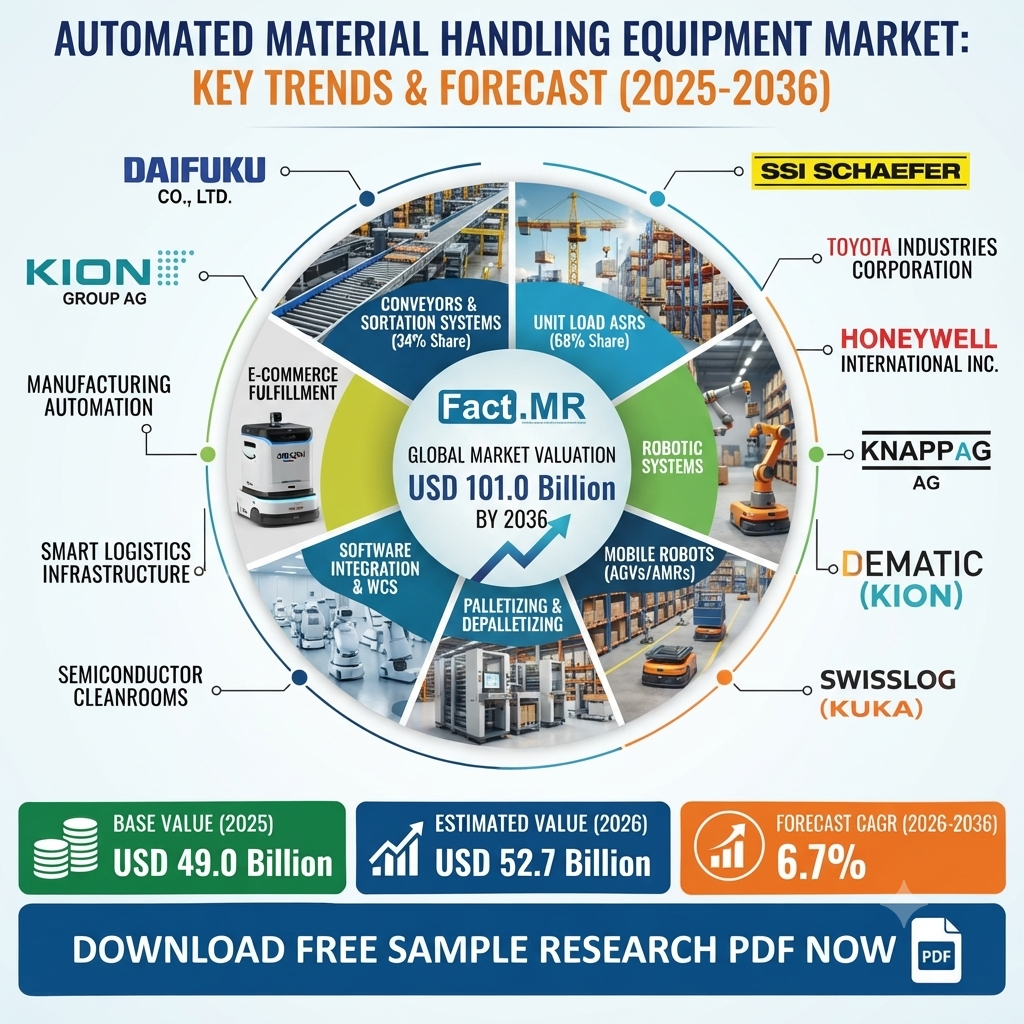
Rockville, MD, November 25, 2026 — The global automated material handling equipment market is projected to reach USD 101.0 billion by 2036, up from USD 49.0 billion in 2025, according to Fact.MR. The market is estimated at USD 52.7 billion in 2026 and is forecast to expand at a compound annual growth rate (CAGR) of 6.7% from 2026 to 2036. The projected increase represents an absolute dollar opportunity of USD 48.3 billion over the forecast period, supported by e-commerce fulfilment expansion, manufacturing automation and investments in smart logistics infrastructure.
The demand outlook reflects a change in warehouse procurement priorities. E-commerce operators, third-party logistics (3PL) providers and manufacturers are increasingly adopting integrated systems that combine automated storage and retrieval systems (ASRS), conveyors, sortation equipment and robotics. China is expected to lead country-level growth at 9.5% CAGR through 2036, while India follows at 8.6%, according to Fact.MR.
Request for PDF Report Sample Pages: https://www.factmr.com/connectus/sample?flag=S&rep_id=10471
Automated Material Handling Equipment Market: Key Demand Drivers
Automated material handling equipment market growth is closely connected to the expansion of fulfilment infrastructure and the need to improve material movement across industrial facilities. The equipment covered includes powered robotic systems, conveyors, cranes, ASRS platforms and automated sortation solutions used in warehouses, distribution centres and manufacturing plants.
Fact.MR is a market research and consulting firm that provides industry forecasts, competitive assessments and strategic market intelligence. Its automated material handling equipment analysis evaluates demand across product categories, system types, functions, end uses and geographical markets.
E-commerce fulfilment remains a major source of procurement activity. Amazon, JD.com and Cainiao accelerated automated warehouse development in 2024 to support same-day delivery commitments. Amazon also expanded its Proteus and Sparrow robotic systems across 20 additional North American fulfilment centres during the year, targeting automated tote and package handling.
China's smart logistics programme provides another measurable demand stimulus. The Ministry of Commerce of the People's Republic of China designated 150 national logistics parks for smart automation upgrades under its 14th Five-Year Plan strategy through 2025. The programme allocated CNY 300 billion through 2025, supporting procurement of automated conveyors, sortation equipment and robotic systems.
South Korea is also developing as an important market. Samsung Electronics and SK Hynix expanded clean-room-compatible automated transport and storage requirements in semiconductor manufacturing facilities during 2024. Precision handling requirements in semiconductor fabrication are creating opportunities for specialised equipment suppliers.
Conveyors and Sortation Systems Account for 34% Share
Conveyors and sortation systems are estimated to account for approximately 34% of the automated material handling equipment market in 2026. Their adoption across e-commerce fulfilment, food processing and automotive parts logistics supports their leading position.
Unit load material handling systems represent approximately 68% share in 2026. These systems serve palletised and discrete-item movement requirements across warehouses, retail distribution networks and manufacturing facilities.
Transportation leads by function, accounting for approximately 30% share in 2026. The segment benefits from frequent material movement requirements within automated warehouses and industrial production facilities. Meanwhile, e-commerce represents approximately 26% of market demand by end use, reflecting continued investment in fulfilment capacity.
An important operational detail illustrates the scale of automation. BEUMER Group deployed its Crisplant high-speed overhead sortation system at a major European postal logistics hub in Q2 2025, with processing capacity of 25,000 parcels per hour.
China and India Lead Country-Level Growth
Asia Pacific is expected to remain the fastest-growing regional market through 2036. Government-backed logistics infrastructure, expanding online retail operations and manufacturing automation are supporting investment across the region.
China is forecast to register a 9.5% CAGR through 2036. India follows with 8.6%, supported by e-commerce warehouse expansion and logistics park development. South Korea is projected to grow at 6.7%, reflecting semiconductor and electronics manufacturing requirements. Japan is expected to record 6.2% growth as businesses respond to labour shortages and workforce replacement needs.
In North America, the United States is forecast to expand at 6.8% CAGR through 2036. E-commerce fulfilment investment, 3PL expansion and labour cost pressures are supporting demand. Germany is projected to register 6.5% growth, with Industry 4.0 adoption and electric vehicle production line upgrades supporting industrial automation procurement.
Software Integration Reshapes Competitive Strategies
The market is gradually moving beyond standalone equipment procurement. Large e-commerce companies and 3PL operators increasingly prefer integrated contracts covering physical automation systems, warehouse management software and ongoing maintenance.
Daifuku Co., Ltd. and KION Group AG are incorporating software-defined warehouse management capabilities into hardware supply agreements. This approach helps suppliers secure longer-term customer relationships while addressing operational requirements beyond initial equipment installation.
Capital expenditure remains a restraint. High installation costs for ASRS and robotics systems can delay purchasing decisions, particularly among smaller operators. Skilled technician shortages in emerging markets also create challenges for system commissioning and maintenance.
Shambhu Nath Jha, Principal Consultant at Fact.MR, observes that purchasing priorities are changing.
"CXOs will see a clear shift in where value is being created. E-commerce-driven conveyor and ASRS contracts are emerging as high-margin segments," Jha said.
He added that semiconductor clean-room automation presents another premium opportunity, particularly because of the precision and reliability requirements associated with chip manufacturing.
Analyst Perspective and Market Outlook
Fact.MR's forecast incorporates e-commerce warehouse development pipelines, semiconductor fabrication expansion programmes, robotics cost trends and expert inputs from automated material handling equipment system integrators.
The research also draws on manufacturer disclosures from Daifuku Co., Ltd., KION Group AG, SSI Schaefer, Toyota Industries Corporation and Honeywell International Inc. The methodology combines manufacturer revenue estimates with warehouse automation investment data, robotics installation statistics and average system selling prices.
For equipment manufacturers, opportunities are concentrated in software-integrated ASRS platforms, robotics and specialised transportation systems. Suppliers expanding integration partnerships in China and India may benefit from the forecast infrastructure investment cycle, while clean-room-compatible solutions offer access to semiconductor manufacturing procurement.
View Related Reports :
Frozen Bakery Products Market : https://www.factmr.com/report/260/frozen-bakery-products-market
Organic Bakery Market : https://www.factmr.com/report/284/organic-bakery-market
Gluten-free Bakery Products Market : https://www.factmr.com/report/3035/gluten-free-bakery-products-market
Bakery Topping Market : https://www.factmr.com/report/bakery-topping-market
About Fact.MR
Fact.MR is a market research and consulting firm providing actionable intelligence, industry analysis and market forecasts across a wide range of sectors. The company combines primary research, proprietary forecasting models and secondary data analysis to help businesses understand market developments, evaluate competitive environments and identify growth opportunities.
\

 Arabic
 French
 Spanish
 Portuguese
 Deutsch
 Turkish
 Dutch
 Italiano
 Russian
 Romaian
 Portuguese (Brazil)
 Greek