


Why Is a Plastic Pulley Useful in Modern Equipment Design?
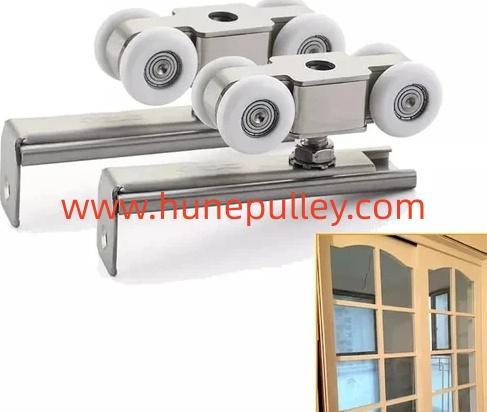
Mechanical components often need to balance functional performance, structural compatibility, and convenient installation. In this context, the Plastic Pulley has become a useful option for equipment manufacturers seeking lightweight components with adaptable design possibilities. With attention to product construction, material selection, and application requirements, Hunepulley provides pulley solutions for different hardware systems and mechanical environments.
Plastic pulley components are valued for their relatively lightweight construction and flexibility in product design. Compared with certain metal alternatives, plastic materials can help reduce the overall weight of an assembly while offering useful resistance to corrosion and moisture in suitable environments. These characteristics make them relevant to equipment where component weight, surface contact, and operating noise are important considerations.
Material selection plays an essential role in determining how a pulley performs. Different engineering plastics offer different combinations of rigidity, wear resistance, friction characteristics, and environmental adaptability. Nylon, POM, and other industrial plastics may be considered according to the intended working conditions. Each material has its own properties, so manufacturers should evaluate the expected load, contact surface, temperature conditions, and movement requirements before choosing a suitable option.
Structural design is another important factor. The wheel diameter, groove profile, central opening, and mounting arrangement all influence compatibility with the surrounding mechanism. A grooved pulley may help guide a cable or track, while a flat-profile design can serve applications involving different contact arrangements. Appropriate dimensions and carefully considered geometry help maintain stable positioning during operation.
Another practical advantage of plastic pulley components is their potential to support quieter mechanical movement. When properly matched with the corresponding track or contact surface, suitable plastic materials can help reduce unwanted friction and operating noise. This can be particularly useful in furniture hardware, sliding mechanisms, household equipment, and machinery used in indoor environments.
The range of possible applications extends across different industries. Furniture manufacturers may incorporate pulley wheels into sliding cabinet systems and movable storage structures. Industrial equipment designers may use them in guiding mechanisms, conveying arrangements, and compact transmission assemblies. In household products, pulley components can contribute to convenient movement and functional space utilization. Although these applications have different requirements, each depends on suitable component selection and mechanical compatibility.
For manufacturers and distributors, product consistency is also worth considering. A pulley needs appropriate dimensional accuracy, a well-formed wheel surface, and a compatible central structure. Consistent manufacturing processes help ensure that components fit their intended assemblies and perform according to their design requirements. Attention to material preparation, molding quality, and inspection can support a more organized production and sourcing process.
Customization offers further possibilities for projects with specific requirements. Depending on the intended application, manufacturers may need different wheel profiles, colors, materials, internal structures, or mounting dimensions. Communicating these details during product development helps clarify the technical requirements and makes it easier to identify a suitable configuration. This flexibility can be valuable when developing new equipment or updating existing mechanical systems.
Maintenance should also be included in the overall product planning process. Although plastic components can offer practical benefits, their service conditions still depend on material characteristics, loading, installation accuracy, and environmental exposure. Regular inspection can help identify surface wear, deformation, or alignment issues. Matching the pulley to its intended working conditions is therefore an important part of maintaining reliable mechanical movement.
As product designs continue to emphasize compact structures, functional simplicity, and adaptable hardware, plastic pulley components remain a practical consideration for many applications. Their usefulness comes from the relationship between material properties, wheel geometry, and the surrounding mechanical system.
A small wheel can influence how an entire mechanism moves. Give your next hardware project a fresh starting point by visiting https://www.hunepulley.com/product/ . Browse the product possibilities, examine the available designs, and uncover a component idea that could bring your next mechanical concept into motion.

 English
 French
 Spanish
 Portuguese
 Deutsch
 Turkish
 Dutch
 Italiano
 Russian
 Romaian
 Portuguese (Brazil)
 Greek