


Drip Irrigation Market: Innovations Shaping Sustainable Farming Practices
Overview of the Drip Irrigation Market
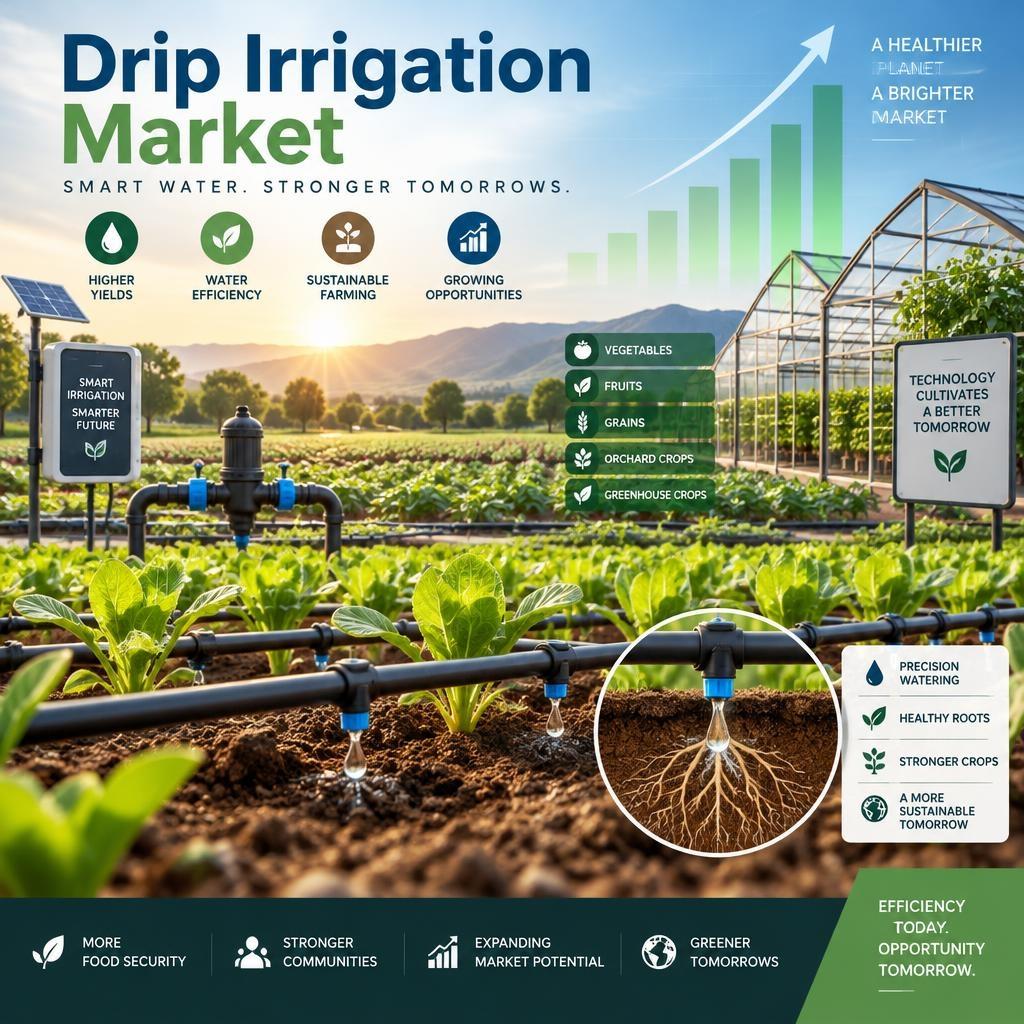
The Drip Irrigation Market is an important part of the agricultural technology industry, supporting the transition toward more efficient and sustainable farming practices. Agriculture requires appropriate water management to maintain crop development and support reliable food production. Traditional irrigation approaches may not always provide the level of control required for different crops and soil conditions. Drip irrigation addresses this requirement by delivering water directly to plant root zones through a controlled network of pipes and emitters. This approach allows agricultural producers to manage irrigation according to the specific needs of cultivated plants.
The increasing interest in drip irrigation systems and sustainable agricultural water management highlights the importance of innovative irrigation technologies in modern farming. These solutions combine specialized irrigation components with filtration, automation, and monitoring technologies. Farmers are exploring different system configurations for field crops, orchards, vegetables, greenhouses, and commercial horticultural operations. Manufacturers are also focusing on improved equipment designs that support installation flexibility, water distribution, and long-term system management.
Smart Irrigation Systems and Automation
Smart irrigation technology is changing the way farmers manage agricultural water resources. Conventional irrigation scheduling often depends on manual observations and predetermined watering routines.
Automated systems offer greater control by allowing irrigation activities to be managed through electronic controllers and monitoring equipment.
Soil moisture sensors can provide information about the moisture conditions around plant roots. This information helps growers understand whether irrigation is required.
Weather monitoring technologies can also support irrigation planning by considering environmental conditions.
Automated valves and controllers allow irrigation schedules to be adjusted according to the requirements of different agricultural areas.
These developments are creating opportunities for technology providers offering integrated irrigation management solutions.
Advancements in Drip Irrigation Components
Drip irrigation systems depend on several components that work together to distribute water.
Drip pipes and tapes form the distribution network through which water moves across agricultural fields.
Emitters regulate water discharge and help deliver it near plant roots. Their design is important because consistent water distribution supports effective irrigation management.
Filtration equipment helps remove unwanted particles that could block emitters and affect system performance.
Valves and connectors support system operation and allow different irrigation sections to be managed.
Manufacturers are focusing on improving component durability, installation convenience, and compatibility with different agricultural environments.
Growing Role of Fertigation
Fertigation is an agricultural practice that combines irrigation with the application of suitable plant nutrients.
Drip irrigation systems can support fertigation by delivering appropriately prepared nutrient solutions through the irrigation network.
This approach allows nutrients to be supplied near plant root zones according to crop requirements and suitable agricultural recommendations.
Fertigation requires careful management of nutrient compatibility, water quality, application procedures, and system maintenance.
When properly planned, it can support coordinated water and nutrient management.
The growing interest in precision agriculture is encouraging farmers to explore integrated irrigation and nutrient delivery systems.
Applications in Greenhouse Agriculture
Greenhouse cultivation is an important application area for drip irrigation technologies.
Controlled growing environments require suitable management of water, nutrients, temperature, and other growing conditions.
Drip irrigation allows water to be delivered directly to individual plants or designated growing areas.
This can be particularly useful in greenhouse vegetable production, nursery operations, and specialized horticultural applications.
Automated controllers and monitoring equipment can further support irrigation management.
Manufacturers are developing solutions that can be adapted to different greenhouse layouts and crop requirements.
Sustainability and Resource Management
Sustainable agriculture requires careful management of natural resources. Water availability, soil conditions, and crop requirements influence irrigation decisions.
Drip irrigation can support responsible water distribution by applying water near plant roots and reducing unnecessary watering in areas where it is not required.
However, achieving effective performance depends on proper system design, installation, and maintenance.
Farmers must consider water quality because suspended particles and other impurities can contribute to emitter clogging.
Regular filtration maintenance and inspection are important for maintaining irrigation efficiency.
Combining drip irrigation with soil conservation, appropriate crop management, and responsible fertilizer practices can support broader agricultural sustainability goals.
Challenges Affecting Market Development
The adoption of drip irrigation can involve challenges associated with equipment expenses, installation requirements, maintenance, and farmer awareness.
Small agricultural producers may require technical guidance to select appropriate systems.
Water quality management is another important concern because inadequate filtration can affect system performance.
In some agricultural areas, limited access to installation services and replacement components may also create difficulties.
Manufacturers and distributors can address these challenges by offering technical support, farmer education, and equipment designed for different agricultural requirements.
Future Opportunities in the Drip Irrigation Market
The future of the Drip Irrigation Market will be influenced by agricultural automation, water conservation priorities, precision farming, and improvements in irrigation equipment.
Manufacturers can explore opportunities through smart controllers, advanced emitters, filtration systems, durable piping, and integrated fertigation technologies.
Partnerships with agricultural organizations and irrigation service providers can also support wider technology adoption.
As sustainable farming becomes increasingly important, innovative drip irrigation systems will continue to contribute to modern agricultural water management.
Frequently Asked Questions
Q1. What technologies are shaping the Drip Irrigation Market?
Important technologies include automated irrigation controllers, soil moisture sensors, smart monitoring systems, advanced emitters, improved filtration equipment, and fertigation solutions.
Q2. How does drip irrigation support sustainable farming?
Drip irrigation supports targeted water delivery, improved irrigation planning, and more controlled nutrient application, helping farmers manage agricultural resources responsibly.

 English
 Arabic
 French
 Spanish
 Portuguese
 Deutsch
 Turkish
 Dutch
 Italiano
 Russian
 Romaian
 Greek