


Label Printers Market Trends Reflect Growing Adoption Of High-Resolution Printing And RFID Technology
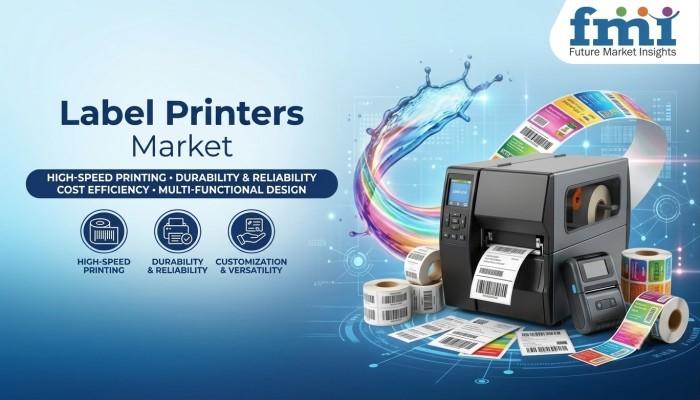
The global label printers market is projected to grow from USD 5.1 billion in 2026 to USD 8.7 billion by 2036, registering a compound annual growth rate (CAGR) of 5.4% over the forecast period. The market was valued at USD 4.9 billion in 2025, according to the latest market analysis by Future Market Insights, Inc. (FMI).
Demand is being shaped by warehouse automation, e-commerce parcel processing, pharmaceutical serialization and the transition toward higher-resolution product identification. Businesses are replacing older standalone printers with network-connected industrial systems that can produce durable barcodes, support RFID encoding and integrate with automated production and distribution equipment.
Get detailed market forecasts, competitive benchmarking, and pricing trends:
https://www.futuremarketinsights.com/reports/sample/rep-gb-10777
KEY MARKET TAKEAWAYS
- Market Valuation: USD 5.1 billion in 2026, projected to reach USD 8.7 billion by 2036.
- Growth Rate: The market is forecast to expand at a 5.4% CAGR between 2026 and 2036.
- Leading Printing Technology: Thermal Transfer Printing High Durability Ribbons are expected to account for 48.5% of printing technology demand in 2026.
- Leading Device Mechanism: Industrial Heavy-Duty Tabletop Label Printers are projected to hold a 54.0% share in 2026.
- Leading End-use Industry: Transportation Logistics Warehousing and 3PL are estimated to represent 38.0% of demand.
- Fastest-Growing Country: The United States leads national growth projections with a 6.1% CAGR through 2036.
- Core Growth Driver: Warehouse automation, item-level traceability and the adoption of GS1 2D barcodes are encouraging industrial printer upgrades.
INDUSTRY SHIFTS & MARKET DYNAMICS
Label printers are becoming essential components of automated warehouse and manufacturing operations. Distribution centers process large volumes of parcels and pallets, each requiring accurate routing information, tracking codes and product identifiers. As conveyor systems and automated sorting equipment become more widely deployed, operators need printers capable of generating scannable labels at high speeds. FMI's procurement analysis indicates that warehouse operators and plant managers are moving from standalone 203-DPI units toward networked 300-DPI thermal transfer and UHF RFID printers to reduce sorting delays.
Thermal transfer technology remains central to applications where labels must withstand moisture, chemicals, friction and temperature changes. Resin and wax-resin ribbons transfer pigment onto synthetic label materials, helping preserve barcode readability during storage and transportation. The technology is particularly relevant to automotive components, cold-chain logistics and industrial identification. In 2026, this category is estimated to hold 48.5% of printing technology demand.
However, higher equipment and maintenance costs remain obstacles for smaller buyers. Thermal printhead abrasion, adhesive accumulation on linerless printer cutters and the cost of replacing damaged components can extend hardware replacement cycles. Businesses also need to balance printer investment against recurring expenditure on labels, ribbons and maintenance. Vendors that improve printhead durability, simplify ribbon changes and provide fleet diagnostics may gain an advantage when large enterprises renew multi-site equipment contracts.
The adoption of RFID-enabled printers and high-resolution output is creating another upgrade opportunity. Compact 2D DataMatrix codes, serialized pharmaceutical labels and electronic product identifiers require precise printing and reliable verification. Wired Industrial Ethernet and Fieldbus connectivity is expected to account for 52.0% of connectivity architecture demand in 2026, reflecting the need for dependable communication with programmable logic controllers on automated production lines.
REGIONAL MARKET SUMMARY
FMI's country-level forecasts indicate varied growth across major manufacturing and logistics markets between 2026 and 2036:
- United States: 6.1% CAGR, supported by pharmaceutical serialization requirements and warehouse automation.
- Brazil: 6.0% CAGR, driven by freight distribution and fiscal barcode requirements.
- Poland: 5.9% CAGR, supported by near-shoring activity and new fulfillment facilities.
- Canada: 5.8% CAGR, reflecting manufacturing activity and bilingual packaging requirements.
- Germany: 5.6% CAGR, supported by factory networking and industrial automation.
- France: 5.3% CAGR, with packaging compliance and label-material requirements influencing upgrades.
- Japan: 4.9% CAGR, driven by factory automation and high-resolution electronics labeling.
- Italy: 4.7% CAGR, supported by pharmaceutical exports and packaging machinery integration.
The United States is projected to record the fastest growth among the countries assessed. Its market is benefiting from demand for package-level pharmaceutical identification and RFID-enabled logistics operations. Brazil and Poland also offer strong growth prospects as distribution networks and automated fulfillment facilities expand.
ANALYST INSIGHTS
“Distribution centers and contract manufacturers no longer purchase label printers as standalone desktop peripherals; they specify networked print engines on five-year printhead durability and zero-downtime ribbon changeovers. Hardware vendors that combine 300-DPI thermal transfer reliability with onboard UHF RFID encoding and cloud fleet diagnostics will capture multi-site enterprise refresh contracts through 2036,” stated Nandini Roy Choudhury, Principal Consultant at Future Market Insights.
ABOUT THE REPORT
The FMI report, Label Printers Market, examines industry revenue and demand across printing technology, device mechanism, end-use industry, print resolution and connectivity architecture. It provides market forecasts for 2026 to 2036, alongside country-level growth assessments and competitive analysis. The study covers North America, Latin America, Western Europe, Eastern Europe, East Asia, South Asia and Pacific, and the Middle East and Africa. Its research approach combines primary interviews, secondary research, market sizing and forecast triangulation.
Related Report Links:
https://www.openpr.com/news/4696623/top-players-in-the-holy-books-and-scriptures-packaging-market
https://www.openpr.com/news/4696624/top-players-in-the-multi-pack-packaging-for-toddler-toys-market
https://www.openpr.com/news/4696626/top-players-in-the-material-passport-systems-for-circular
FMI Custom Research: Strategic Intelligence for Confident Decision-Making
In today’s rapidly evolving business environment, leadership teams need more than market data—they need clear, actionable intelligence tailored to their strategic objectives. FMI’s Custom Research solutions are designed around the specific business questions organizations need answered, enabling executives to evaluate growth opportunities, validate investments, assess competitive dynamics, and reduce uncertainty before making critical decisions. By combining deep industry expertise, primary research, and proprietary market intelligence, FMI delivers insights that help organizations move from assumptions to evidence-based strategies with greater speed and confidence.
Business Impact
FMI helps organizations transform market complexity into strategic clarity, enabling leadership teams to identify growth opportunities faster, optimize resource allocation, strengthen competitive positioning, and make high-stakes business decisions with confidence.
To explore how FMI Custom Research can support your strategic priorities, please connect with our team at – sales@futuremarketinsights.com
About Future Market Insights (FMI)
Future Market Insights, Inc. (FMI) is an ESOMAR-certified, ISO 9001:2015 market research and consulting organization, trusted by Fortune 500 clients and global enterprises. With operations in the U.S., UK, India, and Dubai, FMI provides data-backed insights and strategic intelligence across 30+ industries and 1200 markets worldwide.

 English
 Arabic
 French
 Spanish
 Portuguese
 Turkish
 Dutch
 Italiano
 Russian
 Romaian
 Portuguese (Brazil)
 Greek