


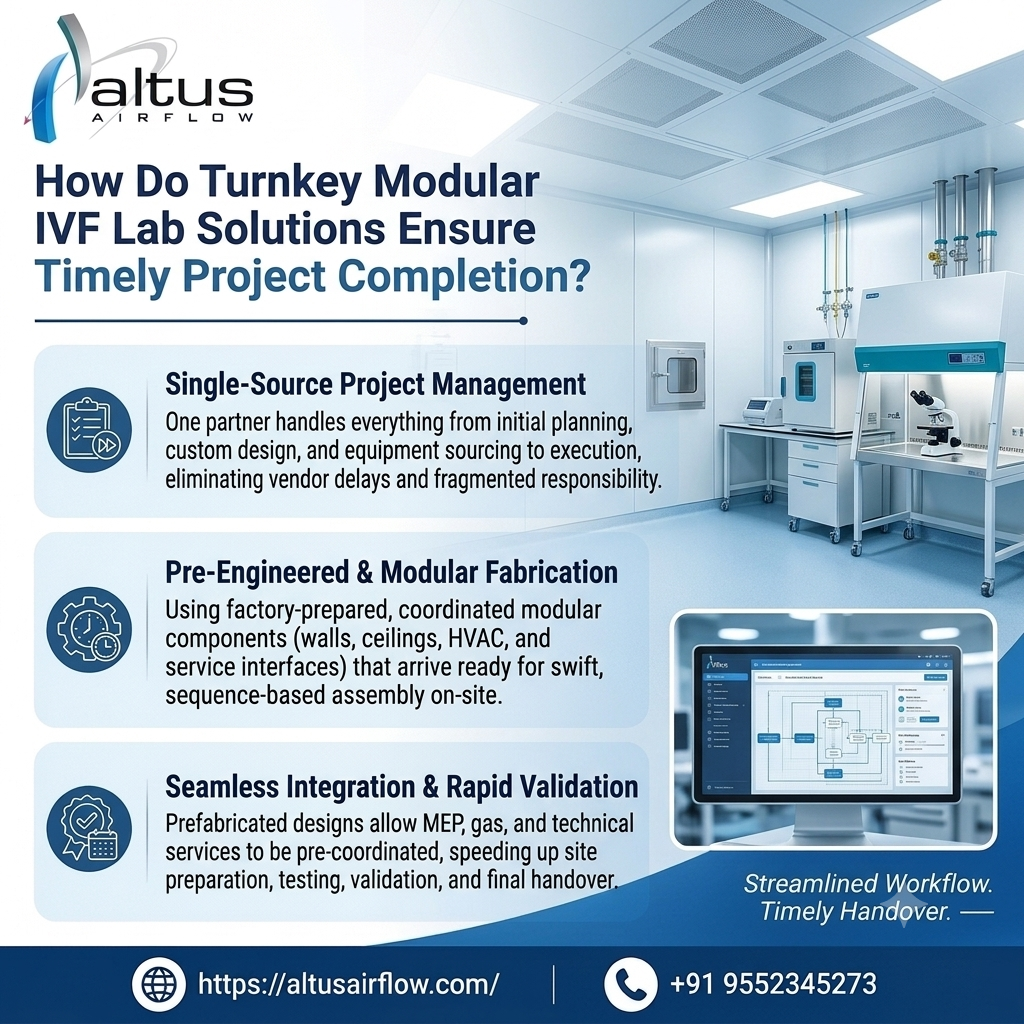
How Do Turnkey Modular IVF Lab Solutions Ensure Timely Project Completion?
Introduction
Altus Airflow understands that completing an IVF laboratory project within the planned timeline requires proper coordination, technical expertise, and systematic project management. Turnkey Modular IVF Lab Solutions simplify the development process by bringing design, engineering, modular construction, ventilation, electrical systems, and equipment integration under a coordinated project approach. This helps fertility centres manage multiple installation activities efficiently while maintaining the technical requirements of a specialised laboratory.
Timely completion also depends on effective communication between architects, consultants, engineers, equipment suppliers, and installation teams. A well-organised execution strategy helps minimise delays, avoid installation conflicts, and prepare the laboratory for testing and commissioning.
1. Centralised Project Management and Coordination
One of the primary reasons turnkey projects support timely completion is centralised project management. Instead of coordinating multiple independent contractors, hospitals and fertility centres can work through an organised project execution structure.
A dedicated project management team oversees different activities and ensures that each stage progresses according to the approved schedule.
Important responsibilities include:
-
Preparing project execution plans.
-
Assigning responsibilities to technical teams.
-
Coordinating architects and engineering consultants.
-
Monitoring material procurement.
-
Supervising installation activities.
-
Tracking project milestones.
-
Managing communication between stakeholders.
Centralised coordination reduces confusion regarding responsibilities and helps project teams identify potential delays early.
Regular progress meetings and documented updates also help ensure that all stakeholders understand the project requirements and upcoming activities.
2. Detailed Planning Before Project Execution
Proper planning is essential for completing an IVF laboratory project within the intended timeframe. Before beginning installation, the project team should understand the facility's operational requirements, available space, technical specifications, and equipment needs.
The planning stage generally includes:
Site assessment: Engineers inspect the available location to understand its dimensions, existing infrastructure, structural conditions, and installation requirements.
Requirement analysis: The fertility centre's laboratory activities are reviewed to determine the necessary workspaces, equipment arrangements, and environmental conditions.
Layout preparation: Architects and technical consultants develop laboratory layouts that support efficient movement and functional separation of different activities.
Technical drawings: Electrical, HVAC, plumbing, and modular construction drawings are prepared for coordination.
Project scheduling: Activities are organised into stages with defined responsibilities and completion milestones.
Detailed planning helps identify potential technical challenges before installation begins. This reduces the possibility of repeated modifications during construction and supports smoother project execution.
3. Faster Installation Through Modular Construction
Traditional laboratory construction may involve several sequential activities, including civil work, surface preparation, electrical installation, and interior finishing.
Modular construction can simplify this process by using prefabricated components that are manufactured according to approved specifications.
These components may include:
-
Modular wall panels.
-
Ceiling systems.
-
Laboratory partitions.
-
Doors and viewing panels.
-
Specialised flooring arrangements.
-
Service access panels.
-
Integrated utility provisions.
Since several components can be prepared before they reach the project location, installation activities can be better coordinated with other site work.
For example, modular wall panels can be manufactured while electrical and HVAC planning is being completed. This allows certain activities to progress simultaneously instead of waiting for every preceding construction task to finish.
However, proper dimensional verification and design approval are necessary before manufacturing begins. Accurate planning helps prevent fitting issues and unnecessary installation changes.
4. Efficient HVAC and Airflow System Integration
Environmental control is one of the most important aspects of IVF laboratory infrastructure. HVAC systems must be planned carefully to support the laboratory's temperature, humidity, air quality, and pressure requirements.
Delays in ventilation installation can affect several other project activities. Therefore, HVAC coordination should begin during the initial engineering stage.
Important activities include:
HVAC load calculations: Engineers determine the environmental control requirements according to laboratory size, equipment heat loads, occupancy, and operational conditions.
Airflow planning: Supply and return air arrangements are designed to support the intended environmental conditions.
Filtration selection: Suitable filtration arrangements are identified according to laboratory specifications.
Pressure management: Required pressure relationships between laboratory areas and adjoining spaces are incorporated into the design.
Ducting coordination: Duct routes are planned to avoid conflicts with electrical services, ceilings, and other infrastructure.
When HVAC drawings are approved early, installation teams can prepare the required provisions alongside modular construction activities.
This coordination helps reduce delays during the final installation and testing stages.
5. Proper Procurement and Material Management
Material availability directly influences project completion timelines. Delayed delivery of modular panels, HVAC equipment, electrical components, or specialised laboratory fittings can interrupt installation activities.
A structured procurement strategy helps prevent these problems.
Project teams should prepare a detailed material schedule that identifies:
-
Required materials and equipment.
-
Technical specifications.
-
Supplier responsibilities.
-
Expected delivery dates.
-
Inspection requirements.
-
Storage arrangements.
-
Installation priorities.
Long-lead equipment should be identified during the planning stage so that procurement can begin early.
Material inspections should also be completed before installation. Checking product specifications, dimensions, and documentation helps prevent unsuitable materials from reaching the construction site.
Maintaining proper inventory records allows project managers to monitor available materials and coordinate installation activities more efficiently.
6. Coordination Between Architects, Engineers, and Consultants
IVF laboratory development requires collaboration between professionals from different technical backgrounds. Architects, structural engineers, HVAC consultants, electrical engineers, and laboratory equipment suppliers must work according to a coordinated design.
Poor communication between these teams can lead to installation conflicts and repeated modifications.
For example, an electrical panel location may conflict with a laboratory workstation, or an HVAC duct route may interfere with the modular ceiling arrangement.
To prevent such problems, project teams should:
-
Conduct multidisciplinary design meetings.
-
Share updated technical drawings.
-
Verify equipment dimensions.
-
Coordinate utility connection points.
-
Review ceiling and wall service provisions.
-
Obtain approvals before installation.
-
Maintain records of design changes.
This approach helps ensure that all technical systems are compatible before work begins at the project site.
7. Integration of IVF Laboratory Equipment
Equipment installation is another important stage that can influence project completion.
IVF laboratories require specialised equipment for activities such as fertilisation procedures, embryo culture, sample preparation, and microscopic examination.
The laboratory layout should accommodate the equipment according to operational requirements and manufacturer specifications.
Equipment integration may involve:
-
Workstation positioning.
-
Electrical connection planning.
-
Equipment ventilation requirements.
-
Utility connection arrangements.
-
Temperature-sensitive equipment provisions.
-
Access for servicing and maintenance.
-
Coordination with laboratory furniture.
Equipment specifications should be collected during the design stage rather than after modular construction is completed.
This allows technical teams to prepare appropriate electrical points, service connections, and installation spaces in advance.
A coordinated equipment installation plan also reduces the possibility of repositioning laboratory equipment after commissioning activities have started.
8. Monitoring Project Progress Through Defined Milestones
A structured project schedule helps management teams track progress and identify delays before they affect the overall completion date.
Projects can be divided into clearly defined milestones.
Typical milestones include:
-
Initial consultation and site assessment.
-
Laboratory layout and design approval.
-
Engineering drawing finalisation.
-
Material procurement and manufacturing.
-
Site preparation and infrastructure work.
-
Modular panel installation.
-
HVAC and electrical integration.
-
Laboratory equipment installation.
-
Testing and commissioning.
-
Final inspection and project handover.
Each milestone should have a responsible team and a defined completion target.
Project managers can use progress reports, inspection records, and coordination meetings to compare actual progress against the approved schedule.
If an activity falls behind, corrective measures can be introduced before the delay affects subsequent work.
9. Quality Control During Every Installation Stage
Completing a project quickly should never mean compromising laboratory quality.
IVF laboratories require carefully controlled environmental conditions and suitable infrastructure to support sensitive laboratory procedures.
Quality inspections should therefore be conducted throughout the installation process rather than only at the end.
Important quality control activities include:
Modular construction inspection: Verify panel alignment, surface finish, joints, and sealing arrangements.
Electrical inspection: Check wiring, distribution panels, connections, earthing, and protective devices.
HVAC inspection: Verify duct connections, filtration arrangements, airflow performance, and control systems.
Interior inspection: Ensure that flooring, walls, doors, and ceilings meet approved project specifications.
Equipment inspection: Confirm that installed equipment is positioned correctly and connected according to manufacturer instructions.
Early identification of installation defects helps avoid extensive corrections during the final handover stage.
10. Testing and Commissioning Before Handover
Testing and commissioning are essential for confirming that the completed IVF laboratory infrastructure operates according to the approved design.
These activities should be included in the project schedule from the beginning.
Depending on the laboratory design, commissioning may include:
-
HVAC functional testing.
-
Temperature and humidity verification.
-
Airflow measurement.
-
Differential pressure testing.
-
HEPA filter integrity testing, where applicable.
-
Electrical safety checks.
-
Lighting verification.
-
Equipment operational checks.
-
Alarm and monitoring system verification.
Environmental stability should be assessed over an appropriate monitoring period based on the laboratory's requirements.
Commissioning documentation should record test results, identified issues, corrective actions, and final verification.
This helps the hospital or fertility centre understand the performance of the installed infrastructure before accepting the project.
11. Reducing Delays Through Risk Management
Unexpected challenges can arise during any specialised laboratory project. These may include design changes, equipment delivery delays, site restrictions, or technical installation problems.
Risk management helps project teams prepare for such situations.
Common preventive measures include:
-
Conducting detailed site inspections before work begins.
-
Identifying long-lead materials early.
-
Maintaining alternative procurement arrangements where appropriate.
-
Reviewing technical drawings before manufacturing.
-
Scheduling regular coordination meetings.
-
Monitoring critical installation activities.
-
Keeping contingency time for unexpected technical issues.
-
Documenting and approving design changes.
A risk register can help project managers record potential problems, assess their impact, and assign responsibility for corrective actions.
This systematic approach helps maintain project continuity even when unexpected challenges occur.
12. Importance of Documentation and Final Project Handover
Proper documentation is important for completing the project successfully and preparing the laboratory for future maintenance.
At the handover stage, the project team should provide relevant technical documents and inspection records.
These may include:
-
Approved architectural and engineering drawings.
-
HVAC and electrical layouts.
-
Equipment installation records.
-
Product specifications.
-
Testing and commissioning reports.
-
Operation and maintenance manuals.
-
Warranty documentation.
-
Maintenance recommendations.
A structured handover ensures that the fertility centre's facility management team understands the installed systems and their maintenance requirements.
It also provides a useful reference for future upgrades, repairs, and infrastructure modifications.
Conclusion
Timely IVF laboratory project completion depends on detailed planning, centralised coordination, modular construction, efficient procurement, and systematic installation management. Integrating HVAC systems, electrical infrastructure, laboratory equipment, and modular interiors during the design stage helps reduce installation conflicts and unnecessary delays. Regular progress monitoring, quality inspections, and proper commissioning further support successful project delivery.
Turnkey Modular IVF Lab Solutions provide an organised approach to managing different project activities under a coordinated execution strategy. Altus Airflow focuses on specialised modular healthcare and laboratory infrastructure, supporting fertility centres through planning, engineering, and installation coordination. With attention to technical specifications, project milestones, and quality control, Altus Airflow helps develop functional IVF laboratory environments while maintaining a structured project execution process.
Frequently Asked Questions (FAQs)
1. How do turnkey solutions ensure timely IVF laboratory project completion?
Turnkey Modular IVF Lab Solutions coordinate design, procurement, modular construction, HVAC installation, equipment integration, and commissioning through a structured project management approach.
2. Why is project planning important for IVF laboratory development?
It helps identify technical requirements, coordinate activities, and prevent avoidable installation delays.
3. How does modular construction reduce installation time?
Prefabricated components can be manufactured before site installation, allowing several project activities to progress simultaneously.
4. Why is HVAC coordination important in IVF laboratories?
It helps maintain the required temperature, humidity, filtration, and environmental conditions.
5. How does procurement planning support timely completion?
Early material scheduling and supplier coordination help prevent installation interruptions caused by delayed deliveries.
Read Our Previous Blog ---------------> Why should healthcare providers invest in professional Turnkey Andrology Room Solutions?

 English
 Arabic
 French
 Spanish
 Portuguese
 Deutsch
 Turkish
 Dutch
 Russian
 Romaian
 Portuguese (Brazil)
 Greek