


3D Printing in Aerospace and Defence Market Size, Share, and Industry Forecast 2026–2034
3D Printing in Aerospace and Defence technology is supporting the development of next-generation military equipment. Defense manufacturers use additive manufacturing to produce specialized components and replacement parts. Faster production improves equipment availability and maintenance efficiency. Increasing defense modernization programs are creating new opportunities.
3D Printing in Aerospace and Defence Market Overview
The Global 3D Printing in Aerospace and Defence Market is experiencing remarkable growth, driven by increasing demand for lightweight aircraft components, advanced manufacturing technologies, and cost-efficient production processes. Also known as additive manufacturing, 3D printing enables manufacturers to create complex components layer by layer using materials such as metals, polymers, and ceramics. This technology is transforming aerospace and defence manufacturing by reducing material waste, shortening production cycles, and enabling the development of customized components with improved performance.
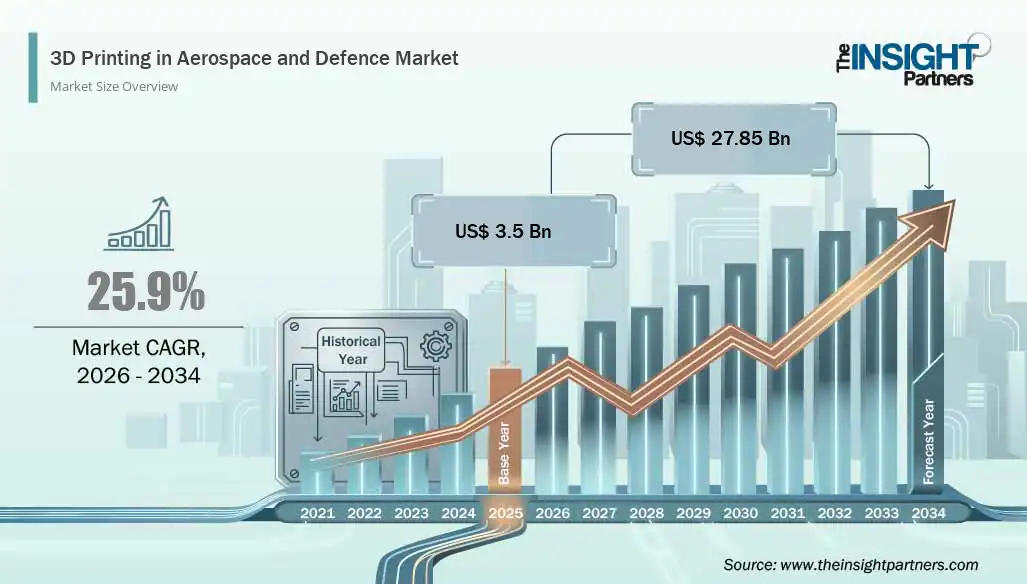
The 3D Printing in Aerospace and Defence Market size is expected to reach US$ 27.85 Billion by 2034 from US$ 3.5 Billion in 2025. The market is estimated to record a CAGR of 25.90% from 2026 to 2034. The rapid adoption of additive manufacturing across commercial aviation, military aircraft, unmanned aerial vehicles, and spacecraft is contributing significantly to market expansion.
Get a PDF Sample: https://www.theinsightpartners.com/sample/TIPRE00020469
Aerospace and defence manufacturers are increasingly adopting 3D printing to produce engine components, structural parts, brackets, turbine components, and specialized equipment. The technology offers greater design flexibility and allows manufacturers to develop complex geometries that are difficult or expensive to produce using conventional manufacturing methods.
Key Market Drivers and Emerging Trends
One of the major factors driving the 3D Printing in Aerospace and Defence Market is the growing demand for lightweight aircraft components. Reducing aircraft weight helps improve fuel efficiency, increase payload capacity, and lower operating costs. Additive manufacturing supports the production of lightweight structures while maintaining strength, durability, and performance requirements.
Another important growth driver is the increasing investment in defence modernization programs. Military organizations are adopting advanced manufacturing technologies to improve equipment availability, reduce supply chain dependencies, and manufacture specialized replacement parts. 3D printing also enables on-demand production, reducing the need to maintain large inventories of spare components.
Technological advancements in metal additive manufacturing are further supporting market development. Processes such as selective laser melting, direct metal laser sintering, and electron beam melting allow manufacturers to produce high-performance metal components for demanding aerospace applications.
Additionally, the growing use of 3D printing in spacecraft manufacturing is creating new opportunities. Space companies are exploring additive manufacturing for satellite components, propulsion systems, and lightweight structural parts.
3D Printing in Aerospace and Defence Market Segmentation
The global market is segmented based on material and application.
By Material
-
Metal
-
Polymer
-
Ceramics
Metal materials are widely used in aerospace and defence applications because of their strength, heat resistance, and durability. Titanium, aluminum, and nickel-based alloys are commonly used to manufacture critical aircraft and engine components. Polymer materials are gaining popularity for lightweight interior components, protective structures, and non-critical applications. Ceramics are also attracting interest due to their thermal resistance and suitability for specialized aerospace applications.
By Application
-
Aircraft
-
Unmanned Aerial Vehicle
-
Spacecraft
The aircraft segment represents an important application area due to the increasing adoption of additive manufacturing for engine parts, cabin components, structural elements, and replacement parts. Unmanned aerial vehicles are also benefiting from 3D printing because the technology enables lightweight designs and rapid prototyping. Meanwhile, spacecraft manufacturers are adopting additive manufacturing to develop complex components, propulsion systems, and satellite structures.
Key Players in the 3D Printing in Aerospace and Defence Market
Leading companies are investing in research and development, advanced materials, and innovative additive manufacturing technologies to strengthen their market positions. Strategic collaborations and product development initiatives are also supporting industry competition.
Key players operating in the market include:
-
3D Systems
-
Boeing
-
GE Aviation
-
Aerojet Rocketdyne
-
Airbus
-
Rolls-Royce
-
HP Development Company
-
Safran Turbomeca
-
Optomec
-
Stratasys
These companies are focusing on improving printing accuracy, material performance, production efficiency, and certification processes to expand the adoption of additive manufacturing across aerospace and defence applications.
Future Outlook of the 3D Printing in Aerospace and Defence Market
The future of the 3D Printing in Aerospace and Defence Market looks highly promising, supported by continuous technological advancements and increasing investments in next-generation manufacturing solutions. The growing demand for fuel-efficient aircraft, lightweight structures, and advanced defence equipment is expected to accelerate the adoption of additive manufacturing.
Furthermore, improvements in metal 3D printing, multi-material manufacturing, artificial intelligence integration, and automated production processes are likely to enhance manufacturing capabilities. The expansion of space exploration programs and commercial satellite manufacturing will also create new opportunities for additive manufacturing providers.
The increasing adoption of on-demand spare parts production is expected to transform aerospace supply chains by reducing inventory requirements and improving maintenance efficiency. Overall, rising aerospace production, defence modernization, material innovation, and the growing demand for customized components are expected to drive the global 3D Printing in Aerospace and Defence Market through 2034.
Related Reports:
Industrial 3D Printing Market Trends, Size & Growth by 2034
Automotive 3D Printing Market Trends, Size & Growth by 2034
About Us
The Insight Partners is a leading market research and consulting firm delivering actionable insights through in-depth industry analysis and strategic intelligence. The firm supports clients across various industries in making informed decisions by providing comprehensive market forecasts, competitive assessments, and growth opportunities.
Contact Us:
If you have any queries about this report or if you would like further information, please contact us:
Contact Person: Ankit Mathur
E-mail: sales@theinsightpartners.com'
Also Available in : Korean | German | Japanese | French | Chinese | Italian | Spanish

 English
 Arabic
 Spanish
 Portuguese
 Deutsch
 Turkish
 Dutch
 Italiano
 Russian
 Romaian
 Portuguese (Brazil)
 Greek