


Hair Transplant: Procedure, Techniques, Benefits, Cost, Recovery, and Results
Hair loss is a common concern affecting millions of men and women worldwide. Although losing a few strands of hair every day is normal, excessive hair shedding, thinning hair, receding hairlines, and bald patches can significantly affect a person's appearance and self-confidence. Hair loss may occur due to genetics, hormonal changes, aging, medical conditions, nutritional deficiencies, stress, or other factors.
A hair transplant is one of the most effective long-term solutions for certain types of permanent hair loss. It is a surgical procedure in which healthy hair follicles are taken from a donor area, usually the back or sides of the scalp, and transplanted into areas experiencing thinning or baldness.
Modern hair transplantation techniques have made it possible to achieve natural-looking hairlines, improved hair density, and long-lasting results. Procedures such as Follicular Unit Extraction (FUE) and Follicular Unit Transplantation (FUT) allow qualified surgeons to restore hair according to the patient's facial structure, hair characteristics, and individual needs.
This comprehensive guide explains everything you need to know about hair transplantation, including how it works, available techniques, eligibility, benefits, risks, recovery, results, and factors affecting treatment costs.
What Is a Hair Transplant?
A hair transplant is a minimally invasive surgical procedure designed to restore hair in areas affected by permanent hair loss. During the treatment, hair follicles are collected from a donor region of the scalp and carefully implanted into areas where hair growth has decreased or stopped.
The transplanted follicles are generally taken from the back and sides of the head because these areas are often more resistant to the hormonal effects responsible for androgenetic alopecia (pattern hair loss).
Unlike temporary hair restoration products, a hair transplant uses the patient's own hair follicles. Once successfully transplanted and established, these follicles can continue producing hair in their new locations.
Hair transplantation can be used to improve:
-
Receding hairlines.
-
Male pattern baldness.
-
Female pattern hair loss in selected patients.
-
Thinning hair on the crown.
-
Bald patches caused by certain injuries or scars.
-
Hair loss following burns or surgery.
-
Eyebrow hair loss in suitable cases.
-
Beard and moustache hair deficiencies.
However, not everyone experiencing hair loss is an ideal candidate. A proper consultation and scalp examination are necessary before deciding on treatment.
How Does Hair Transplant Surgery Work?
Hair transplantation works by relocating healthy hair follicles from a donor area to a recipient area.
The procedure generally involves the following stages:
-
Consultation and assessment: The surgeon examines the scalp, evaluates the pattern of hair loss, reviews medical history, and determines whether the patient has sufficient donor hair.
-
Hairline design: A natural-looking hairline is planned according to the patient's facial proportions, age, and future hair-loss considerations.
-
Donor hair extraction: Healthy follicular units are collected from the donor area using the selected surgical technique.
-
Graft preparation: Extracted follicles are examined, sorted, and prepared for transplantation.
-
Recipient site creation: Small openings are created in the thinning or bald areas, following the desired direction, angle, and distribution of hair.
-
Graft implantation: The prepared hair follicles are carefully placed into the recipient sites.
-
Post-procedure care: The patient receives instructions about scalp hygiene, medication, sleeping position, and follow-up appointments.
The procedure is usually performed under local anesthesia, allowing patients to remain awake while the treated areas are numbed.
Types of Hair Transplant Techniques
Several hair transplantation techniques are available. The most commonly performed methods are FUE and FUT. The appropriate technique depends on the patient's hair-loss pattern, donor supply, scalp characteristics, and treatment goals.
1. Follicular Unit Extraction (FUE)
Follicular Unit Extraction (FUE) is a popular hair transplantation technique in which individual follicular units are extracted directly from the donor area using specialized instruments.
Instead of removing a strip of scalp, the surgeon collects individual follicular units, which are then implanted into the recipient area.
How FUE works:
-
The donor area is trimmed and prepared.
-
Local anesthesia is administered.
-
Individual follicular units are extracted using a small punch instrument.
-
The extracted grafts are prepared for transplantation.
-
Small recipient sites are created.
-
Hair follicles are implanted according to the planned hairline and density.
Benefits of FUE:
-
Does not require a linear donor-area incision.
-
Leaves small dot-like scars rather than one long linear scar.
-
Generally involves a shorter recovery period than FUT.
-
Allows patients to wear relatively short hairstyles, depending on scarring.
-
Can be used to restore the hairline, crown, and other areas.
FUE is not completely scar-free. Tiny scars can remain in the donor area, and excessive extraction can cause visible thinning.
2. Follicular Unit Transplantation (FUT)
Follicular Unit Transplantation (FUT), also known as the strip method, is another established hair restoration technique.
In this procedure, a narrow strip of scalp containing healthy hair follicles is surgically removed from the donor area. The strip is then divided into individual follicular units under magnification.
How FUT works:
-
The donor area is prepared and numbed.
-
A strip of scalp is surgically removed.
-
The donor wound is closed with sutures.
-
The strip is divided into individual follicular grafts.
-
Recipient sites are prepared.
-
The grafts are implanted into the targeted areas.
Benefits of FUT:
-
Can provide a substantial number of grafts in one session.
-
Preserves surrounding donor hair during strip harvesting.
-
May be appropriate for patients who need extensive coverage.
-
Does not require shaving the entire donor area in every case.
The main disadvantage is the linear scar left in the donor area. Some patients also experience more discomfort or a longer recovery period because of the surgical incision.
3. Direct Hair Implantation (DHI)
Direct Hair Implantation (DHI) is a variation of follicular hair transplantation in which extracted hair follicles are implanted using a specialized implanter pen.
The instrument allows the surgeon to create an implantation site and place a follicular unit during the same step.
Benefits of DHI:
-
Provides precise control over follicle placement.
-
Allows careful adjustment of implantation angles.
-
Can be useful for detailed hairline restoration.
-
May reduce the time grafts spend outside the body in certain workflows.
DHI is not a completely separate biological method of hair transplantation. It is primarily an implantation approach, and its suitability depends on the surgeon's expertise and the patient's requirements.
FUE vs. FUT vs. DHI: Key Differences
|
Feature |
FUE |
FUT |
DHI |
|---|---|---|---|
|
Extraction method |
Individual follicles |
Scalp strip |
Usually FUE |
|
Linear scar |
No |
Yes |
No, if FUE extraction is used |
|
Recovery |
Generally shorter |
Generally longer |
Depends on extraction method |
|
Implantation |
Forceps or implanter |
Forceps or implanter |
Specialized implanter |
|
Suitable for |
Many hair-loss patterns |
Selected extensive cases |
Selected precision cases |
No single technique is best for everyone. An experienced hair transplant surgeon should recommend the approach that offers the best balance of donor preservation, coverage, natural appearance, and long-term planning.
Who Is an Ideal Candidate for a Hair Transplant?
Hair transplantation can be an effective option, but successful results depend heavily on patient selection.
A suitable candidate generally has:
-
Permanent hair loss or a stable pattern of hair thinning.
-
Sufficient healthy donor hair.
-
Realistic expectations about density and coverage.
-
Good overall health for surgery.
-
A scalp condition suitable for transplantation.
-
A clearly identified cause of hair loss.
Hair Transplant for Men
Men experiencing androgenetic alopecia are among the most common candidates for hair transplantation.
The procedure can help restore:
-
Receding frontal hairlines.
-
Bald areas around the temples.
-
Thinning crowns.
-
Extensive male pattern baldness.
-
Hair density in selected scalp regions.
Hair Transplant for Women
Women can also benefit from hair transplantation, particularly when they experience localized hair loss or a stable pattern of thinning.
However, female hair loss is often more diffuse, which may limit donor hair availability. A detailed medical assessment is particularly important before surgery.
Who May Not Be Suitable?
Hair transplantation may not be appropriate for individuals who:
-
Have insufficient donor hair.
-
Experience active or uncontrolled hair loss.
-
Have certain untreated scalp disorders.
-
Have temporary hair shedding that may recover naturally.
-
Have medical conditions that increase surgical risks.
-
Expect unrealistic hair density.
-
Have certain types of scarring alopecia without disease control.
A specialist may recommend medical treatment or further investigation before considering surgery.
Hair Transplant Procedure: Step-by-Step Process
A hair transplant involves several stages, from the initial consultation to the final placement of grafts. The exact process depends on the technique, number of grafts, and individual treatment plan.
1. Initial Consultation
The first step is a consultation with a qualified hair transplant surgeon. During this appointment, the specialist evaluates:
-
The extent and pattern of hair loss.
-
Hair density in the donor area.
-
Scalp health and condition.
-
Hair thickness and texture.
-
Medical history and current medications.
-
Previous hair restoration treatments.
-
Expected results and treatment goals.
The surgeon may also recommend blood tests or additional investigations when medically appropriate.
2. Hairline Design
Designing a natural-looking hairline is one of the most important parts of hair transplantation.
The surgeon considers the patient's facial structure, forehead proportions, age, existing hairline, and potential future hair loss.
A hairline that is too low or artificially straight may look unnatural. Therefore, the design should provide a balanced appearance while preserving enough donor hair for possible future procedures.
3. Preparing the Donor Area
The donor area is cleaned and prepared for extraction. Depending on the selected technique, some or all of the hair may need to be trimmed.
Local anesthesia is administered to minimize discomfort during the procedure.
4. Extraction of Hair Follicles
The surgeon collects healthy follicular units from the donor region using FUE or FUT.
The extracted grafts are carefully handled because their condition plays an important role in successful transplantation.
5. Graft Preparation
The collected follicles are examined and separated according to the number of hairs in each follicular unit.
They are maintained under appropriate conditions until implantation.
6. Implantation of Hair Follicles
The surgeon creates small recipient sites in the areas affected by hair loss. The follicles are then implanted while considering:
-
Natural hair growth direction.
-
Appropriate implantation angle.
-
Hairline design.
-
Distribution of grafts.
-
Desired coverage and density.
Single-hair grafts are commonly used along the frontal hairline to create a softer, natural appearance, while multi-hair grafts may be placed behind the hairline to improve density.
7. Post-Procedure Instructions
After the procedure, patients receive instructions regarding scalp washing, medication, sleeping position, physical activity, and follow-up visits.
Following these instructions is essential for proper healing and graft protection.
How Long Does a Hair Transplant Take?
The duration of a hair transplant depends on the number of grafts, surgical technique, complexity of the procedure, and clinic's workflow.
Generally, a smaller procedure may take several hours, while larger procedures can require a full day or multiple sessions.
Factors affecting treatment duration include:
-
Number of grafts required.
-
Size of the recipient area.
-
Donor hair density.
-
Extraction technique.
-
Graft preparation requirements.
-
Surgical team experience.
Patients should prioritize surgical quality and safety rather than choosing a clinic simply because it promises the fastest procedure.
Hair Transplant Recovery Timeline
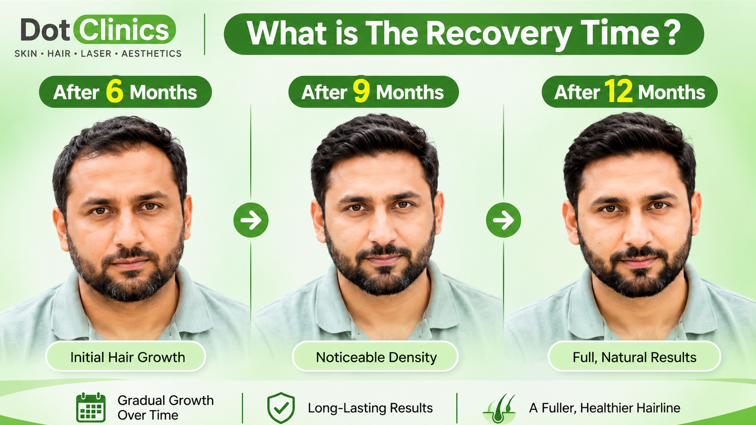
Recovery after hair transplantation takes place gradually. Although the initial healing period is relatively short, visible hair growth requires several months.
The following timeline provides a general overview.
|
Time after surgery |
What to expect |
|---|---|
|
Days 1–3 |
Mild swelling, redness, tenderness, and small scabs |
|
Days 4–7 |
Gradual healing and reduction in swelling |
|
Days 7–14 |
Scabs gradually disappear with appropriate washing |
|
Weeks 2–8 |
Temporary shedding of transplanted hair may occur |
|
Months 3–4 |
Early new hair growth may become visible |
|
Months 5–6 |
Hair growth and coverage become more noticeable |
|
Months 7–9 |
Continued improvement in density and appearance |
|
Months 10–12 |
Significant cosmetic results are usually visible |
|
Months 12–18 |
Further maturation and final results, particularly in some crown cases |
These are approximate stages, not guaranteed deadlines. Individual growth patterns vary.
Is Hair Shedding Normal After a Hair Transplant?
Yes. Temporary shedding after transplantation is common and is often called shock loss or postoperative shedding.
Many transplanted hair shafts fall out during the first few weeks, but the follicles generally remain beneath the skin. New hair growth usually begins after the resting phase of the hair growth cycle.
Patients should not assume that early shedding means the transplant has failed.
However, unusual pain, increasing redness, pus, fever, or worsening swelling should be assessed by a medical professional.
Benefits of Hair Transplant Surgery
Hair transplantation offers several potential benefits for individuals experiencing permanent hair loss.
1. Natural-Looking Results
Modern hair transplantation techniques allow surgeons to place individual follicular units according to natural hair direction and distribution.
When performed by an experienced surgeon, the transplanted hairline can blend with existing hair.
2. Long-Term Hair Restoration
Transplanted follicles taken from appropriate donor regions generally retain characteristics that make them relatively resistant to the hormonal processes responsible for pattern hair loss.
Consequently, transplanted hair can provide long-lasting growth.
However, surrounding natural hair may continue to thin, and future hair loss should be considered during surgical planning.
3. Improved Hair Density
Hair transplantation can improve coverage in areas affected by thinning or baldness.
The degree of improvement depends on donor availability, graft survival, hair characteristics, and the size of the recipient area.
4. Permanent Hair Follicle Relocation
Unlike temporary cosmetic products, hair transplantation relocates the patient's own follicles.
Once successfully established, these follicles can continue producing hair in their new location.
5. Improved Confidence and Appearance
Hair loss can influence personal appearance and confidence. Restoring hair coverage may help individuals feel more comfortable with their appearance.
The psychological benefits vary from person to person, and surgery should be considered a personal choice rather than a requirement.
6. Versatility
Hair transplantation can be used for several restoration purposes, including:
-
Frontal hairline restoration.
-
Crown hair restoration.
-
Temple reconstruction.
-
Eyebrow transplantation.
-
Beard restoration.
-
Moustache restoration.
-
Scar coverage in selected patients.
Hair Transplant Risks and Side Effects
Although hair transplantation is generally considered safe when performed by qualified professionals on suitable patients, it remains a surgical procedure and carries potential risks.
Patients should understand the possible side effects before making a decision.
Common Temporary Side Effects
1. Swelling: Mild swelling around the forehead or scalp may occur after surgery and generally improves within several days.
2. Redness: The donor and recipient areas may appear red during the early healing period.
3. Scabbing: Small crusts can form around implanted follicles. These usually disappear as the scalp heals.
4. Itching: Some patients experience itching during recovery. Scratching or rubbing the treated area should be avoided.
5. Temporary Hair Shedding: Transplanted hair shafts may fall out before new growth begins.
6. Mild Pain or Discomfort: Tenderness in the donor and recipient areas is common during early recovery.
Potential Complications
Less common but more significant complications include:
-
Infection.
-
Excessive bleeding.
-
Poor graft survival.
-
Visible donor-area scarring.
-
Unnatural hairline design.
-
Uneven hair density.
-
Folliculitis.
-
Persistent numbness.
-
Shock loss affecting existing hair.
-
Overharvesting of the donor area.
Selecting an appropriately qualified surgeon, undergoing a proper medical assessment, and following postoperative instructions can help reduce avoidable risks.
Severe pain, fever, spreading redness, pus, or other unexpected symptoms require prompt medical evaluation.
How Many Grafts Are Required for a Hair Transplant?
The number of grafts required depends on the size of the bald area, existing hair density, donor availability, and desired cosmetic improvement.
A graft is a naturally occurring follicular unit containing one or more hairs. Therefore, graft numbers and individual hair counts are not the same.
The following figures are illustrative planning ranges, not fixed treatment requirements.
|
Treatment area |
Approximate graft range |
|---|---|
|
Small temple restoration |
500–1,000 |
|
Frontal hairline |
1,000–1,800 |
|
Frontal and mid-scalp |
1,800–3,000 |
|
Crown restoration |
1,000–2,000 |
|
Extensive baldness |
3,000–5,000+ |
The actual number may be higher or lower depending on individual circumstances.
What Determines the Number of Grafts?
Several factors influence graft requirements:
-
Size of the bald area.
-
Existing hair density.
-
Thickness of individual hair strands.
-
Number of hairs in each follicular unit.
-
Donor hair availability.
-
Hair color and contrast with the scalp.
-
Desired coverage.
-
Future progression of hair loss.
A qualified surgeon should estimate the graft requirement after examining the scalp rather than promising a fixed number without an assessment.
Hair Transplant Cost: What Determines the Price?
Hair transplant costs vary considerably between countries, clinics, and individual treatment plans.
There is no universal price because the final cost depends on the surgical technique, number of grafts, surgeon's experience, facility standards, and complexity of the procedure.
Factors Affecting Hair Transplant Prices
1. Number of Grafts
The number of grafts is one of the most important cost factors. Larger treatment areas generally require more surgical time and resources.
2. Surgical Technique
FUE, FUT, and DHI may have different pricing structures depending on the clinic and its equipment.
3. Surgeon's Experience
The surgeon's qualifications, experience, and involvement in the procedure can influence treatment costs.
4. Clinic Facilities
Sterilization standards, surgical equipment, trained staff, and patient-care facilities contribute to the overall cost.
5. Additional Services
Some clinics include consultation, medications, follow-up appointments, and postoperative care in their packages, while others charge separately.
Hair Transplant Cost in Pakistan
Pakistan is a popular destination for hair restoration treatments because patients can access various surgical options at different price levels.
The cost of a hair transplant in Pakistan depends on the number of grafts, treatment technique, clinic location, and surgeon's expertise.
Patients should not choose a clinic based exclusively on low prices or attractive package offers. The qualifications of the operating surgeon, donor management, graft handling, hygiene standards, and follow-up care are more important considerations.
Before booking a procedure, request a detailed quotation explaining the number of grafts, technique, surgeon's role, medications, and aftercare services included.
Hair Transplant Aftercare: Essential Instructions
Proper aftercare helps protect the transplanted follicles and supports the healing process.
Every patient should follow the instructions provided by their operating surgeon because recommendations may differ depending on the surgical technique and individual healing.
1. Protect the Transplanted Area
Avoid touching, rubbing, scratching, or applying pressure to the newly transplanted grafts during the initial recovery period.
2. Wash Your Hair Carefully
Follow the clinic's recommended washing schedule. Use only the products and techniques approved by the surgeon.
Avoid forceful rubbing or directing strong water pressure onto the grafts.
3. Sleep With Your Head Elevated
During the first few nights, the surgeon may recommend sleeping with the head elevated to help reduce swelling.
4. Avoid Strenuous Exercise
Heavy workouts, weightlifting, and strenuous activities should be avoided for the period recommended by the surgeon.
5. Avoid Direct Sun Exposure
Protect the scalp from excessive sunlight during early healing. Ask the surgeon when it is safe to resume normal sun exposure and use head protection.
6. Avoid Smoking During Recovery
Smoking can negatively affect circulation and wound healing. Patients should discuss smoking cessation with their healthcare provider.
7. Attend Follow-Up Appointments
Follow-up visits allow the surgeon to assess healing, identify complications, and monitor hair growth.
8. Take Prescribed Medication
Use prescribed medications according to medical instructions. Do not start, stop, or change medication without consulting the treating professional.
Hair Transplant vs. Other Hair Loss Treatments
Hair transplantation is not the only option for managing hair loss. Depending on the underlying cause, patients may benefit from medication, topical treatments, platelet-rich plasma (PRP), or other hair restoration approaches.
|
Treatment |
Main purpose |
Expected outcome |
|---|---|---|
|
Hair transplant |
Relocates healthy follicles |
Long-term hair restoration |
|
Minoxidil |
Supports hair growth |
May improve hair density |
|
Finasteride |
Reduces DHT-related hair loss |
May slow progression in suitable patients |
|
PRP therapy |
Uses platelet-rich plasma |
May improve hair density in selected patients |
|
Low-level laser therapy |
Uses light-based stimulation |
May provide modest improvement |
|
Microneedling |
Creates controlled micro-injuries |
May support hair growth in selected cases |
1. Minoxidil
Minoxidil is a medication commonly used to treat certain types of hair loss. It is available in topical formulations and, in selected cases, oral formulations under medical supervision.
It may help slow hair loss and improve hair density. However, results generally require continued treatment, and hair loss may resume after discontinuation.
2. Finasteride
Finasteride is a prescription medication used primarily for male pattern hair loss. It works by reducing the conversion of testosterone into dihydrotestosterone (DHT), a hormone involved in follicular miniaturization.
It may help slow hair loss and maintain existing hair in suitable patients.
Potential adverse effects should be discussed with a qualified doctor before starting treatment.
3. Platelet-Rich Plasma (PRP) Therapy
PRP therapy involves collecting a small blood sample, processing it to concentrate platelets, and injecting the prepared plasma into selected areas of the scalp.
It may be considered as a nonsurgical treatment for certain types of hair thinning. However, results vary, and it does not replace a hair transplant when substantial permanent baldness needs coverage.
4. Low-Level Laser Therapy
Low-level laser therapy uses specific wavelengths of light to target the scalp. Some devices may help improve hair density in individuals with certain types of hair loss.
It is a nonsurgical option, but results are generally more modest than surgical restoration.
Important: Hair loss treatments are not interchangeable. The best option depends on the underlying diagnosis, severity, medical history, and treatment goals. A dermatologist or qualified hair restoration specialist can recommend an appropriate approach.
How to Choose the Best Hair Transplant Clinic
Selecting the right clinic is one of the most important decisions when considering hair transplantation.
A successful outcome depends not only on the technique but also on the surgeon's expertise, donor management, graft handling, hairline design, and postoperative care.
Consider the following factors before choosing a clinic.
1. Qualified and Experienced Surgeon
Check the surgeon's medical qualifications, relevant surgical training, and experience in hair restoration procedures.
Ask who will perform the important surgical steps, including donor harvesting, recipient-site creation, and graft implantation.
2. Before-and-After Results
Review photographs of previous patients with similar hair-loss patterns.
Look for consistent results, natural hairlines, appropriate density, and donor-area appearance.
3. Modern Equipment and Techniques
The clinic should have appropriate equipment for the selected procedure and follow safe surgical practices.
Modern technology is helpful, but it cannot replace surgical experience and proper medical judgment.
4. Personalized Treatment Planning
Every patient has different hair characteristics and restoration requirements.
A reputable clinic should provide an individualized treatment plan rather than recommending the same graft number or technique to everyone.
5. Hygiene and Safety Standards
Ensure that the clinic follows appropriate sterilization procedures, infection-control protocols, and patient-monitoring standards.
6. Transparent Pricing
The clinic should clearly explain the estimated graft number, treatment technique, surgeon's involvement, and additional costs.
7. Postoperative Support
Proper aftercare and follow-up appointments are essential for monitoring recovery and identifying potential complications.
Common Myths About Hair Transplants
There are several misconceptions surrounding hair transplantation. Understanding the facts can help patients make informed decisions.
Myth 1: Hair Transplant Results Are Visible Immediately
Fact: Hair transplantation requires time. Transplanted hair often sheds initially, and new growth generally becomes noticeable after three to four months.
Myth 2: Hair Transplants Are Completely Painless
Fact: Local anesthesia helps minimize pain during surgery, but patients may experience mild discomfort, swelling, or tenderness afterward.
Myth 3: Hair Transplantation Leaves No Scars
Fact: Both FUE and FUT produce scars. FUE generally leaves tiny scattered scars, while FUT leaves a linear scar.
Myth 4: Transplanted Hair Never Falls Out
Fact: Transplanted follicles can provide long-lasting growth, but the surrounding natural hair may continue to thin.
Myth 5: Everyone With Hair Loss Can Have a Hair Transplant
Fact: Patients must have suitable donor hair, appropriate scalp conditions, and realistic expectations.
Myth 6: More Grafts Always Mean Better Results
Fact: Proper graft distribution, donor preservation, natural hairline design, and graft survival are more important than simply maximizing graft numbers.
Myth 7: Hair Transplantation Is Only for Men
Fact: Women can also undergo hair transplantation when their type of hair loss and donor characteristics make them suitable candidates.
Frequently Asked Questions About Hair Transplants
1. Is a hair transplant permanent?
Hair transplantation can provide long-lasting results because follicles taken from suitable donor areas generally retain their resistance to pattern hair loss. However, surrounding natural hair may continue to thin over time.
2. How long does a hair transplant last?
Transplanted hair can last for many years and may provide lifelong growth. Individual outcomes depend on donor hair characteristics, surgical quality, genetics, and ongoing hair loss.
3. Is hair transplantation painful?
The procedure is generally performed under local anesthesia. Patients may experience mild discomfort during anesthesia injections and some soreness or tenderness during recovery.
4. How many days are required for recovery?
Most patients experience initial healing within approximately 7–14 days. However, complete cosmetic recovery and visible hair growth take considerably longer.
5. When will I see the final results?
Early growth generally becomes noticeable around three to four months. Significant improvement usually develops over six to twelve months, while further maturation can continue for 12–18 months.
6. Can women undergo hair transplantation?
Yes. Women with suitable hair-loss patterns and sufficient donor hair may benefit from transplantation. A detailed evaluation is necessary to determine eligibility.
7. Can a hair transplant treat a completely bald head?
Hair transplantation may help individuals with extensive baldness if sufficient healthy donor follicles are available. However, complete coverage and high density may not be achievable in every case.
8. Can transplanted hair turn grey?
Yes. Transplanted hair generally retains the characteristics of the donor hair, including its tendency to turn grey with age.
9. Can I wear a cap after a hair transplant?
Patients should follow their surgeon's instructions regarding headwear. Tight caps and anything that places pressure on newly implanted grafts should be avoided during early recovery.
10. Can I wash my hair after a hair transplant?
Yes. Hair washing is usually resumed according to the surgeon's postoperative instructions. Gentle washing is important to avoid disturbing the grafts.
11. Is FUE better than FUT?
Neither technique is universally better. FUE avoids a linear scar, whereas FUT may be appropriate for certain patients who require a larger number of grafts. The best technique depends on individual circumstances.
12. Can transplanted hair grow naturally?
Yes. Successfully transplanted follicles can produce natural-growing hair. The appearance depends on proper hairline design, implantation angle, graft placement, and surgical expertise.
13. Does a hair transplant stop future hair loss?
No. Hair transplantation does not stop the underlying progression of androgenetic alopecia. Medical treatments may be recommended to preserve existing hair when appropriate.
14. Can I undergo another hair transplant?
Yes, additional procedures may be possible if sufficient healthy donor hair remains and the patient is medically suitable. The donor area must be evaluated before another surgery.
15. Is a hair transplant safe?
Hair transplantation is generally safe when performed by appropriately qualified medical professionals in a suitable clinical setting. Nevertheless, complications such as infection, bleeding, scarring, and poor graft survival are possible.
16. Can beard hair be used for a scalp hair transplant?
Beard hair may sometimes be used as an additional donor source in selected patients. However, beard and scalp hair have different characteristics, so its use requires careful surgical planning.
17. What is the best age for a hair transplant?
There is no single ideal age for everyone. The stability and progression of hair loss, donor availability, and long-term treatment plan are more important than age alone. Younger patients often require additional caution because future hair loss can be difficult to predict.
18. Can I return to work after a hair transplant?
Many patients return to work within approximately one to two weeks, depending on the procedure, healing, and nature of their work.
Conclusion
Hair transplantation is an effective long-term hair restoration option for individuals experiencing certain types of permanent hair loss. Modern techniques such as FUE, FUT, and DHI-based implantation approaches allow surgeons to relocate healthy hair follicles and improve coverage in thinning or bald areas.
The success of a hair transplant depends on several factors, including proper patient selection, donor hair quality, surgical expertise, graft survival, natural hairline design, and postoperative care.
Although the procedure can improve hair density and appearance, it is important to understand its limitations, potential risks, and recovery timeline. Hair transplantation does not prevent future natural hair loss, so long-term planning and appropriate medical management are important.
Before undergoing surgery, consult a qualified hair transplant surgeon, discuss your expectations, and compare available treatment options. Choosing a medically appropriate procedure and an experienced surgical team can help achieve natural-looking, sustainable results.
Medical References and Further Reading
The following established medical organizations provide additional information about hair transplantation, surgical techniques, and recovery:
-
International Society of Hair Restoration Surgery (ISHRS) – A Guide to Hair Transplant Surgery.
-
MedlinePlus – Hair Transplant: Medical Information.
-
International Alliance of Hair Restoration Surgeons (IAHRS) – Who Is a Hair Transplant Candidate?.
Medical disclaimer: This article is intended for educational purposes and does not replace an individual consultation, diagnosis, or treatment recommendation from a qualified healthcare professional.

 English
 Arabic
 French
 Portuguese
 Deutsch
 Turkish
 Dutch
 Italiano
 Russian
 Romaian
 Portuguese (Brazil)
 Greek