


Rising Orthopedic Trauma, Foot and Ankle Procedures, and Osteoporotic Fractures Fuel Demand for Nitinol Implants
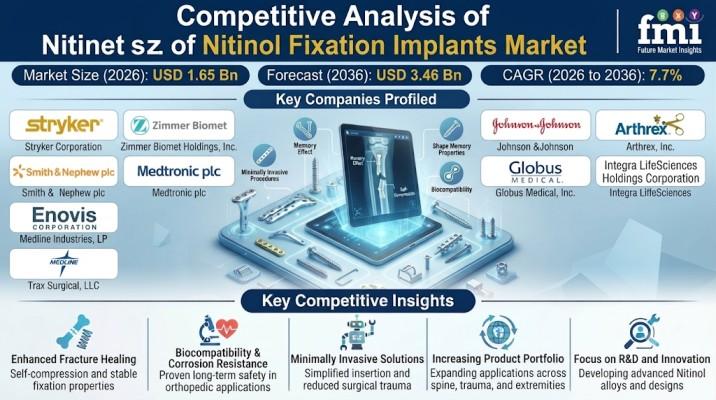
The global Nitinol Fixation Implants Market is projected to grow from USD 1.65 billion in 2026 to USD 3.46 billion by 2036, registering a compound annual growth rate (CAGR) of 7.7% during the forecast period. Increasing adoption of nitinol-based compression implants in foot and ankle procedures, rising orthopedic surgery volumes and demand for fixation systems that maintain stable compression are supporting market expansion.
Nitinol, a nickel-titanium alloy, offers shape-memory and superelastic properties that allow implants to maintain compression and adapt to mechanical stress. These characteristics make nitinol relevant to orthopedic applications requiring stable bone apposition, including fusion, osteotomy and fracture stabilization.
Hospitals and ambulatory surgical centers are evaluating these implants based on fixation performance, ease of placement, compatibility with existing instrumentation and potential to support consistent surgical workflows. As orthopedic care expands across established and emerging markets, manufacturers are focusing on product designs that address procedure-specific requirements.
Request for Sample: https://www.futuremarketinsights.com/reports/sample/rep-gb-32242
Nitinol Fixation Implants Market: Key Growth Indicators
· Market value (2026): USD 1.65 billion
· Forecast value (2036): USD 3.46 billion
· CAGR (2026–2036): 7.7%
· Leading implant type: Compression staples, accounting for 38.0% share in 2026
· Leading application area: Foot and ankle, representing 30.0% share in 2026
· Fastest-growing country: India, with a projected CAGR of 9.8%
Why Is Demand for Nitinol Fixation Implants Increasing?
Demand is being supported by the need for fixation systems that maintain compression during bone healing. Conventional fixation approaches remain widely used, but nitinol implants offer an alternative for selected procedures where continuous compression and low-profile implant designs are important.
Three factors are influencing adoption:
· Increasing orthopedic procedure volumes: Growing demand for foot and ankle fusion, corrective osteotomy and fracture stabilization is creating opportunities for specialized fixation implants.
· Benefits of shape-memory technology: Nitinol's superelastic behavior can help maintain compression across the fixation site, supporting stable apposition during healing.
· Demand for efficient surgical workflows: Implants designed for straightforward placement and compatibility with standardized instrumentation can support procedural consistency in hospitals and ambulatory surgery centers.
However, adoption remains influenced by surgeon familiarity, clinical evidence, procurement decisions and the cost difference compared with conventional fixation systems.
Compression Staples Lead the Implant Type Segment
Compression staples are projected to account for 38.0% of the market in 2026, making them the leading implant type. Their ability to provide sustained compression makes them relevant to fusion and osteotomy procedures, particularly in foot and ankle surgery.
Nitinol plates and screws, including systems incorporating nitinol components, represent another important category. These constructs can be used where surgeons require additional structural support or fixation across more complex anatomical areas.
Other product categories include intramedullary nails, clips and anchors, spinal fixation adjuncts and other nitinol-based fixation components. Product development is increasingly focused on implant geometry, deployment characteristics and performance across specific surgical indications.
Foot and Ankle Applications Account for the Largest Share
Foot and ankle procedures are expected to represent 30.0% of market share in 2026. Fusion and corrective procedures in this application area frequently require reliable compression and stable fixation, supporting demand for nitinol compression staples.
Upper extremity applications account for the next-largest share at 18.0%. Hand and wrist procedures can benefit from low-profile fixation designs and consistent bone apposition.
Sports medicine, spine, cranio-maxillofacial (CMF) procedures and trauma represent additional application areas. Manufacturers that develop indication-specific products and provide surgeon training may be better positioned to expand adoption across these categories.
India and China Lead Country-Level Growth
FMI projects India to record the fastest growth among the countries highlighted, with a CAGR of 9.8% between 2026 and 2036. China follows at 9.2%, supported by expanding orthopedic procedure volumes and increasing adoption of advanced fixation technologies.
Other country forecasts include:
· Brazil: 8.1%
· United States: 7.1%
· Germany: 6.0%
· United Kingdom: 5.6%
· Japan: 5.0%
India's growth opportunity is associated with rising orthopedic procedure volumes and expansion of private hospital capacity. In China, increasing sports medicine and trauma caseloads are supporting demand for advanced fixation options.
The United States represents an established market, with adoption supported by foot and ankle surgery and outpatient orthopedic pathways. In Germany and the United Kingdom, procurement discipline and established surgeon preferences are expected to influence the pace of technology adoption.
Competitive Landscape: Product Innovation and Surgeon Adoption Shape Competition
The market includes orthopedic device manufacturers and specialized implant developers competing through product portfolios, clinical support, surgeon relationships and distribution networks.
Key companies profiled by FMI include:
· Medline Industries, LP
· Trax Surgical, LLC
· Enovis Corporation
· Smith & Nephew plc
· Meduloc
· Arthrex, Inc.
· BME, Inc.
· Johnson & Johnson
· Medtronic plc
· Stryker Corporation
· Zimmer Biomet Holdings, Inc.
· MẌ Orthopedics
· Globus Medical, Inc.
· Integra LifeSciences Holdings Corporation
Competition is shaped by implant performance, manufacturing consistency, surgeon familiarity and access to established orthopedic purchasing channels. Companies are also pursuing product development and portfolio expansion to address foot and ankle, extremity and trauma applications.
Recent product developments highlight this direction. Trax Surgical received FDA 510(k) clearance in May 2025 for its LINKT Compression Staple System. In April 2025, Medline UNITE announced FDA clearance for its REFLEX HYBRID Nitinol Implant System. These developments demonstrate continued investment in nitinol-based orthopedic fixation technologies.
Access Full Report: https://www.futuremarketinsights.com/reports/nitinol-fixation-implants-market
What Should Nitinol Fixation Implant Providers Prioritize?
Market participants can strengthen their positioning by focusing on five priorities:
- Expand procedure-specific portfolios: Develop compression staples and fixation systems suited to foot and ankle, upper extremity and trauma procedures.
- Strengthen clinical evidence: Support product adoption through clinical performance data and clear documentation of fixation characteristics.
- Invest in surgeon education: Provide training on implant handling, deployment techniques and the role of shape-memory compression.
- Improve hospital procurement support: Offer procedure kits, instrumentation availability and technical assistance to support standardized workflows.
- Build emerging-market distribution: Strengthen commercial access in India, China and Brazil, where orthopedic procedure volumes are creating growth opportunities.
Frequently Asked Questions
1. How large is the Nitinol Fixation Implants Market in 2026?
The global market is estimated at USD 1.65 billion in 2026.
2. What is the projected market value by 2036?
The market is forecast to reach USD 3.46 billion by 2036, based on the supplied figures.
3. What is the expected CAGR from 2026 to 2036?
The market is projected to expand at a CAGR of 7.7% during the forecast period.
4. Which implant type leads the market?
Compression staples are expected to lead, accounting for 38.0% of market share in 2026.
5. Which application area holds the largest share?
Foot and ankle applications are projected to account for 30.0% of the market in 2026.
6. Which country is expected to grow fastest?
India is projected to record the highest growth among the countries highlighted, at a CAGR of 9.8% through 2036.
7. Who are the key companies in the market?
Key companies profiled by FMI include Medline Industries, Trax Surgical, Enovis, Smith & Nephew, Meduloc, Arthrex, BME, Johnson & Johnson, Medtronic, Stryker, Zimmer Biomet, MẌ Orthopedics, Globus Medical and Integra LifeSciences.
Related Reports:
· Dental Operatory Products Market - https://www.futuremarketinsights.com/reports/dental-operatory-products-market
· Heart Failure Biomarker Market - https://www.futuremarketinsights.com/reports/heart-failure-biomarker-market
· Long-Acting Implantable GLP-1 Obesity Devices Market - https://www.futuremarketinsights.com/reports/long-acting-implantable-glp-1-obesity-devices-market
About Future Market Insights (FMI)
Future Market Insights (FMI) is a global market intelligence and consulting firm providing comprehensive market research, competitive intelligence, and strategic business insights across industries. The firm delivers detailed forecasts, technology analysis, and data-driven recommendations that support informed decision-making for manufacturers, investors, distributors, and policymakers worldwide.
For Press & Corporate Inquiries
Rahul Singh
AVP – Marketing and Growth Strategy
Future Market Insights, Inc.
+91 8600020075
For Sales – sales@futuremarketinsights.com

 English
 Arabic
 French
 Spanish
 Portuguese
 Turkish
 Dutch
 Italiano
 Russian
 Romaian
 Portuguese (Brazil)
 Greek