


Best Merchant Account Providers in 2026: How to Choose
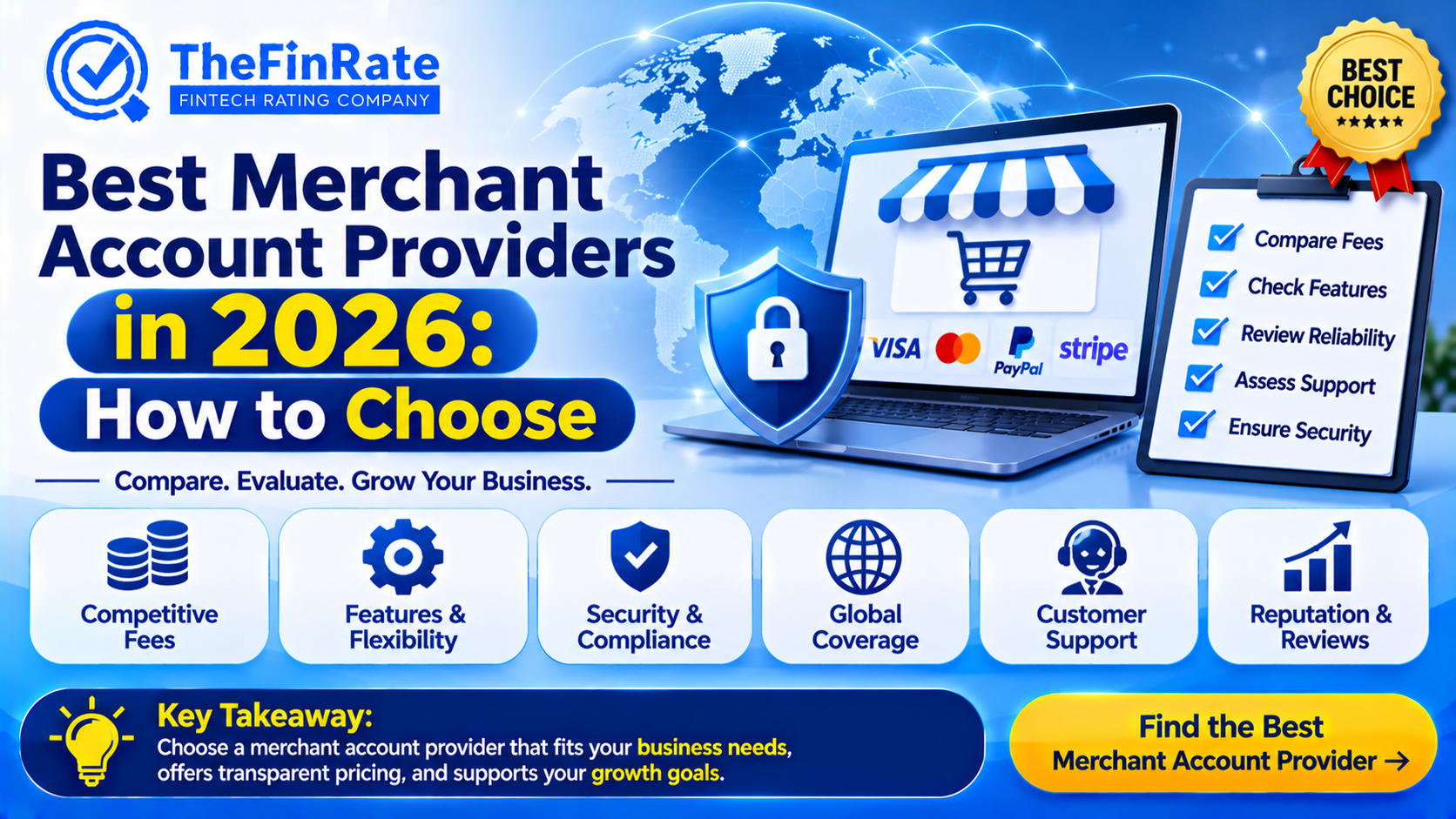
The best merchant account providers are not the ones with the lowest advertised rate. They are the ones whose pricing, contract terms and underwriting fit how your business actually sells. Two providers can quote similar percentages and still produce very different monthly bills once gateway, PCI, chargeback and termination fees are added.
This guide explains what to compare, which provider types suit which businesses and how to avoid the mistakes that cost merchants the most. For a wider directory, see TheFinRate's list of merchant account providers.
Quick Answer
There is no single best provider. Match the provider type to your situation:
- New or low-volume sellers: aggregated providers such as Square or Stripe for fast setup.
- Cost-focused growing businesses: interchange-plus providers such as Helcim.
- Established businesses that value bank backing: bank-offered services such as Chase Payment Solutions.
- Higher-volume merchants: subscription-style pricing such as Stax.
- High-risk industries: specialists such as PaymentCloud or Durango Merchant Services.
These are examples of providers commonly considered, not a ranking from hands-on testing. Fees, plans and eligibility change, so confirm everything in writing.
What a Merchant Account Does
A merchant account is where card payments are held after approval, before payout to your business bank account. You can have a dedicated account in your own name, or process under a provider's master account. Dedicated accounts give more control and often lower costs at scale. Aggregated accounts are faster to start but can bring more holds and less flexibility.
Best Provider Types by Business Type
| Business type | Provider type to look at | Why | Watch for |
|---|---|---|---|
| New online store | Aggregated provider | Fast approval, simple setup | Holds when activity spikes |
| Growing eCommerce | Interchange-plus provider | Transparent, cheaper at volume | Fewer extras, limited countries |
| Retail or restaurant | POS-led provider | Hardware and software together | Reseller contracts and leases |
| SaaS or subscriptions | Online-first provider | Recurring billing, APIs | Chargebacks on trials |
| Established high volume | Dedicated or subscription pricing | Lower effective rate | Monthly fees at low volume |
| High-risk industries | High-risk specialist | Accepts restricted models | Reserves, higher fees |
| International sellers | Multi-currency provider | Local methods, FX control | Cross-border and conversion fees |
Providers Commonly Considered
- Helcim: interchange-plus pricing with volume-based markups. Check country availability.
- Stax: monthly subscription plus near-wholesale processing costs. Run a break-even calculation.
- Chase Payment Solutions and U.S. Bank Merchant Services: bank-backed options for conventional businesses. Terms depend on plan and banking relationship.
- Square: POS, online checkout and invoicing in one system. Flat-rate pricing can cost more at higher volume.
- Stripe: strong for online payments, subscriptions and platforms. Advanced setups need developer time.
- PaymentCloud and Durango Merchant Services: high-risk specialists. Expect higher fees and possible reserves.
What to Compare
| Fee or term | What to ask |
|---|---|
| Processing rate | Is it flat rate, interchange-plus, subscription or tiered? |
| Monthly and gateway fees | Is there a monthly minimum or software charge? |
| PCI compliance fee | Is it monthly, annual or waived? |
| Chargeback and refund fees | What is charged per dispute or refund? |
| Reserves | Is a rolling reserve possible and for how long? |
| Contract length | Is there auto-renewal or an equipment lease? |
| Termination fee | What is the cost to leave early? |
| Cross-border fees | What extra applies to international cards and currency conversion? |
Pricing Models in Short
Flat rate is simple and predictable, best for low volume. Interchange-plus is more transparent and usually cheaper as volume grows. Subscription can reduce effective cost at higher volume. Tiered pricing groups transactions into qualified and non-qualified rates and can hide costs, so ask for a breakdown.
How to Choose in Six Steps
- Estimate monthly volume, average ticket size and refund and chargeback rates.
- Decide whether you sell online, in person or both, and in which countries.
- Confirm the provider explicitly accepts your industry, in writing.
- Request quotes from at least three providers and compare total monthly cost.
- Read the contract for reserves, auto-renewal, equipment leases and termination fees.
- Pilot with a small volume, then add a backup provider as you scale.
For smaller operations, TheFinRate's guide to the best merchant account providers for small business is a good next step.
Common Mistakes to Avoid
- Choosing on the headline percentage and ignoring monthly, PCI and termination fees.
- Signing long contracts or equipment leases without comparing alternatives.
- Describing the business inaccurately, which can lead to frozen funds.
- Not asking who actually holds the merchant account when using a reseller.
- Letting chargebacks build until they trigger card network monitoring.
- Relying on one account with no backup.
Frequently Asked Questions
- What is a merchant account provider?
A company that provides the merchant account and related services so a business can accept card payments, often with a gateway, processor and support included. - Which pricing model is cheapest?
It depends on volume. Flat rate suits small sellers, while interchange-plus and subscription pricing usually become cheaper at higher volume. - Do I need a dedicated merchant account?
Not always. Aggregated providers let you start quickly, while dedicated accounts offer more control and often lower costs at scale. - How long does approval take?
Aggregated accounts can be approved within days. Dedicated or high-risk accounts take longer, depending on documents and underwriting. - Can a merchant account be frozen?
Yes, if the contract allows it. Holds and reserves usually relate to risk, chargebacks or compliance reviews, so read those terms before signing. - Should I switch providers?
It can be worth it if you are overpaying or facing holds, but compare total costs and termination fees first.
Final Verdict
The best merchant account provider in 2026 is the one whose total cost, contract terms and underwriting fit your business. Start with your business type, shortlist two or three providers, compare written quotes and check every fee type before you sign. Test a small volume first and keep a backup ready as you grow.
Ready to compare more options? Browse TheFinRate's payment gateway reviews or start at TheFinRate.

 English
 Arabic
 French
 Spanish
 Portuguese
 Deutsch
 Dutch
 Italiano
 Russian
 Romaian
 Portuguese (Brazil)
 Greek