


Kids Footwear Market Benefits from Rising Demand for Customized Designs
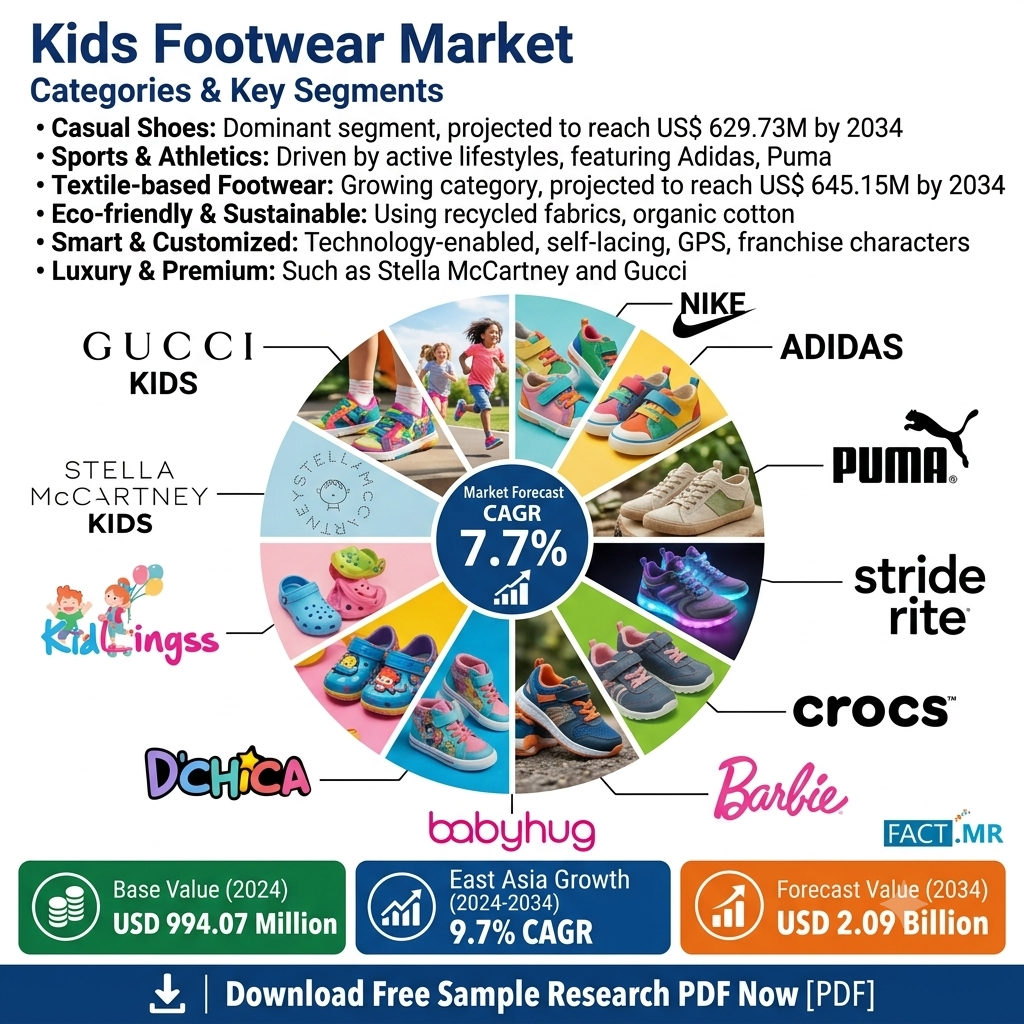
Rockville, MD, November 26, 2026 — The global kids footwear market is projected to grow from US$ 994.07 million in 2024 to US$ 2.09 billion by 2034, expanding at a compound annual growth rate (CAGR) of 7.7% during the forecast period, according to Fact.MR. Rising parental attention to children's foot health, increasing participation in sports, and demand for fashionable footwear are shaping product development across the industry. Manufacturers are also introducing customized designs and technology-enabled shoes to address changing expectations among young consumers and their parents.
Request for PDF Report Sample Pages: https://www.factmr.com/connectus/sample?flag=S&rep_id=3609
The expansion reflects a shift in purchasing priorities. Parents increasingly consider comfort, orthopedic support, material quality, and appearance when selecting footwear for children. At the same time, online shopping and mobile internet access are making branded children's footwear more accessible. Fact.MR estimates North America's kids footwear market at US$ 234.62 million in 2024, while East Asia is projected to record the fastest regional growth at a 9.7% CAGR through 2034.
Kids Footwear Market Growth Driven by Comfort and Product Innovation
Technology is becoming a more visible part of children's footwear development. Brands are introducing products that address growing feet while offering features associated with convenience and personalization.
Nike's Adapt BB provides an example of this approach. The self-lacing shoe uses smartphone application controls, allowing youngsters to customize the fit. The technology is designed to maintain a snug fit as children's feet grow, addressing comfort and foot-health considerations.
Stride Rite has also introduced Ortho-Step Technology for growing feet. Its footwear incorporates flexible soles, cushioned insoles, and improved arch support. These features position supportive footwear as an important consideration for parents looking beyond appearance when purchasing children's shoes.
Fact.MR is a market research and consulting firm that provides industry analysis, market forecasts, and business intelligence across global industries. Its kids footwear analysis identifies product innovation, changing fashion preferences, and greater health awareness as important factors influencing market development.
Fashion Preferences and Sustainable Materials Influence Purchasing Decisions
Children's footwear is increasingly connected to everyday fashion. Sneakers, once primarily associated with sports activities, have become regular wardrobe choices for young consumers. Manufacturers are responding through new colors, prints, character-based designs, and footwear collections suitable for different occasions.
Customization is gaining attention. Parents can increasingly choose footwear featuring specific colors, names, designs, and popular entertainment characters. Collaborations involving children's entertainment franchises, including Disney and superhero properties, are helping brands develop products that appeal to younger buyers.
Sustainability is another developing area. Manufacturers are exploring recycled fabrics and organic cotton as alternatives in children's footwear production. Some companies are also adopting circular economy initiatives, including shoe collection and recycling programs that repurpose used footwear or provide discounts on future purchases.
Technology offers another route for differentiation. Built-in sensors can monitor steps, activity levels, and other fitness indicators. Collaborations between footwear manufacturers and technology companies are also supporting the development of GPS tracking and fitness-monitoring features.
Casual Shoes and Textile Materials Lead Market Segments
Casual shoes remain the dominant product category, accounting for more than 50% of the global kids footwear market. The segment is forecast to reach US$ 629.73 million by 2034. Its position reflects demand for versatile footwear that combines everyday comfort with fashionable designs.
Textile-based footwear is another important category. The textile segment is expected to reach US$ 645.15 million by 2034. Cotton, polyester, wool, and nylon are among the materials used across this category.
Sports footwear is expected to gain momentum as children's participation in indoor and outdoor activities increases. Growing awareness of sedentary lifestyles is encouraging parents to consider footwear designed for athletic activities. Brands such as Adidas and Puma are expanding their footwear offerings across age groups, including younger consumers.
Rubber and foam footwear also maintain an important position because of their lightweight construction and comfort. These materials can help reduce discomfort associated with shoe bites, making them practical choices for children.
Regional Outlook: East Asia Records Faster Growth
North America currently holds a leading position in the kids footwear market. The region's market value was estimated at US$ 234.62 million in 2024. Awareness of sports and athletics in the United States and Canada supports demand, while expanding fitness activities are creating opportunities in toddler footwear.
East Asia is expected to register a stronger growth trajectory, with a projected CAGR of 9.7% between 2024 and 2034. China plays an important role as a manufacturer, consumer, and exporter of children's footwear. India and China also contribute to global production, with exports reaching markets such as the United States and the United Kingdom.
The Middle East presents opportunities for premium children's footwear. Luxury brands, including Stella McCartney and Gucci, offer children's collections in the Middle Eastern and North American markets, connecting premium fashion preferences with younger consumers.
Competitive Landscape and Industry Opportunities
Competition in the kids footwear industry is shaped by product quality, pricing, promotional activity, and design differentiation. Companies are expanding collections across casual, ethnic, sneaker, and comfort-oriented footwear categories.
Floral prints, bright colors, retro-inspired designs, and traditional ethnic footwear are among the styles attracting attention. Lighting footwear also appeals to toddlers, while sneakers remain popular for their combination of comfort and contemporary styling.
Online sales channels are adding another competitive dimension. Promotional campaigns and digital platforms allow manufacturers to reach parents directly, while customized product offerings help brands distinguish their collections.
Companies profiled in the Fact.MR analysis include BabyHug, D'Chica, Magic Needles, Morison's Baby Dreams, Kidlings, Crocs, and Barbie.
View Related Reports :
Dual-Action Dishwasher Tablets Market : https://www.factmr.com/report/dual-action-dishwasher-tablets-market
Refill-Compatible Dispensing Units Market : https://www.factmr.com/report/refill-compatible-dispensing-units-market
Waterless Hand Sanitizing Foams Market : https://www.factmr.com/report/waterless-hand-sanitizing-foams-market
Marine Cleaning Products Market : https://www.factmr.com/report/marine-cleaning-products-market
About Fact.MR
Fact.MR is a global market research and consulting firm providing comprehensive market intelligence, industry analysis, and strategic insights across multiple sectors. The company delivers data-driven research covering market size, growth forecasts, competitive landscapes, emerging trends, and regional opportunities to help businesses make informed decisions.

 English
 Arabic
 French
 Spanish
 Portuguese
 Deutsch
 Turkish
 Italiano
 Russian
 Romaian
 Portuguese (Brazil)
 Greek