


qPCR Reagents Market Advances Toward USD 5.6 Billion by 2035, China at 8.9% CAGR, Germany at 7.8%, and the United States at 7.6%
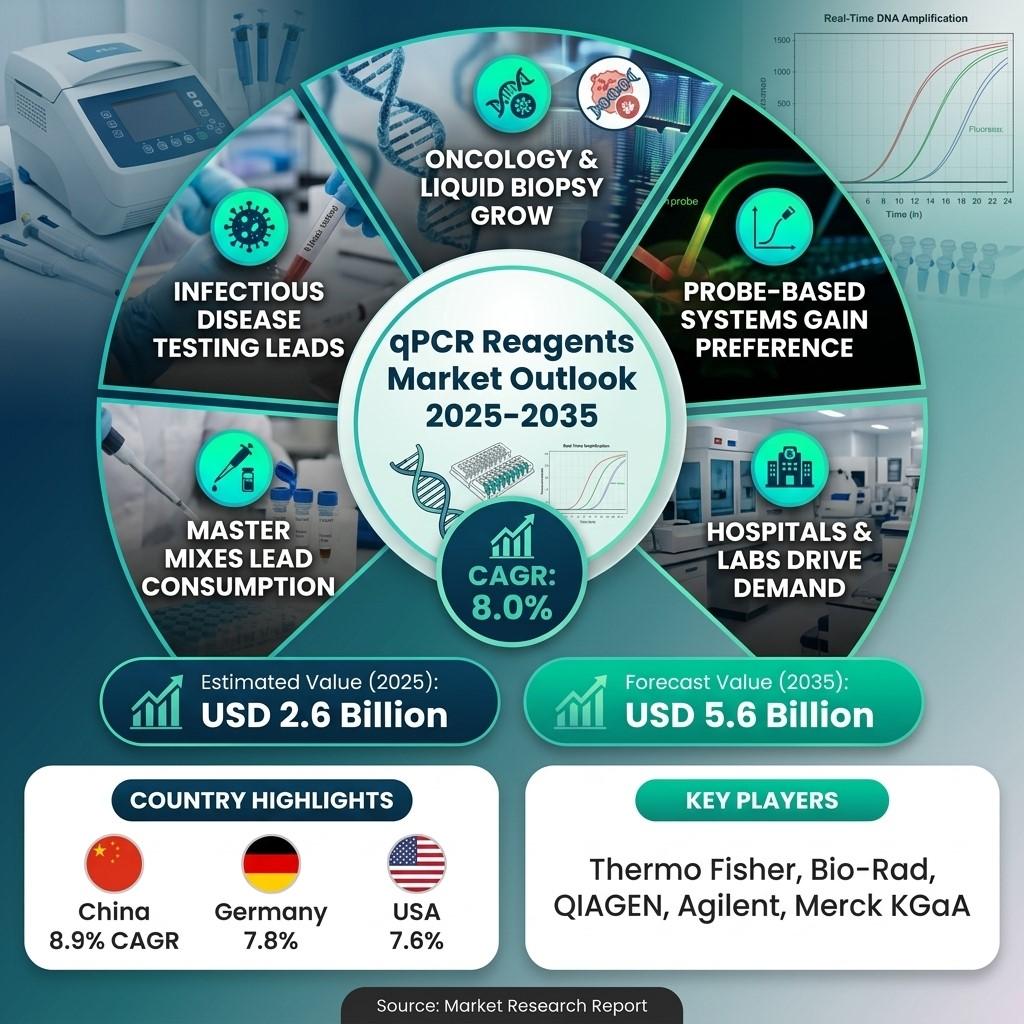
The global qPCR reagents market is projected to expand from USD 2.6 billion in 2025 to USD 5.6 billion by 2035, registering a CAGR of 8.0% over the forecast period. Fact.MR attributes market growth to increasing demand for molecular diagnostics, rising prevalence of infectious and genetic diseases, and wider use of precision medicine across clinical and research settings.
Growing investments in molecular testing infrastructure are strengthening reagent demand across hospitals, diagnostic laboratories, pharmaceutical companies, and academic research facilities. qPCR technology is widely used for pathogen detection, gene expression analysis, mutation testing, and biomarker identification. Expanding research activity in oncology, genetic disorders, and personalized treatment is creating sustained requirements for reliable amplification and detection reagents.
Get detailed market forecasts, competitive benchmarking, and pricing trends:
https://www.factmr.com/connectus/sample?flag=S&rep_id=8312
Master Mixes Maintain Leading Position
By product type, master mixes represent the leading category in the qPCR reagents market. Their ready-to-use formulations combine essential components such as enzymes, buffers, dNTPs, and detection chemistries, helping laboratories simplify preparation and maintain consistency across testing workflows. Demand for optimized mixes is rising as researchers and diagnostic providers seek reliable performance across gene expression studies, pathogen testing, and genotyping applications.
Enzymes, including reverse transcriptases, hot-start DNA polymerases, and RNase inhibitors, also remain important reagent components. Growing adoption of one-step quantitative reverse transcription PCR workflows is supporting their use in RNA-based infectious disease testing and molecular research. Manufacturers are developing formulations suited to low-concentration targets, faster cycling protocols, and high-throughput testing requirements.
Probe-based detection methods are gaining traction where specificity and accurate quantification are important. These systems are increasingly used in clinical testing and pharmaceutical applications involving multiple genetic targets. Improvements in fluorogenic probes and assay chemistry are supporting more sensitive detection and helping laboratories reduce the likelihood of nonspecific results.
China, Germany, and the United States Show Growth Potential
China is projected to record an 8.9% CAGR in the qPCR reagents market through 2035. Investments in domestic diagnostic reagent manufacturing, biotechnology research, and infectious disease preparedness are supporting market expansion. The development of multiplex assays for tuberculosis, hepatitis, and human papillomavirus testing is also increasing demand for specialized reagent formulations across public and private laboratories.
Germany is expected to register a 7.8% CAGR over the forecast period. Demand is supported by advanced molecular diagnostic infrastructure, research activity across university hospitals and pharmaceutical companies, and wider adoption of biomarker-driven testing. Growing applications in oncology, rare disease management, and clinical research are creating opportunities for reagent suppliers focused on high-quality formulations and automated laboratory workflows.
The United States is projected to expand at a 7.6% CAGR through 2035. Established clinical laboratory networks, strong biotechnology investment, and continued funding for infectious disease surveillance and genomic research are supporting reagent consumption. Expansion of companion diagnostics, precision medicine, and molecular testing applications is also strengthening demand for qPCR products across healthcare and research institutions.
Competitive Landscape
Competition in the qPCR reagents market includes manufacturers with established molecular biology portfolios, diagnostic capabilities, and research-focused product offerings. Key companies profiled by Fact.MR include Thermo Fisher Scientific, Bio-Rad Laboratories, QIAGEN N.V., Agilent Technologies, Merck KGaA, Takara Bio Inc., Promega Corporation, Danaher Corporation, Bioline, and GeneCopoeia Inc.
Procurement decisions are influenced by reagent sensitivity, assay compatibility, stability, reproducibility, and pricing. Laboratories are increasingly evaluating formulations that support multiplex testing, automated workflows, and different qPCR platforms. Manufacturers are also investing in distribution partnerships, customized assay solutions, and open-system-compatible reagents to expand their reach across diagnostic and research markets.
Technology Advancements and Diagnostic Applications Shape Market Growth
The qPCR reagents market is evolving alongside developments in multiplex testing, digital PCR, liquid biopsy, and molecular diagnostics. Reagent suppliers are focusing on improved sensitivity, optimized amplification efficiency, and formulations suited to lower-volume testing. Lyophilized reagents and room-temperature-stable products are also gaining attention as laboratories seek to simplify storage and transportation requirements, particularly in decentralized testing environments.
Infectious disease testing continues to support reagent consumption, while oncology and genetic testing are creating additional opportunities. qPCR reagents are increasingly used for mutation analysis, gene expression studies, minimal residual disease assessment, and biomarker-based research. Growing interest in microbiome analysis, liquid biopsy, and pharmacogenomics is broadening the range of applications.
As molecular diagnostics becomes more integrated into routine healthcare, research, and precision medicine, reagent manufacturers are expected to focus on assay performance, product stability, multiplexing capabilities, and workflow efficiency. Fact.MR's report examines market opportunities, segment trends, country-level forecasts, and competitive developments through 2035.
To View Top Reports
Ready-to-Stir Medical Proteins Market: https://www.factmr.com/report/ready-to-stir-medical-proteins-market
High-Leucine Medical Protein Isolates Market: https://www.factmr.com/report/high-leucine-medical-protein-isolates-market
Medical-Grade Barrier Formulations Market: https://www.factmr.com/report/medical-grade-barrier-formulations-market
About Fact.MR
Fact.MR is a market research and consulting company providing market intelligence, competitive analysis, and forecasting across global industries. Its research supports businesses with data-driven insights into emerging markets, technology trends, competitive dynamics, regional opportunities, and changing demand patterns.

 English
 Arabic
 French
 Portuguese
 Deutsch
 Turkish
 Dutch
 Italiano
 Russian
 Romaian
 Portuguese (Brazil)
 Greek