


GCC Conversational AI Market Size, Share, Growth, and Forecast 2026-2034
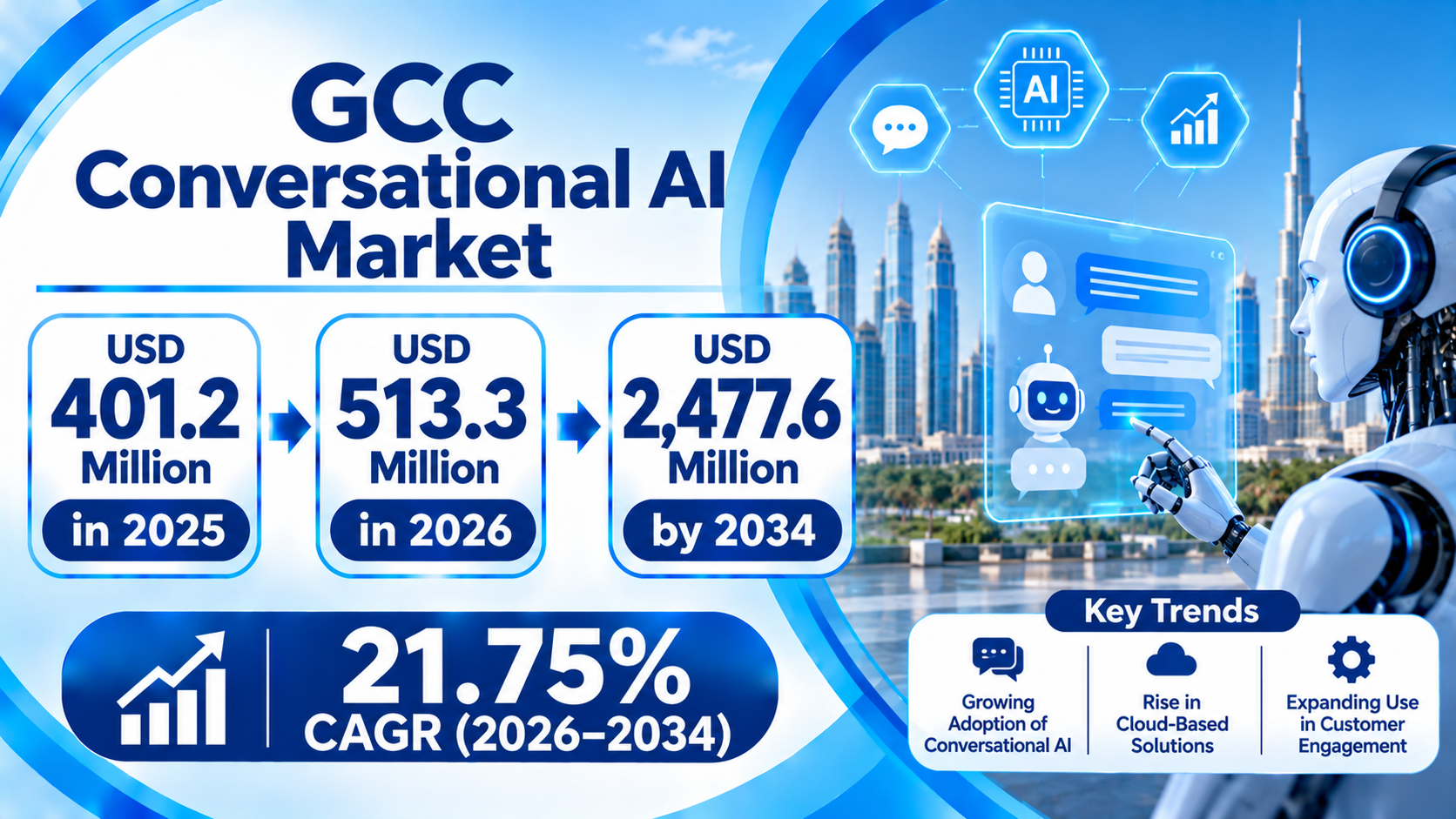
IMARC Group, a leading global market research and management consulting firm, has published its latest market intelligence report on the GCC Conversational AI Market. The GCC conversational AI market size increased from USD 401.2 Million in 2025 to USD 513.3 Million in 2026 and is projected to reach USD 2,477.6 Million by 2034, exhibiting a CAGR of 21.75% during 2026-2034. Growth is being driven by the heightened emphasis on customer experience, the booming e-commerce sector, expanding digitalization, favorable government initiatives, and sector-specific optimization across industries.
Conversational AI, the chatbots, voice assistants and AI agents that talk with customers and employees in natural language, is moving quickly from simple scripted bots to Arabic-capable, tool-using agents in the Gulf. Banks, telecom operators, retailers, hospitals and governments are deploying assistants to answer questions, complete transactions and route cases around the clock, while national champions in Saudi Arabia, the UAE and Qatar are building their own Arabic large language models that understand dialects and mixed Arabic and English speech. High smartphone penetration, multicultural populations and national AI strategies are widening demand. At the same time, most AI systems still operate primarily in English, customers in some markets remain cautious after earlier poor bot experiences, and regulators and enterprises are putting growing weight on data residency, governance and human supervision. Combined with strong demand in the UAE and Saudi Arabia and growing activity across Qatar, Oman, Kuwait, and Bahrain, these forces are shaping a high-growth, long-term path for the market.
GCC Conversational AI Market at a Glance:
- Market Size (2025): USD 401.2 Million
- Market Size (2026): USD 513.3 Million
- Market Forecast (2034): USD 2,477.6 Million
- Growth Rate (2026-2034): CAGR of 21.75%
- Base Year: 2025 | Historical Period: 2020-2025 | Forecast Period: 2026-2034
How AI is Reshaping the Future of the GCC Conversational AI Market
- Arabic-First Large Language Models Become the Foundation: HUMAIN, the PIF-owned AI company, launched HUMAIN Chat in August 2025, an Arabic-first conversational app powered by its ALLaM 34B model that handles dialects, Arabic-English switching, speech input and real-time web search. On 6 November 2026, Abu Dhabi's Jais 3 was reported to combine Arabic speech recognition with instruction following, software tool use and multi-step tasks, and to retain English terms inside Arabic speech, while TII's Falcon family now includes Falcon-Emirati, Falcon-ASR and Falcon-OCR-Arabic.
- Agentic and Voice AI Moves Into Banking: Emirates NBD said it has more than 150 AI initiatives underway, with 65 already in production, won a 2026 Global AI Innovation Award for voice banking with its generative AI-powered Enterprise Conversational Agent, and announced in October 2026 that it will run OpenAI models on in-country UAE infrastructure. ADCB unveiled an AI-powered mobile banking app on 11 May 2026 that lets customers use voice and text commands, and digital Islamic bank ruya deployed agentic AI in production in August 2026.
- AI Agents in Government, Telecom and Customer Experience: On 23 November 2026, the UAE unveiled mira, an AI personal assistant for government services available from March 2027, as part of a Government 4.0 vision that targets 50% of services being AI-enabled within two years. stc Bahrain launched Bayan at LEAP 2026, a contact center with voice and digital agents and native Bahraini and Gulf Arabic capabilities, and Lucidya introduced an Enterprise AI Agent for Arabic-first businesses in July 2026.
Grab a sample PDF of this report: https://www.imarcgroup.com/gcc-conversational-ai-market/requestsample
GCC Conversational AI Market Trends and Drivers:
Demand for conversational AI in the GCC is being underpinned by customer experience, digitalization and e-commerce. The report notes that a rising number of businesses are prioritizing personalized and prompt interactions, that widespread digitalization and soaring smartphone penetration are pushing consumers toward frictionless on-demand services, and that e-commerce is fueling chatbots that guide shoppers through purchases. Adoption is uneven, with a February 2026 Khaleej Times report noting that Saudi Arabia shows high openness to AI-driven service while UAE consumers are more cautious after earlier negative bot experiences, leading enterprises toward governed, human-supervised models.
The market's structural differentiator is language and sovereignty. The report points to conversational AI's proficiency in numerous languages as vital for the region's multicultural landscape, and a PwC Strategy& article published in May 2026 noted that most AI systems still operate primarily in English while Arabic-native models such as ALLaM, JAIS, Falcon and Fanar remain nascent and mostly confined to front-end conversational layers. Dialect handling and code-switching are therefore a competitive edge, which Lucidya addresses with Arabic-first agents and Jais 3 addresses with dialect and speech capabilities.
A third driver is the shift from chatbots to agents across industries. The report highlights healthcare uses such as appointment scheduling, remote patient monitoring and medical consultations, and financial services uses such as virtual banking assistants, automated transactions and personalized advice. Emirates NBD's agents, ADCB's voice and text app, stc Bahrain's contact center and the UAE's mira show how organizations are moving toward end-to-end workflow automation, a dynamic that is set to intensify over the coming decade.
Government Schemes and National Initiatives Shaping Demand:
- UAE Government 4.0 and the mira Assistant: On 23 November 2026, the UAE unveiled mira, an AI-enabled personal assistant for citizens and residents available from March 2027, positioned as the first government assistant designed to work for everyone. It is part of the Government 4.0 vision in which agentic AI plays a central role in service delivery, and the UAE is targeting 50% AI-enabled services within two years.
- Saudi Arabia's HUMAIN and National AI Push: The Public Investment Fund's HUMAIN is building a full-stack AI ecosystem, from infrastructure to the ALLaM model and applications such as HUMAIN Chat, which it describes as enterprise-ready for integration into government services, financial systems and customer platforms. Saudi Arabia also declared 2026 the Year of Artificial Intelligence in March.
- Open Banking Licensing in Saudi Arabia: In March 2026, the Saudi Central Bank began licensing fintech companies to provide open banking services, creating data-rich digital channels that conversational assistants can use for balances, payments and personalized advice.
- Data Protection and Data Residency: UAE and Saudi personal data protection laws and Qatar's data protection law encourage sensitive data to stay in the country, and Emirates NBD's plan to run OpenAI models on UAE-based infrastructure for customer, risk and compliance work reflects the push for in-country processing. Regulators are also placing increasing emphasis on governance and transparency in AI.
- National AI Models and Government Collaboration: National initiatives such as Saudi Arabia's ALLaM, the UAE's JAIS and Falcon, and Qatar's Fanar, along with the OpenAI and G42 collaboration on a customized government model, reflect a shift toward Arabic-native, institution-specific AI supported by state funding and research institutes.
GCC Conversational AI Market Industry Segmentation:
The report has segmented the market into the following categories:
Breakup By Component:
- Platform
- Services
The report provides a detailed breakup and analysis of platform and services, with platforms supported by Arabic-first models and agent products from firms such as HUMAIN, Lucidya and TII, and services covering integration, governance and managed AI operations, as enterprises move from pilots to production and need human-supervised models.
Breakup By Deployment:
- Cloud-Based
- On-Premises
The report provides a detailed breakup and analysis of cloud-based and on-premises deployment, with cloud-based solutions favored for scalability and speed, as seen in the growth of in-country hyperscale capacity, and on-premises or in-country deployment important for regulated sectors, as shown by Emirates NBD's plan to run OpenAI models on UAE-based infrastructure.
Breakup By Type:
- Intelligent Virtual Assistant (IVAs)
- Chatbots
The report provides a detailed breakup and analysis of intelligent virtual assistants (IVAs) and chatbots, with IVAs advancing through voice-enabled assistants such as ADCB's voice and text banking app, HUMAIN Chat and the UAE's mira, and chatbots evolving from scripted bots to tool-using agents, such as Emirates NBD's AI Travel Assistant, launched in October 2026 with Visa and Tripadvisor.
Breakup By End User:
- BFSI
- Retail and E-Commerce
- Healthcare
- IT and Telecom
- Media and Entertainment
- Others
The report provides a detailed breakup and analysis of BFSI, retail and e-commerce, healthcare, IT and telecom, media and entertainment, and others, with BFSI at the forefront through Emirates NBD, ADCB and ruya, retail and e-commerce using chatbots to guide purchases, healthcare using assistants for appointments and remote monitoring, IT and telecom led by contact centers such as stc Bahrain's Bayan, media and entertainment benefiting from speech tools such as Falcon-ASR for subtitling, and government services in others through mira.
Breakup By Country:
- Saudi Arabia
- UAE
- Qatar
- Oman
- Kuwait
- Bahrain
The report provides a comprehensive analysis of all the major regional markets, including Saudi Arabia, the UAE, Qatar, Oman, Kuwait and Bahrain, with Saudi Arabia building sovereign Arabic AI through HUMAIN and ALLaM and showing high openness to AI service, the UAE leading deployments through Jais, Falcon, banks and the mira government assistant, Qatar developing Fanar, and Bahrain adding Arabic-first contact centers through stc Bahrain.
Competitive Landscape:
The report provides a comprehensive analysis of the competitive landscape, covering market structure, key player positioning, top winning strategies, the competitive dashboard and the company evaluation quadrant, along with detailed profiles of major companies. The market brings together national AI champions such as HUMAIN, G42 and MBZUAI (Jais), TII (Falcon) and Qatar's Fanar, Arabic-first enterprise platforms such as Lucidya, global model providers such as OpenAI, banks and telecom operators building their own agents, and system integrators, with competition centered on Arabic dialect accuracy, data residency, governance and integration with enterprise workflows.
What Does The Full Report Cover?
- Historical, current, and forecast market size for the GCC conversational AI market from 2020 to 2034
- Market breakup by component, deployment, type, end user, and country
- Country analysis covering Saudi Arabia, the UAE, Qatar, Oman, Kuwait, and Bahrain
- Key driving factors and challenges shaping the market
- Value chain analysis of the GCC conversational AI market
- Porter's Five Forces analysis of new entrants, competitive rivalry, supplier power, buyer power, and threat of substitution
- Competitive landscape, market structure, and player positioning
- Detailed profiles of major conversational AI companies in the GCC
Recent News and Developments in the GCC Conversational AI Market
- November 2026: The UAE unveiled mira on 23 November, an AI personal assistant for government services available from March 2027, as it targets 50% AI-enabled services in two years under its Government 4.0 vision.
- November 2026: Jais 3 was reported on 6 November as Abu Dhabi's new Arabic AI that combines speech recognition with instruction following and tool use, and can understand dialects while retaining English terms in speech.
- October 2026: Emirates NBD announced on 19 October a collaboration to become the first bank in the MENA region to run OpenAI models on in-country UAE infrastructure across customer, risk and compliance work, and launched the UAE's first bank-led AI Travel Assistant with Visa and Tripadvisor.
- July 2026: Lucidya introduced an Enterprise AI Agent designed for Arabic-first businesses, aimed at the challenges of deploying AI across customer-facing operations where English-trained systems struggle with dialects and mixed Arabic-English conversations.
- May 2026: ADCB unveiled a next-generation mobile banking app built around AI on 11 May, letting customers interact by voice and text commands instead of menus, as part of an AI strategy announced in 2025.
Note: If you require specific details, data, or insights that are not currently included in the scope of this report, we are happy to accommodate your request. As part of our customization service, we will gather and provide the additional information you need, tailored to your specific requirements. Please let us know your exact needs, and we will ensure the report is updated accordingly to meet your expectations.
Key Questions This Report Answers
- How has the GCC conversational AI market performed so far and how will it perform in the coming years?
- What is the breakup of the GCC conversational AI market on the basis of component, deployment, type, and end user?
- What is the breakup of the GCC conversational AI market on the basis of country?
- What are the various stages in the value chain of the GCC conversational AI market?
- What are the key driving factors and challenges in the GCC conversational AI market?
- What is the structure of the GCC conversational AI market and who are the key players?
- What role are Arabic large language models, agentic AI, and data residency rules playing in the future of GCC conversational AI?
About Us
IMARC Group is a global management consulting firm that helps the world's most ambitious changemakers to create a lasting impact. The company provides a comprehensive suite of market entry and expansion services. IMARC offerings include thorough market assessment, feasibility studies, company incorporation assistance, factory setup support, regulatory approvals and licensing navigation, branding, marketing and sales strategies, competitive landscape and benchmarking analyses, pricing and cost research, and procurement research.
Media and Sales Contact
IMARC Group
Email: sales@imarcgroup.com
United States: +1-201-971-6302
India: +91-120-433-0800
United Kingdom: +44-753-714-6104

 Arabic
 French
 Spanish
 Portuguese
 Deutsch
 Turkish
 Dutch
 Italiano
 Russian
 Romaian
 Portuguese (Brazil)
 Greek