


Indonesia Kitchen Appliances Market Size, Trends, and Growth Forecast 2026-2034
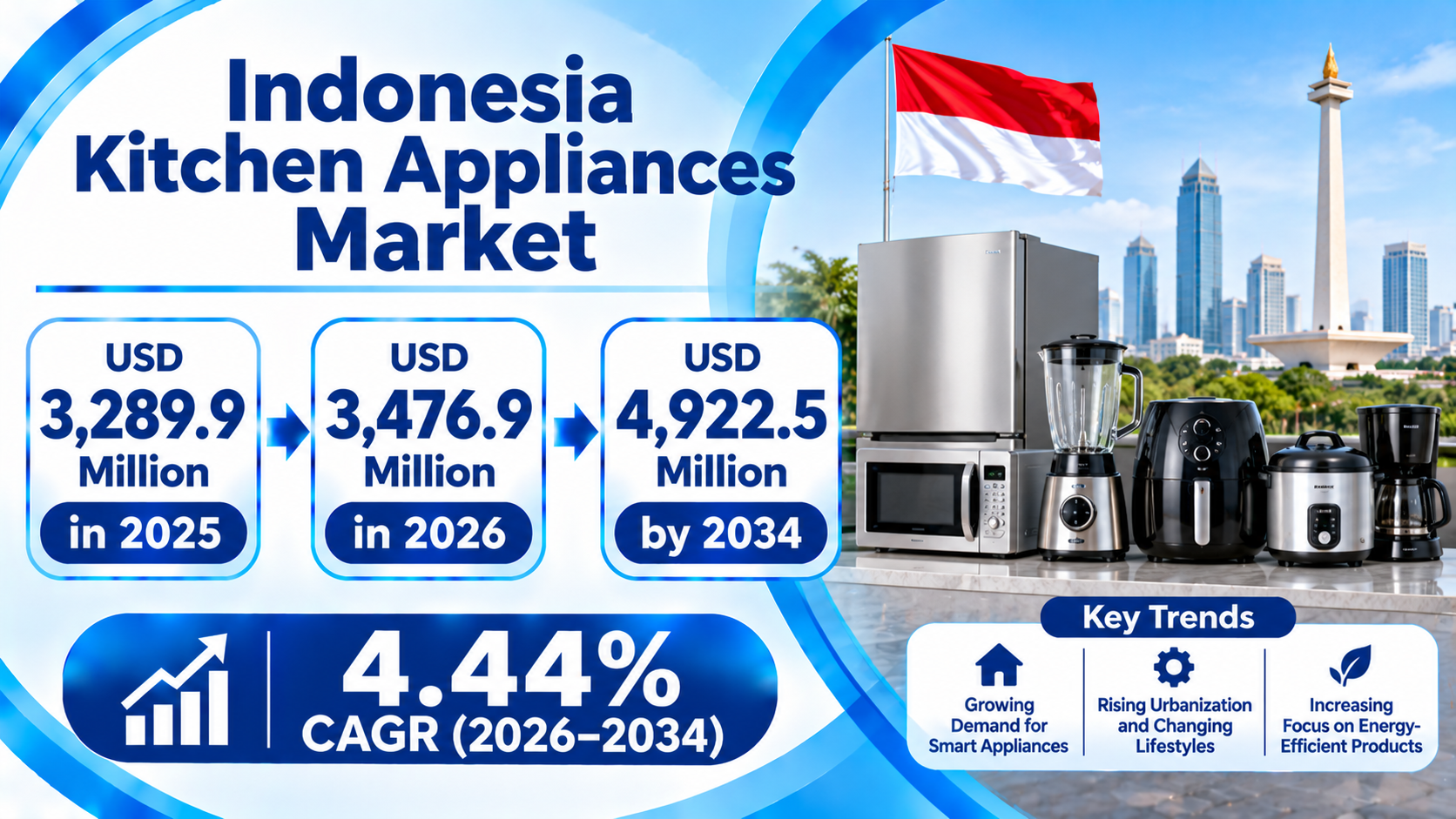
IMARC Group, a leading global market research and management consulting firm, has published its latest market intelligence report on the Indonesia Kitchen Appliances Market. The Indonesia kitchen appliances market grew from USD 3,289.9 Million in 2025 to USD 3,476.9 Million in 2026 and is projected to reach USD 4,922.5 Million by 2034, exhibiting a CAGR of 4.44% during 2026-2034. Growth is being driven by urbanization, changing culinary habits and a growing preference for modern, time-saving appliances, alongside rising middle-class incomes, expanding e-commerce platforms and increased awareness of energy-efficient technologies.
Kitchen appliances are among the most visible signs of rising living standards in Indonesia, spanning refrigerators, microwave ovens, induction stoves, dishwashers and water purifiers in both built-in and free-standing formats, powered by cooking gas or electricity. As more people move to cities, demand is rising for modern housing equipped with functional kitchens, and rising disposable income is moving consumers from basic to premium appliances that blend functionality with style. At the same time, smart features such as Wi-Fi connectivity, touch screens and self-cleaning systems are reaching mainstream models, while online platforms and modern retail chains are making products easier to compare and buy. Combined with energy policy that is encouraging a shift from LPG to electric cooking, these forces are driving Indonesia kitchen appliances market growth and reshaping the competitive landscape across Java, Sumatra, Kalimantan, Sulawesi and beyond.
Indonesia Kitchen Appliances Market at a Glance:
- Market Size (2025): USD 3,289.9 Million
- Market Size (2026): USD 3,476.9 Million
- Market Forecast (2034): USD 4,922.5 Million
- Growth Rate (2026-2034): CAGR of 4.44%
- Base Year: 2025 | Historical Period: 2020-2025 | Forecast Period: 2026-2034
How AI is Reshaping the Future of the Indonesia Kitchen Appliances Market
- Smart and Connected Kitchen Appliances: The report notes that IoT products, automated products and products that connect with mobile applications are gaining traction, especially among technologically inclined younger generations. Wi-Fi-connected smart rice cookers, voice-controlled dishwashers and ovens have become popular for the convenience, efficiency and energy savings they provide.
- Global AI Induction and Kitchen Launches: In April 2026, Samsung launched the Bespoke AI Extractor Induction Hob in South Korea, integrating a ventilation hood with automatic cookware detection, while LG unveiled a built-in kitchen package anchored by a hood-integrated induction cooktop at EuroCucina 2026 in Milan. Such launches by brands active in Indonesia point to where AI-enabled cooking is heading.
- A National AI Push: In April 2026, Indonesia's Coordinating Minister for Economic Affairs described digitalization and AI as new growth engines and said the government is preparing 15,000 AI-ready talents this year, supporting the digital skills and platforms on which smart home ecosystems depend.
Grab a sample PDF of this report: https://www.imarcgroup.com/indonesia-kitchen-appliances-market/requestsample
Indonesia Kitchen Appliances Market Trends and Drivers:
Demand for kitchen appliances in Indonesia is being underpinned by technological advancements and smart features. Manufacturers are adding touch screens, self-cleaning systems and multi-purpose capabilities, and these innovations align with growing interest in smart home ecosystems, accelerating adoption of high-tech appliances in both new and renovated homes across the country.
The region's structural differentiator is the combination of rapid urbanization and a growing middle class. As more people move to urban areas, demand rises for modern housing with functional kitchens and for appliances such as microwave ovens, induction cooktops and smart refrigerators, while rising disposable income is driving a shift toward premium products, modular kitchens and energy-efficient models. Expansion of residential construction in urban centers supports both built-in and freestanding appliances.
A third driver is the growth of e-commerce and retail penetration. Platforms such as Shopee, Tokopedia and Lazada let consumers compare products, find competitive prices and use flexible payment options, while modern supermarkets and electronics chains are expanding in urban and semi-urban areas with product demonstrations and after-sales support. In January 2025, Midea Electronics Indonesia introduced its Midea Everest refrigerator, combining spacious storage, advanced technological features and energy-saving capabilities at an accessible price point, a dynamic that is set to intensify over the coming decade.
Government Schemes and Policy Initiatives Driving Demand:
- LPG-to-Induction Conversion Program: To cut dependence on subsidized and imported LPG, PLN piloted the conversion of 3 kg LPG stoves to induction cookers in 2022 in Solo City, Central Java, and Badung Regency, Bali, with each household receiving a two-burner induction cooker. PLN estimated that converting one million stoves would lower LPG imports by 136.8 thousand tons and cut LPG subsidies by IDR 778.7 billion a year. A July 2026 IEEFA briefing notes that the pilot was discontinued before scaling up, and that the government has signaled a new electric stove program.
- Tighter Targeting of Subsidized 3 kg LPG: Market commentary reports that in the first quarter of 2026 the Ministry of Energy and Mineral Resources tightened access to subsidized 3 kg LPG using registry data, a step that narrows the cost gap between gas and electric cooking for middle-class households.
- National Digital Economy and AI Agenda: Indonesia's digital economy is approaching USD 100 Billion according to the Coordinating Minister for Economic Affairs, with 15,000 AI-ready talents being prepared in 2026, supporting the e-commerce platforms and connected devices through which kitchen appliances are increasingly sold.
Indonesia Kitchen Appliances Market Industry Segmentation:
The report has segmented the market into the following categories:
Breakup By Product Type:
- Refrigerators
- Microwave Ovens
- Induction Stoves
- Dishwashers
- Water Purifiers
- Others
The report provides a detailed breakup and analysis of the market by product type, covering refrigerators, microwave ovens, induction stoves, dishwashers, water purifiers and others, with induction stoves and smart refrigerators highlighted among the products gaining prospects as consumers upgrade.
Breakup By Structure:
- Built-In
- Free Stand
The report provides a detailed breakup and analysis of the market by structure, covering built-in and free-standing appliances, with expanding residential construction in urban centers supporting both formats.
Breakup By Fuel Type:
- Cooking Gas
- Electricity
- Others
The report provides a detailed breakup and analysis of the market by fuel type, covering cooking gas, electricity and others, as LPG subsidy policy and electrification programs influence the shift toward induction and other electric appliances.
Breakup By Application:
- Residential
- Commercial
The report provides a detailed breakup and analysis of the market by application, covering residential and commercial uses.
Breakup By Distribution Channel:
- Supermarkets and Hypermarkets
- Specialty Stores
- Online Stores
- Departmental Stores
- Others
The report provides a detailed breakup and analysis of the market by distribution channel, with the synergy between online and offline channels creating a seamless shopping experience that broadens market reach.
Breakup By Region:
- Java
- Sumatra
- Kalimantan
- Sulawesi
- Others
The report provides a comprehensive analysis of all the major regional markets, covering Java, Sumatra, Kalimantan, Sulawesi and Others.
Competitive Landscape:
The report provides a comprehensive analysis of the competitive landscape in the Indonesia kitchen appliances market, covering market structure, key player positioning, top winning strategies, a competitive dashboard and a company evaluation quadrant. Detailed profiles of all major companies are also included. Global and regional appliance brands are competing through smart features, energy-efficient models, premium and value ranges, and expanded online and offline retail reach.
What Does The Full Report Cover?
- Historical, current, and forecast market size for the Indonesia kitchen appliances market from 2020 to 2034
- Market breakup by product type, structure, fuel type, application, distribution channel, and region
- Regional analysis covering Java, Sumatra, Kalimantan, Sulawesi, and Others
- Key market driving factors and challenges, along with the value chain of the market
- Porter's Five Forces analysis assessing new entrants, competitive rivalry, supplier power, buyer power, and the threat of substitution
- Competitive landscape, market structure, key player positioning, top winning strategies, and company evaluation quadrant
- Detailed profiles of major companies operating in the Indonesia kitchen appliances market
Recent News and Developments in the Indonesia Kitchen Appliances Market
- January 2025: Midea Electronics Indonesia introduced its latest refrigerator model, the Midea Everest, engineered for today's consumers with spacious storage, advanced technological features and energy-saving capabilities at an accessible price point.
- First Quarter 2026: Indonesia's Ministry of Energy and Mineral Resources was reported to have tightened access to subsidized 3 kg LPG using registry data, a policy that affects the economics of gas versus electric cooking for households.
- April 2026: Samsung launched the Bespoke AI Extractor Induction Hob in South Korea on 21 April 2026, with automatic cookware detection and integrated ventilation, while LG unveiled its built-in full kitchen package at EuroCucina 2026 in Milan from 20 to 26 April.
- July 2026: An IEEFA briefing note published in July 2026 argued that electric induction offers Indonesia's most cost-effective alternative to LPG cooking, estimating that about 42 million households could qualify for an induction conversion package.
Note: If you require specific details, data, or insights that are not currently included in the scope of this report, we are happy to accommodate your request. As part of our customization service, we will gather and provide the additional information you need, tailored to your specific requirements. Please let us know your exact needs, and we will ensure the report is updated accordingly to meet your expectations.
Key Questions This Report Answers
- How big is the Indonesia kitchen appliances market and what is its growth outlook through 2034?
- What are the key growth drivers and challenges in the Indonesia kitchen appliances market?
- How do refrigerators, microwave ovens, induction stoves, dishwashers, and water purifiers compare?
- How do built-in and free-standing appliances shape the market?
- How do cooking gas and electricity fuel types contribute to demand?
- How do online stores, supermarkets, and specialty stores shape distribution?
- Who are the key players in the Indonesia kitchen appliances market, and how is the competitive landscape evolving?
About Us
IMARC Group is a global management consulting firm that helps the world's most ambitious changemakers to create a lasting impact. The company provides a comprehensive suite of market entry and expansion services. IMARC offerings include thorough market assessment, feasibility studies, company incorporation assistance, factory setup support, regulatory approvals and licensing navigation, branding, marketing and sales strategies, competitive landscape and benchmarking analyses, pricing and cost research, and procurement research.
Media and Sales Contact
IMARC Group
Email: sales@imarcgroup.com
United States: +1-201-971-6302
India: +91-120-433-0800
United Kingdom: +44-753-714-6104

 English
 Arabic
 Spanish
 Portuguese
 Deutsch
 Turkish
 Dutch
 Italiano
 Russian
 Romaian
 Portuguese (Brazil)
 Greek