


Vanadium dioxide thermochromic coating market valued at USD 0.92 Billion in 2025
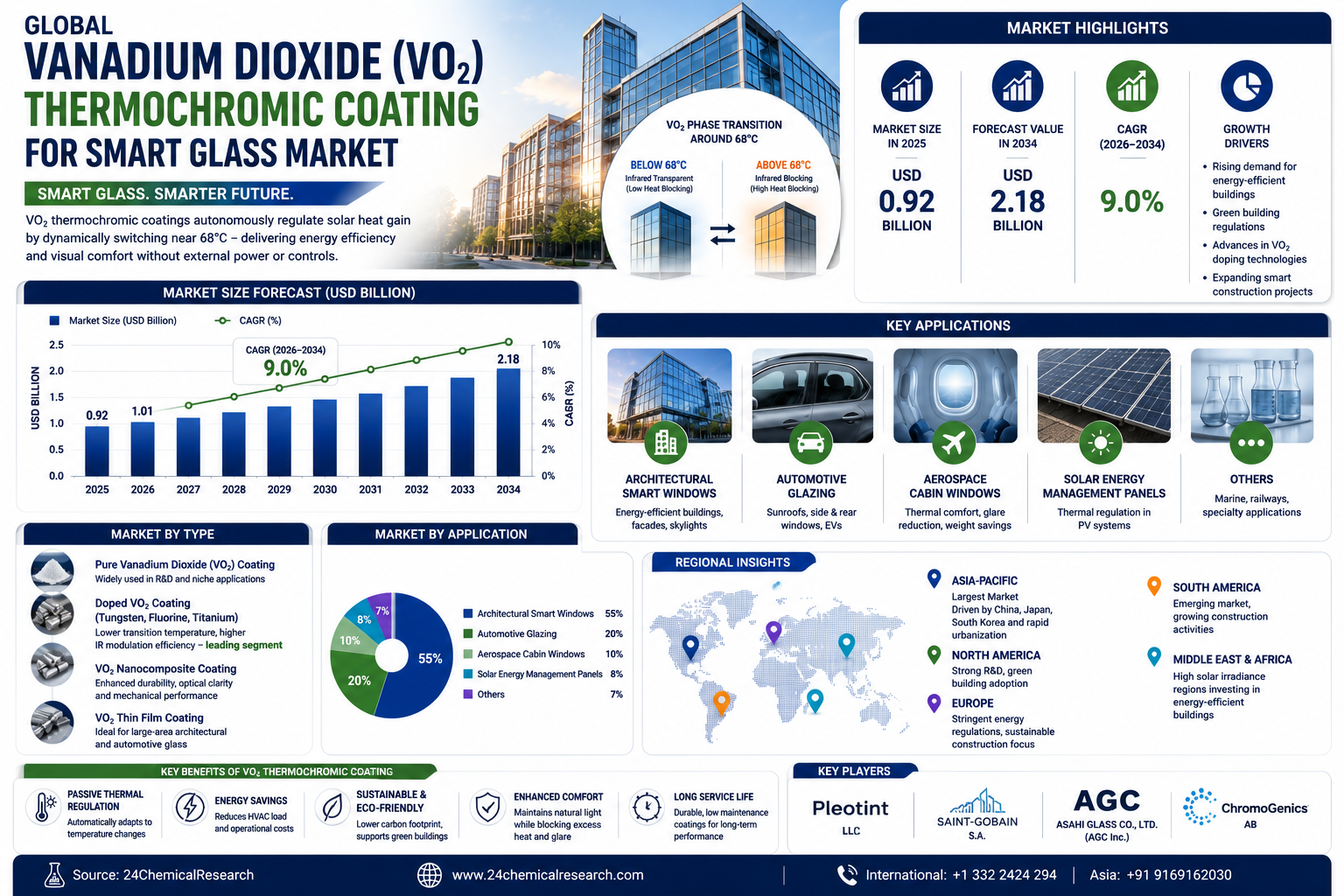
Global Vanadium Dioxide (VO₂) Thermochromic Coating for Smart Glass market size was valued at USD 0.92 billion in 2025. The market is projected to grow from USD 1.01 billion in 2026 to USD 2.18 billion by 2034, exhibiting a CAGR of 9.0% during the forecast period.
Vanadium Dioxide (VO₂) thermochromic coatings are advanced functional materials applied to glass surfaces that undergo a reversible phase transition near 68°C, dynamically switching between infrared-transparent and infrared-blocking states. This unique property enables smart glass to autonomously regulate solar heat gain without requiring external power or electronic controls, making it highly suitable for energy-efficient architectural glazing, automotive windows, and aerospace applications.
The market is gaining strong momentum driven by escalating global demand for energy-efficient building solutions, increasingly stringent green building regulations, and the rapid expansion of smart construction projects across North America, Europe, and Asia-Pacific. Furthermore, ongoing advancements in doping technologies - particularly tungsten and molybdenum doping - have lowered VO₂'s phase transition temperature closer to ambient conditions, significantly broadening its commercial viability. Key players operating in this space include Pleotint LLC, Saint-Gobain S.A., Asahi Glass Co., Ltd. (AGC Inc.), and ChromoGenics AB, each advancing coating performance and scalability through continuous research and strategic partnerships.
Download FREE Sample Report: https://www.24chemicalresearch.com/download-sample/308675/vanadium-dioxide-thermochromic-coating-for-smart-glass-market
Market Overview & Regional Analysis
Asia-Pacific stands as the leading region in the Vanadium Dioxide (VO₂) Thermochromic Coating for Smart Glass Market, driven by a confluence of rapid urbanization, aggressive green building initiatives, and a robust manufacturing ecosystem. Countries such as China, Japan, and South Korea have emerged as pivotal hubs for both the production and adoption of thermochromic smart glass technologies. China, in particular, has made significant strides in advancing VO₂ coating research and scaling up commercial manufacturing, supported by strong government mandates for energy-efficient construction materials in both residential and commercial sectors. Japan's focus on precision engineering and materials innovation has further bolstered the region's standing, with leading academic and industrial research institutions continually refining VO₂ thin-film deposition techniques. The region's construction boom, particularly in high-rise commercial and mixed-use developments, has created substantial demand for smart glazing solutions that reduce solar heat gain without compromising visible light transmission. Additionally, increasing awareness of building energy performance standards across Southeast Asian economies is gradually expanding the addressable market. The combination of cost-competitive manufacturing, government policy support, and expanding end-use infrastructure positions Asia-Pacific as the dominant force shaping the global trajectory of the VO₂ thermochromic smart glass industry.
Asia-Pacific hosts a highly integrated supply chain for VO₂ thermochromic coatings, with raw material sourcing, thin-film deposition, and glass processing largely concentrated within the region. China's dominance in vanadium mining and refining provides a strategic upstream advantage, reducing material costs and ensuring supply continuity for coating manufacturers and downstream smart glass producers. Government-driven energy efficiency frameworks across China, Japan, and South Korea are actively incentivizing the adoption of smart glazing in new construction and renovation projects. Building energy codes increasingly favor passive solar management technologies, making VO₂ thermochromic coatings an attractive compliance solution for architects and developers operating within tightening regulatory environments. The region is home to a dense network of universities, national research institutes, and corporate R&D centers actively advancing VO₂ phase transition properties, doping techniques, and scalable coating deposition methods. Collaborative efforts between academia and industry are accelerating the translation of laboratory breakthroughs into commercially viable thermochromic smart glass products suited for diverse climatic conditions. Unprecedented urban expansion across tier-one and tier-two cities in China, India, and Southeast Asia is generating substantial demand for advanced building envelope solutions. Developers increasingly prioritize facade materials that deliver thermal comfort and energy savings, positioning VO₂ thermochromic smart glass as a technically differentiated option within rapidly growing commercial and mixed-use construction pipelines.
North America represents a mature and innovation-driven market for VO₂ thermochromic coatings in smart glass applications. The United States, in particular, benefits from a well-established green building certification ecosystem, including LEED and ENERGY STAR frameworks, which create consistent demand for energy-efficient glazing technologies. Commercial real estate developers, institutional builders, and federal infrastructure projects have demonstrated growing interest in passive solar control solutions that minimize reliance on mechanical HVAC systems. Leading research universities and national laboratories in the region continue to contribute foundational advances in VO₂ materials science, supporting the pipeline of next-generation coating formulations. Canada's cold climate and focus on building thermal performance further extend the regional opportunity. However, the relatively high cost of VO₂ smart glass compared to conventional alternatives and competing electrochromic technologies remains a consideration for broader mainstream adoption across the region.
Europe occupies a prominent position in the VO₂ thermochromic smart glass market, underpinned by the region's stringent energy efficiency directives and ambitious climate-neutral building targets. The European Union's Energy Performance of Buildings Directive compels member states to progressively upgrade the thermal performance of both new and existing building stock, creating a favorable regulatory environment for thermochromic glazing adoption. Countries such as Germany, France, the Netherlands, and the United Kingdom are at the forefront of integrating smart glass technologies into sustainable architecture projects. European glass manufacturers and specialty coatings firms have made notable investments in pilot-scale VO₂ coating production lines, positioning themselves to capture demand as market readiness increases. The region's deep cultural commitment to sustainable construction and its architectural preference for large glazed facades in commercial developments further align with the value proposition of thermochromic smart glass.
South America presents an emerging opportunity for VO₂ thermochromic smart glass, with market development primarily concentrated in Brazil and, to a lesser extent, Argentina and Chile. The region's tropical and subtropical climate conditions create a compelling functional case for solar-responsive glazing that can passively reduce cooling loads in commercial buildings. Brazil's expanding construction sector and growing adoption of green building standards have begun to generate awareness of advanced smart glass technologies among architects and property developers. However, the market remains at an early stage, with adoption constrained by limited local manufacturing capacity, higher import costs for specialty coatings, and a general prioritization of cost-effective conventional glazing solutions. As regional energy costs rise and building efficiency regulations strengthen, the long-term trajectory for VO₂ thermochromic coatings in South America is considered positive.
The Middle East & Africa region presents a distinctive demand profile for VO₂ thermochromic smart glass, shaped by extreme solar irradiance, high cooling energy consumption, and ambitious urban development programs across Gulf Cooperation Council countries. Nations such as the UAE, Saudi Arabia, and Qatar have invested heavily in landmark commercial and hospitality infrastructure where advanced facade technologies are actively specified. The functional benefits of thermochromic coatings - particularly their ability to autonomously modulate solar heat gain without electrical input - align well with the region's climate challenges and growing sustainability aspirations under frameworks such as Saudi Vision 2030 and UAE Net Zero 2050. Africa's market remains nascent, with adoption limited by economic constraints and infrastructure maturity. Nevertheless, select urban centers in South Africa and North Africa are beginning to engage with energy-efficient building material innovations, suggesting a gradual long-term expansion of the addressable market across the continent.
Key Market Drivers and Opportunities
The global construction industry's intensifying focus on energy efficiency is one of the most significant forces propelling the Vanadium Dioxide (VO₂) thermochromic coating for smart glass market forward. Buildings account for a substantial share of total energy consumption worldwide, with heating, ventilation, and air conditioning (HVAC) systems representing a major portion of that load. VO₂-based thermochromic coatings offer a passive, self-regulating solution - automatically modulating solar heat transmittance in response to temperature changes without requiring external power or complex control systems. This intrinsic functionality makes VO₂-coated smart glass particularly attractive in regions with pronounced seasonal temperature swings, where dynamic solar control can meaningfully reduce cooling and heating energy demands.
Regulatory frameworks across North America, Europe, and parts of Asia-Pacific are increasingly mandating higher energy performance standards for commercial and residential buildings. Building codes such as the European Union's Energy Performance of Buildings Directive (EPBD) and various LEED and BREEAM certification requirements are pushing architects, developers, and building material suppliers toward advanced glazing solutions. VO₂ thermochromic coatings, which transition from a semiconducting to a metallic phase near 68°C - effectively blocking near-infrared radiation when temperatures rise - align well with these compliance requirements. Furthermore, growing corporate sustainability commitments are encouraging property developers to incorporate smart glass technologies as part of broader green building strategies, creating a reinforcing cycle of demand.
The phase-transition temperature of VO₂ can be engineered through doping with elements such as tungsten (W) or molybdenum (Mo), enabling tailored switching temperatures closer to ambient conditions - a critical advancement that has significantly expanded the practical applicability of thermochromic smart glass in real-world architectural settings. Beyond regulatory compliance, the broader sustainability movement is reshaping procurement decisions across commercial real estate, hospitality, healthcare, and retail sectors. Building owners and facility managers are increasingly recognizing that the long-term operational savings achievable through reduced HVAC loads can offset the higher upfront cost of VO₂ thermochromic glazing. As lifecycle cost analyses become standard practice in major construction projects, the value proposition of smart glass solutions is gaining clearer quantification, further stimulating market adoption.
Ongoing materials research is yielding meaningful advances in VO₂ coating performance through nanostructuring, composite architectures, and novel doping strategies. Researchers have demonstrated that incorporating VO₂ nanoparticles into polymer or sol-gel matrices can enable solution-based coating processes - potentially offering a lower-cost, scalable alternative to vacuum deposition techniques. Furthermore, multilayer coating architectures combining VO₂ with anti-reflection layers, selective infrared filters, and protective barrier coatings are showing promise in simultaneously improving visible light transmittance, solar modulation efficiency, and environmental durability. These material and process innovations are progressively narrowing the performance gap between laboratory-optimized VO₂ coatings and the specifications required for commercial architectural adoption, representing a substantial opportunity for manufacturers that can translate these advances into scalable products.
While the architectural smart glass market represents the primary near-term opportunity for VO₂ thermochromic coatings, the technology's passive, self-regulating characteristics are attracting growing interest across adjacent sectors. In automotive glazing, the ability to reduce solar heat gain through windshields and sunroofs without electrical power input aligns with automotive OEM objectives around vehicle thermal management and range extension for electric vehicles. The aerospace sector - where passive thermal regulation of aircraft window glazing can contribute to cabin comfort and HVAC load reduction - represents another emerging application space. Additionally, as consumer electronics manufacturers explore dynamic coatings for portable device displays and enclosures, VO₂-based materials are being evaluated for their potential to provide temperature-responsive optical and thermal management functionality, diversifying the addressable market well beyond traditional construction applications.
Challenges & Restraints
Despite significant research progress, the inherent phase-transition temperature of undoped VO₂ - approximately 68°C - remains well above typical ambient and building surface temperatures encountered in most climates. While doping strategies using tungsten, fluorine, or other elements can lower this switching temperature, achieving the optimal balance between a reduced transition point, high solar modulation efficiency, and acceptable visible light transmittance (luminous transmittance) remains a formidable materials science challenge. Many current VO₂ coatings exhibit a yellowish or brownish tint in their as-deposited form, which can be aesthetically undesirable in architectural applications where optical clarity and neutral coloration are expected by building designers and occupants.
The deposition of high-quality VO₂ thin films typically requires advanced physical vapor deposition (PVD) techniques such as magnetron sputtering, or chemical vapor deposition (CVD) processes, which involve specialized equipment and controlled processing environments. These manufacturing requirements translate into elevated production costs that make VO₂ thermochromic coatings significantly more expensive than conventional low-emissivity (low-e) glass coatings. Scaling these deposition processes to large-area architectural glass panels - commonly measuring several square meters - without compromising film uniformity, phase purity, and adhesion presents ongoing technical and economic challenges for manufacturers seeking to achieve commercial viability.
The smart glass market encompasses several competing dynamic glazing technologies, including electrochromic (EC) glass, suspended particle device (SPD) glass, and polymer-dispersed liquid crystal (PDLC) glass. Electrochromic glass, in particular, has gained considerable commercial traction, supported by substantial investment from major glazing companies and a well-established supply chain. Unlike VO₂ thermochromic coatings - which switch passively based on temperature - electrochromic systems allow users to control tinting manually or through building automation systems, offering greater user flexibility. This perceived controllability advantage means that VO₂-based solutions must compete not only on cost but also on demonstrating the energy and maintenance benefits of passive, self-regulating operation.
While VO₂ thermochromic coatings have been extensively studied in academic and research settings for several decades, the transition from laboratory-scale demonstrations to commercially available, large-area architectural products remains incomplete. The supply chain for high-purity vanadium precursor materials, specialized deposition equipment, and coated glass substrates at commercial scale is still developing. This nascent infrastructure limits the ability of construction and glazing companies to readily specify and procure VO₂ smart glass as a standard building material, effectively constraining market penetration beyond niche research, pilot, and demonstration projects. Until a broader network of qualified manufacturers and distributors is established, adoption will remain constrained.
Architectural glazing products are expected to maintain their optical and functional performance over decades of continuous outdoor exposure, including ultraviolet radiation, thermal cycling, humidity, and mechanical stress. VO₂ thin films are susceptible to oxidation - particularly the undesirable conversion to V₂O₅ - as well as to delamination and degradation of thermochromic performance over time. While protective overcoating strategies using materials such as silicon dioxide (SiO₂) or titanium dioxide (TiO₂) have demonstrated effectiveness in laboratory durability tests, long-term field performance data spanning the 20–30 year service life expected of commercial architectural glass remains limited. This data gap creates hesitancy among building designers, glazing contractors, and building owners when evaluating VO₂ smart glass for major construction projects, acting as a meaningful market restraint.
Market Segmentation by Type
● Pure Vanadium Dioxide (VO₂) Coating
● Doped VO₂ Coating (Tungsten, Fluorine, Titanium)
● VO₂ Nanocomposite Coating
● VO₂ Thin Film Coating
Doped VO₂ Coating stands out as the leading segment within this category, as the incorporation of dopants such as tungsten and fluorine significantly lowers the phase-transition temperature of vanadium dioxide to levels more compatible with ambient environmental conditions. This makes doped variants far more commercially viable for real-world smart glass deployments. Pure VO₂ coatings, while foundational to research and development, face limitations in practical application due to their higher switching temperatures. Nanocomposite coatings are rapidly gaining research momentum, offering improved optical clarity and mechanical durability. Thin film coatings remain critical for large-scale architectural glazing where uniform deposition across expansive surface areas is a primary manufacturing requirement.
Download FREE Sample Report: https://www.24chemicalresearch.com/download-sample/308675/vanadium-dioxide-thermochromic-coating-for-smart-glass-market
Market Segmentation by Application
● Architectural Smart Windows
● Automotive Glazing
● Aerospace Cabin Windows
● Solar Energy Management Panels
● Others
Architectural Smart Windows represent the dominant application segment, driven by an increasing global emphasis on energy-efficient building design and the integration of green building certifications. VO₂ thermochromic coatings applied to commercial and residential facades autonomously modulate infrared solar transmission in response to temperature changes, reducing dependence on mechanical HVAC systems and contributing meaningfully to sustainable building performance. Automotive glazing is emerging as a high-potential application, with automakers seeking passive thermal management solutions to enhance cabin comfort and extend the range of electric vehicles without added electronic complexity. Aerospace cabin windows present a niche but technologically demanding application, where lightweight, passive solar control coatings offer compelling advantages. Solar energy management panels increasingly leverage VO₂ coatings to optimize thermal regulation within photovoltaic systems.
Market Segmentation and Key Players
● Saint-Gobain S.A. (France)
● AGC Inc. (Japan)
● Gentex Corporation (USA)
● Vitro Architectural Glass (Mexico)
● Pleotint LLC (USA)
● Heliotrope General Inc. (USA)
● NSG Group (Pilkington) (Japan / UK)
● Wuhan University of Technology Advanced Materials Division (China)
● ChromoGenics AB (Sweden)
Report Scope
This report presents a comprehensive analysis of the global and regional markets for Vanadium Dioxide (VO₂) Thermochromic Coating for Smart Glass, covering the period from 2026 to 2034. It includes detailed insights into the current market status and outlook across various regions and countries, with specific focus on:
● Sales, sales volume, and revenue forecasts
● Detailed segmentation by type and application
The report features in-depth competitive intelligence including:
● Market share analysis of leading manufacturers
● Production capacity expansions
● Product portfolio assessments
● Strategic partnership evaluations
Our research methodology combines primary interviews with industry leaders and comprehensive data analysis of:
● Production facilities and their geographical distribution
● Raw material sourcing patterns
● End-user industry consumption trends
● Regulatory impact assessments
Get Full Report Here: https://www.24chemicalresearch.com/reports/308675/vanadium-dioxide-thermochromic-coating-for-smart-glass-market
About 24chemicalresearch
Founded in 2015, 24chemicalresearch has rapidly established itself as a leader in chemical market intelligence, serving clients including over 30 Fortune 500 companies. We provide data-driven insights through rigorous research methodologies, addressing key industry factors such as government policy, emerging technologies, and competitive landscapes.
● Plant-level capacity tracking
● Real-time price monitoring
● Techno-economic feasibility studies
With a dedicated team of researchers possessing over a decade of experience, we focus on delivering actionable, timely, and high-quality reports to help clients achieve their strategic goals. Our mission is to be the most trusted resource for market insights in the chemical and materials industries.
International: +1(332) 2424 294 | Asia: +91 9169162030
Website: https://www.24chemicalresearch.com/
Follow us on LinkedIn: https://www.linkedin.com/company/24chemicalresearch

 English
 Arabic
 French
 Spanish
 Portuguese
 Deutsch
 Turkish
 Dutch
Dutch
 Italiano
 Russian
 Romaian
 Greek
Greek