


United States Data Center Liquid Cooling Market Size Projected to Reach USD 3,446.6 Million by 2034 with a CAGR of 15.76%
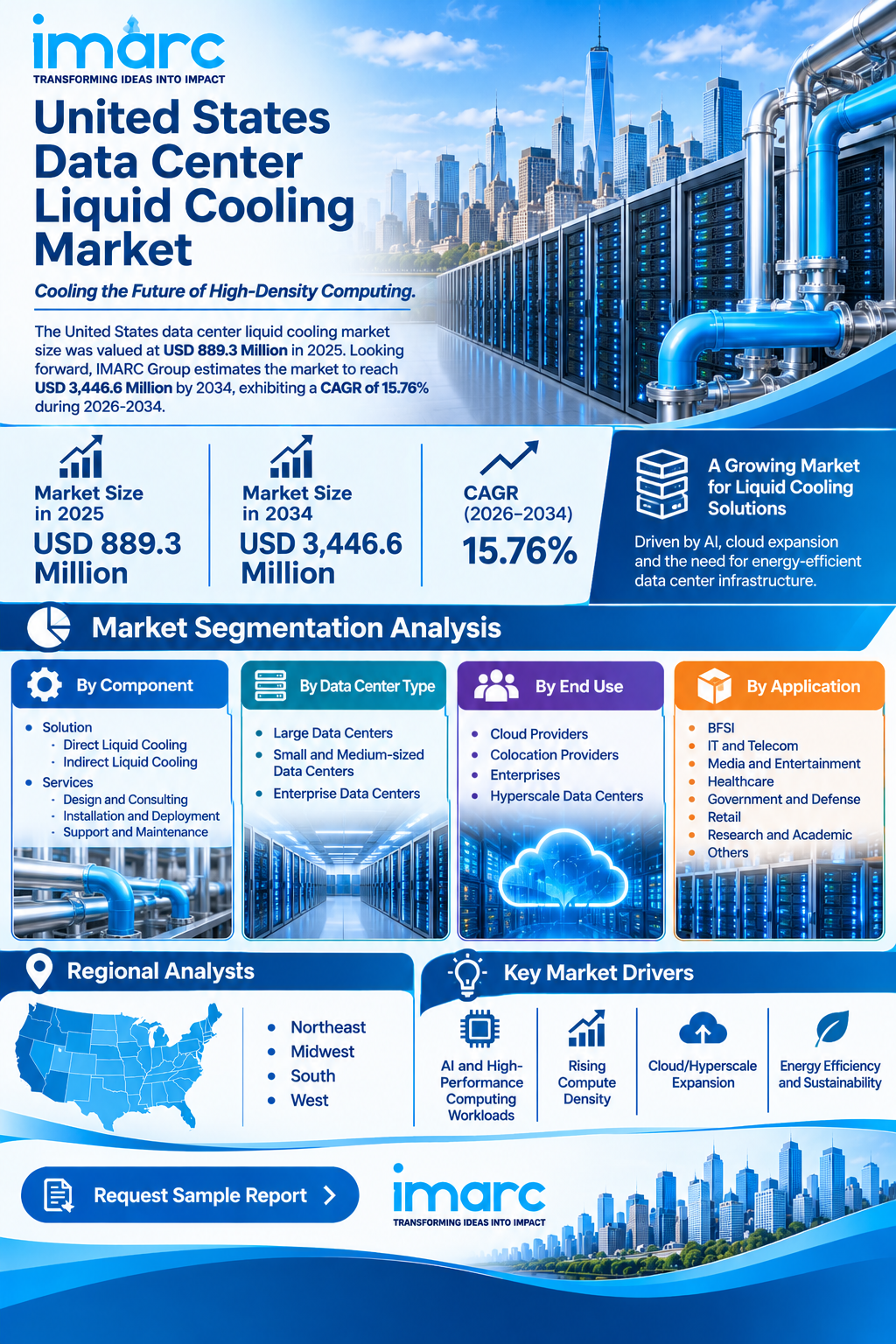
IMARC Group has recently released a new research study titled “United States Data Center Liquid Cooling Market Report by Component, Data Center Type, End Use, Application, and Region, 2026-2034,” which offers a detailed analysis of the market drivers, segmentation, growth opportunities, trends and competitive landscape to understand the current and future market scenarios.
United States Data Center Liquid Cooling Market Size, Growth, and Forecast (2026-2034)
The united states data center liquid cooling market size reached USD 889.3 Million in 2025 and is projected to reach USD 3,446.6 Million by 2034, growing at a CAGR of 15.76% during 2026-2034. Rising demand for data processing and storage, growing emphasis on energy efficiency and sustainability, expanding high-performance computing applications, and the need for 24/7 data service availability are the primary factors driving the market.
Data center liquid cooling uses liquids such as water, dielectric fluids, or refrigerants to remove heat from servers and other IT equipment. Approaches include direct-to-chip, immersion, two-phase, and rear-door heat exchanger systems, which carry heat away far more efficiently than air.
The growth of AI, machine learning, and big data analytics is generating heavy computational workloads and substantial heat. Liquid cooling is a fast-growing part of the broader us critical power cooling market, which keeps high-density facilities running reliably.
Explore Growth Opportunities in the United States Data Center Liquid Cooling Market - Grab Your Sample Report for Evaluation: https://www.imarcgroup.com/united-states-data-center-liquid-cooling-market/requestsample
Key Trends Driving the United States Data Center Liquid Cooling Market
-
Rising demand for HPC and AI workloads: AI, machine learning, and scientific modeling require extremely dense server configurations that traditional air cooling struggles to handle. For instance, in March 2025 Accelsius launched NeuGuard, a support program for its two-phase, direct-to-chip liquid cooling technology designed for AI and advanced computing.
-
Growth of hyperscale and edge data centers: Expanding cloud computing, content delivery, IoT, and 5G networks are driving hyperscale and edge facilities that run at much higher rack densities. Hyperscalers such as Google, Microsoft, and Meta are already adopting liquid cooling to support AI and cloud workloads.
-
Energy efficiency and sustainability requirements: Liquid cooling moves heat more efficiently, enabling data centers to operate at a lower Power Usage Effectiveness and supporting ESG goals. For instance, in February 2025 ZutaCore partnered with Carrier Global Corporation through an investment led by Carrier Ventures.
-
Government support for advanced cooling: The US Department of Energy has allocated funds to support the adoption of advanced cooling technologies in data centers. Programs such as ARPA-E’s COOLERCHIPS are promoting liquid cooling innovations aimed at improving energy efficiency and reducing carbon footprints.
United States Data Center Liquid Cooling Market Report Segmentation:
The United States Data Center Liquid Cooling Market report provides a detailed segmentation analysis to help businesses identify key growth segments and evolving industry dynamics. The market is categorized based on component, data center type, end use, application, and region, offering comprehensive insights across the united states data center liquid cooling market.
Component Insights:
-
Solution: Solutions, including direct liquid cooling and indirect liquid cooling, dominate revenue share. Direct-to-chip, immersion, and two-phase systems handle high thermal loads while improving energy efficiency and rack density.
-
Services: Services such as design and consulting, installation and deployment, and support and maintenance are in growing demand as data centers move from air to liquid cooling and need expert integration and lifecycle support.
Data Center Type Insights:
-
Large Data Centers: Large and hyperscale facilities hold the dominant share, with high-density racks for AI, machine learning, and cloud workloads that make liquid cooling essential for thermal efficiency and energy savings.
-
Small and Medium-sized Data Centers: These facilities often serve edge or regional needs and are adopting compact, scalable liquid cooling to raise compute density within constrained spaces.
-
Enterprise Data Centers: Enterprises operating private cloud and on-premises infrastructure are adopting liquid cooling to support analytics, simulations, and digital twins while meeting sustainability goals.
End Use Insights:
-
Cloud Providers and Hyperscale Data Centers: Cloud providers such as Amazon Web Services, Microsoft Azure, and Google Cloud run AI and big data workloads that demand advanced thermal management, and they invest heavily in efficient cooling at scale.
-
Colocation Providers and Enterprises: Colocation providers use liquid cooling to serve high-density tenants without expanding physical space, while enterprises with hybrid IT environments adopt it to meet rising compute demands and compliance needs.
Application Insights:
-
BFSI: The BFSI sector depends on low latency and high reliability for AI-driven trading, fraud detection, and digital banking, which raises demand for efficient, dependable cooling.
-
IT and Telecom, and Media and Entertainment: IT and telecom operators support cloud, 5G, and edge networks, while media and entertainment companies run GPU-intensive rendering and streaming workloads.
-
Healthcare, Government and Defense, Retail, Research and Academic, and Others: These applications are adding data-intensive and AI workloads that increase thermal loads and favor liquid cooling.
Regional Insights:
-
Northeast: The Northeast is a hub for financial services, healthcare, and government, where space limits, high electricity costs, and strict environmental targets make compact, efficient liquid cooling attractive.
-
Midwest: The Midwest is gaining momentum for hyperscale and enterprise facilities thanks to affordable land and stable energy costs, with AI and IoT driving demand for dense computing and liquid cooling.
-
South: The South hosts growing hyperscale and colocation capacity in hubs such as Dallas, Atlanta, and Northern Virginia, where a hot, humid climate makes liquid cooling more efficient than air.
-
West: The West, led by California and Washington, is home to tech giants and AI firms, with environmental regulations and power constraints pushing adoption of efficient liquid cooling.
United States Data Center Liquid Cooling Market: Recent News and Developments
-
February 2025: Vertiv launched its Liquid Cooling Services portfolio to support high-performance computing and AI systems in the US, covering installation, fluid management, emergency support, and lifecycle maintenance.
-
May 2025: Chemours and DataVolt announced a strategic partnership to advance liquid cooling for AI and high-density computing, using Chemours’ Opteon dielectric fluids to improve efficiency and sustainability.
Challenges Impacting the United States Data Center Liquid Cooling Market
Liquid cooling systems typically involve higher upfront costs and greater design complexity than air cooling. Retrofitting existing air-cooled facilities requires careful integration, specialized skills, and attention to leak prevention and fluid management.
A lack of common standards across direct-to-chip, immersion, and two-phase approaches can slow purchasing decisions, and a limited pool of trained installation and maintenance professionals may constrain deployment speed.
Investment Opportunities in the United States Data Center Liquid Cooling Market
The united states data center liquid cooling market presents compelling investment opportunities supported by its projected growth from USD 889.3 Million in 2025 to USD 3,446.6 Million by 2034. Coolant distribution units, direct-to-chip cold plates, and turnkey modular systems are high-value areas as AI racks push heat loads upward.
Lifecycle services, including design, retrofitting, fluid management, and maintenance, are a growing frontier. Companies that combine scalable hardware with strong service capabilities can build durable positions across the us critical power cooling market.
Outlook of the United States Data Center Liquid Cooling Market (2026-2034)
The outlook for the united states data center liquid cooling market is positive, supported by AI and HPC growth, hyperscale and edge expansion, and sustainability priorities. The market is projected to grow from USD 889.3 Million in 2025 to USD 3,446.6 Million by 2034 at a CAGR of 15.76%.
Direct-to-chip adoption, modular and scalable systems, and bundled lifecycle services will be the defining trends shaping the market through 2034.
Key Players in the United States Data Center Liquid Cooling Market
The united states data center liquid cooling market is highly competitive and is served by established infrastructure providers and specialist innovators competing on thermal performance, efficiency, and total cost of ownership. Key participants include Schneider Electric, Vertiv, LiquidStack, Submer, and CoolIT Systems.
-
Vertiv: A global leader in critical digital infrastructure, Vertiv launched its CoolPhase CDU and CoolChip Fluid Network in October 2024 and introduced Liquid Cooling Services in February 2025, giving it a broad portfolio for AI-ready data centers.
-
Schneider Electric: A global leader in energy management and automation, Schneider Electric supplies integrated power and cooling infrastructure and is among the companies innovating in direct-to-chip and immersion cooling for hyperscale, enterprise, and edge data centers.
Frequently Asked Questions (FAQs): United States Data Center Liquid Cooling Market
1. What is the current United States data center liquid cooling market size?
The united states data center liquid cooling market size reached USD 889.3 Million in 2025 and is projected to reach USD 3,446.6 Million by 2034, growing at a CAGR of 15.76% during 2026-2034.
2. What is data center liquid cooling?
Data center liquid cooling uses liquids to remove heat from servers, through methods such as direct-to-chip, immersion, and two-phase cooling, and handles dense AI and HPC workloads more efficiently than air.
3. What are the key drivers of the united states data center liquid cooling market?
Key drivers include rising HPC and AI workloads, growth of hyperscale and edge data centers, energy efficiency and sustainability goals, and the limits of air cooling for high-density servers.
4. How does liquid cooling fit into the us critical power cooling market?
Liquid cooling is a fast-growing part of the broader us critical power cooling market, which supports uptime for data centers. It addresses the heat created by AI and HPC racks that air cooling cannot efficiently manage.
5. Who are the best CDU manufacturers supplying US data centers?
The best fit depends on workload, scale, and facility design. Vertiv, which launched its CoolPhase CDU in October 2024, Schneider Electric, and CoolIT Systems are among the prominent suppliers named in the report, alongside LiquidStack and Submer.
Author IMARC Group
IMARC Group is a global management consulting firm that helps the world’s most ambitious changemakers to create a lasting impact. The company provide a comprehensive suite of market entry and expansion services. IMARC offerings include thorough market assessment, feasibility studies, company incorporation assistance, factory setup support, regulatory approvals and licensing navigation, branding, marketing and sales strategies, competitive landscape and benchmarking analyses, pricing and cost research, and procurement research.
Contact Us
IMARC Group,
134 N 4th St. Brooklyn, NY 11249, USA,
Email: sales@imarcgroup.com,
United States: +1-201971-6302

 English
 Arabic
 French
 Portuguese
 Deutsch
 Turkish
 Dutch
 Italiano
 Russian
 Romaian
 Portuguese (Brazil)
 Greek