


Rail Asset Management Market Emerging Technologies and Industry Opportunities
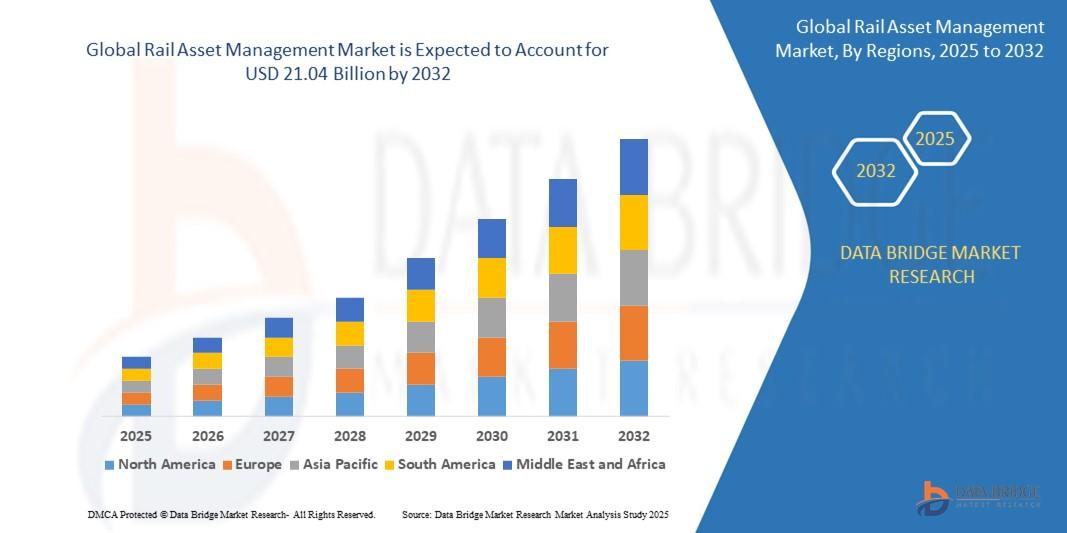
According to the latest report published by Data Bridge Market Research, the Rail Asset Management Market
The global rail asset management market size was valued at USD 12.34 billion in 2024 and is expected to reach USD 21.04 billion by 2032, at a CAGR of 6.90% during the forecast period
The data, information, statistics, facts and figures covered in this comprehensive Rail Asset Management Market report lends a hand to Rail Asset Management Market industry in maximizing or minimizing the production of goods depending on the conditions of demand. The market research report contains lot of features to offer for Rail Asset Management Market industry which includes general market conditions, trends, inclinations, key players, opportunities, and geographical analysis. The Rail Asset Management Market document provides comprehensive explanation of market definition, market segmentation, competitive analysis and key developments in the Rail Asset Management Market industry. All this data aids Rail Asset Management Market industry to take better steps to get their strategies better to trade goods and services.
Stay informed with our latest keyword market research covering strategies, innovations, and forecasts. Download full report: https://www.databridgemarketresearch.com/reports/global-rail-asset-management-market
Rail Asset Management Market Segmentation and Market Companies
Segments
- By Offering:
- Solutions
- Services
- By Application:
- Rolling Stock
- Infrastructure
- By Deployment Mode:
- Cloud
- On-Premises
- By Region:
- North America
- Europe
- Asia-Pacific
- South America
- Middle East and Africa
Rail asset management is witnessing significant growth globally due to the increasing focus on enhancing operational efficiency, ensuring passenger safety, and optimizing costs in the transportation sector. The market can be segmented based on offering, application, deployment mode, and region. In terms of offering, the market is divided into solutions and services. Solutions segment includes software platforms and tools for asset tracking, maintenance planning, and inventory management, while services encompass consulting, implementation, training, and support services. On the basis of application, rail asset management is categorized into rolling stock and infrastructure management. Rolling stock management involves monitoring and maintenance of trains, wagons, and locomotives, while infrastructure management includes tracks, signaling systems, and stations. Deployment mode segment comprises cloud-based and on-premises solutions, with many companies shifting towards cloud-based deployment for scalability and flexibility. Geographically, the market is analyzed across North America, Europe, Asia-Pacific, South America, and the Middle East and Africa regions.
Market Players
- Siemens AG
- IBM
- Hitachi, Ltd.
- Alstom
- Wabtec Corporation
- Trimble Inc.
- Capgemini
- Cisco
- Huawei Technologies Co., Ltd.
- Accenture
- Bentley Systems, Incorporated
Several key players are actively contributing to the global rail asset management market's growth and competitiveness. Siemens AG offers a wide range of solutions for rail asset management, including predictive maintenance and monitoring systems. IBM provides asset management software that enables rail operators to improve maintenance practices and reduce downtime. Hitachi, Ltd. specializes in digital solutions for rail asset monitoring and performance optimization. Alstom is known for its expertise in providing integrated systems for rail infrastructure management. Wabtec Corporation offers advanced technologies for train control and signaling applications. Trimble Inc. provides asset tracking and maintenance management solutions for the rail industry. Capgemini delivers consulting services for optimizing rail asset performance. Cisco and Huawei Technologies Co., Ltd. offer networking and communication solutions for rail asset monitoring and control. Accenture provides digital transformation services for rail operators, while Bentley Systems, Incorporated focuses on infrastructure design and asset lifecycle management solutions.
The global rail asset management market is continually evolving with advancements in technology and increasing investments in the transportation sector. One key trend shaping this market is the growing adoption of predictive maintenance solutions to enhance asset performance and reduce operational costs. Predictive maintenance utilizes data analytics and machine learning algorithms to predict potential equipment failures before they occur, enabling rail operators to schedule maintenance proactively and avoid unplanned downtime. This trend is driven by the need to maximize asset lifespan, improve safety, and ensure reliable operations in the rail industry.
Another notable trend in the rail asset management market is the emphasis on cybersecurity measures to protect critical infrastructure components from cyber threats. As rail networks become more interconnected and digitized, the risk of cyberattacks targeting signaling systems, rolling stock, and maintenance platforms increases. To address this challenge, rail operators are increasingly investing in cybersecurity solutions to safeguard their assets and prevent disruptions to operations. Enhanced data encryption, intrusion detection systems, and cybersecurity training for personnel are some of the strategies being adopted to mitigate cyber risks in the rail sector.
Additionally, the integration of Internet of Things (IoT) technologies in rail asset management is creating new opportunities for data-driven decision-making and operational efficiency. IoT sensors and devices deployed on rolling stock and infrastructure elements enable real-time monitoring of asset performance, condition monitoring, and predictive analytics. By leveraging IoT data, rail operators can optimize maintenance schedules, minimize downtime, and improve asset utilization. The integration of IoT with existing rail asset management systems enhances visibility and control over critical assets, paving the way for digital transformation in the rail industry.
Furthermore, sustainability initiatives and environmental concerns are driving the adoption of green technologies in rail asset management. Rail operators are increasingly focusing on reducing carbon emissions, improving energy efficiency, and implementing eco-friendly practices in their operations. The integration of renewable energy sources, energy-efficient rolling stock, and smart grid technologies are some of the approaches being adopted to achieve sustainability goals in the rail sector. Green technologies not only support environmental conservation efforts but also contribute to cost savings and operational efficiency in rail asset management.
In conclusion, the global rail asset management market is experiencing significant transformations driven by technological innovations, cybersecurity challenges, IoT integration, and sustainability initiatives. As rail operators strive to enhance operational efficiency, ensure passenger safety, and meet regulatory requirements, the adoption of advanced asset management solutions and practices will continue to play a crucial role in shaping the future of the rail industry. By embracing emerging trends and leveraging data-driven insights, rail operators can unlock new opportunities for growth, resilience, and sustainability in the dynamic market landscape.The global rail asset management market is expected to witness continued growth and advancements in the coming years, driven by various factors such as technological innovations, increasing investments in transportation infrastructure, and the growing need for operational efficiency and cost optimization in the rail sector. The adoption of predictive maintenance solutions is a key trend shaping the market, enabling rail operators to enhance asset performance, reduce downtime, and improve overall operational efficiency. By leveraging data analytics and machine learning algorithms, predictive maintenance helps in predicting equipment failures before they occur, allowing for proactive maintenance planning and improved resource allocation.
Another significant trend in the rail asset management market is the focus on cybersecurity measures to protect critical infrastructure components from cyber threats. With the increasing digitization and interconnectivity of rail networks, cybersecurity has become a top priority for rail operators to safeguard their assets and ensure uninterrupted operations. Investments in cybersecurity solutions, data encryption, and intrusion detection systems are crucial in mitigating cyber risks and maintaining the integrity and security of rail assets.
The integration of Internet of Things (IoT) technologies is also reshaping the rail asset management landscape, offering new opportunities for data-driven decision-making and operational efficiency. IoT sensors and devices deployed on rolling stock and infrastructure elements enable real-time monitoring, condition-based maintenance, and predictive analytics, allowing rail operators to optimize maintenance schedules, reduce downtime, and enhance asset utilization. By harnessing IoT data, rail operators can gain valuable insights into asset performance, streamline maintenance operations, and improve overall system reliability.
Moreover, sustainability initiatives and environmental concerns are driving the adoption of green technologies in rail asset management. Rail operators are increasingly focusing on reducing carbon emissions, improving energy efficiency, and embracing eco-friendly practices to minimize their environmental footprint. The integration of renewable energy sources, energy-efficient rolling stock, and smart grid technologies are being implemented to promote sustainability and operational efficiency in the rail industry. Green technologies not only support environmental conservation efforts but also contribute to cost savings and long-term sustainability in rail asset management practices.
In summary, the global rail asset management market is poised for significant growth and transformation, fueled by technological advancements, cybersecurity considerations, IoT integration, and sustainable practices. As the industry continues to evolve, rail operators will need to embrace these emerging trends, adopt advanced asset management solutions, and leverage data-driven insights to enhance operational performance, ensure safety and security, and achieve long-term sustainability objectives in the dynamic and competitive market environment.
Frequently Asked Questions About This Report
How is the Rail Asset Management Market in the U.S. performing compared to Canada?
How are inventory management systems evolving in the Rail Asset Management Market?
What is the future of Teleportation (Logistics) in the Rail Asset Management Market?
What was the valuation of the Segment in 2025?
How is Social Responsibility impacting the Rail Asset Management Market share?
How much is the Services segment projected to be worth in 2033?
How is increasing consumer awareness impacting the Rail Asset Management Market?
What percentage of the global food/tech/healthcare economy does the Rail Asset Management Market represent?
How is the Rail Asset Management Market responding to inflation?
How is the Rail Asset Management Market expected to change by 2033 regarding sentiment?
How is the Rail Asset Management Market adapting to the Direct-to-Consumer trend?
Browse More Reports:
Global Magnetic Resonance Imaging (MRI) Coils Market
Global Marine Derived Proteins Market
Global Mass Spectrometry Devices Market
Global Mud Mixers Market
Global Natural Berry Flavors Market
Global Nitrogen Liquid Fertilizers Market
Global Non-Cigarette Tobacco Market
Global O-Phenylenediamine Market
Global Patient Management Software and Services Market
Global Polyethylene Implants Market
Global Poultry Feed Amino Acids Market
Global Roll Trailer Market
Global Ruminants Feed Mycotoxin Binders and Modifiers Market
Global Servers Technology Market
Global Silicone film Market

 Arabic
 French
 Spanish
 Portuguese
 Deutsch
 Turkish
 Dutch
 Italiano
 Russian
 Romaian
 Portuguese (Brazil)
 Greek