


Should a Tree Service Digital Marketing Agency Still Write Cost Articles?
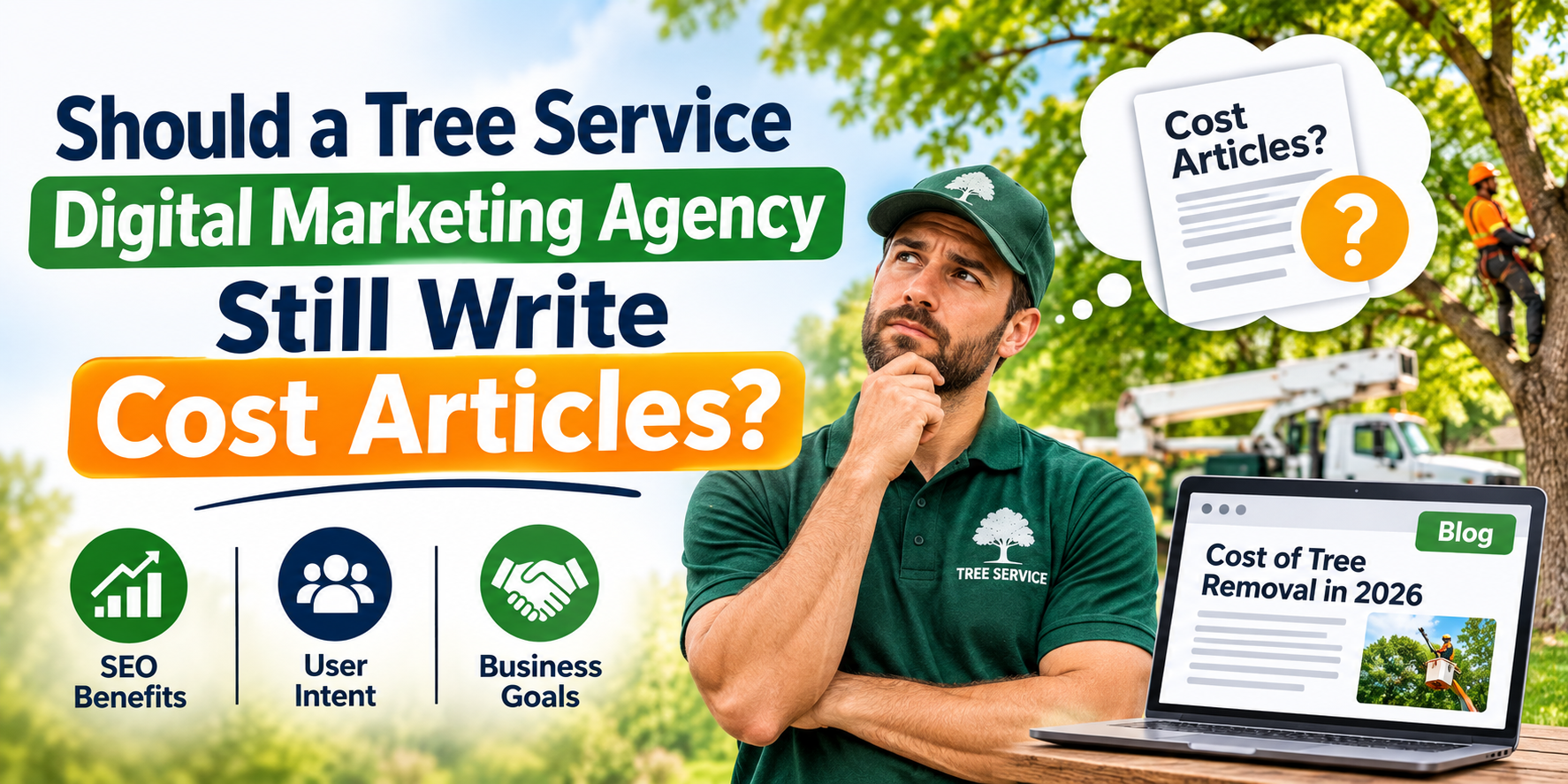
For years, the standard content plan for tree care companies looked similar everywhere. Write articles on tree removal costs, signs a tree is dying, when to prune oaks, and how stump grinding works. Rank for those searches, attract homeowners, and convert some of them into estimates. Agencies produced these articles in volume because they worked.
They work less well now. Google often answers such questions directly with an AI summary at the top of the results. A homeowner who searches for tree removal costs may get a price range, a list of factors, and a few tips without clicking any website. The article that once ranked for that search still exists, but fewer people visit it.
Research from Pew quantifies the effect. When an AI summary appears, users click traditional results about half as often. That does not mean content is dead. It means a tree service content plan built on generic cost and how-to articles keeps losing clicks, and effort should move to assets that a summary cannot replace.
What Pew Found
Pew Research Center's study of Google AI summaries, published in July 2025, analyzed the browsing activity of 900 U.S. adults in March 2025. Users who encountered an AI summary clicked on a traditional search result link in 8% of visits. Those who did not encounter a summary clicked a result nearly twice as often, in 15% of visits. Clicking a link within the AI summary itself occurred in just 1% of visits to pages with such a summary.
For local service businesses, the implication is direct. Searches that can be answered with general information, such as typical cost ranges, are the ones most likely to trigger a summary and least likely to send a visitor to a contractor's website.
Why Generic Cost Articles Lose Clicks
Generic tree service articles share characteristics that make them easy to summarize:
-
General answers: National cost ranges and common factors apply to almost anyone.
-
Similar content everywhere: Hundreds of sites publish nearly identical articles.
-
No local detail: Nothing ties the article to a specific area, permit rule, or crew.
-
No proof: The article does not show that this company has done the work.
An AI summary can synthesize these articles into a short answer. The homeowner gets what they need and moves on. The tree company that wrote one of the source articles may not even be visible. Even when it is cited, Pew's figures suggest few users click through.
What a Summary Cannot Replace
Some content and tools remain valuable because they are specific, interactive, or personal:
-
Photo-based quote requests: A homeowner uploads photos of the tree and gets a real estimate range from the company. No summary can do that.
-
Arborist credentials: Certified arborists, insurance coverage, licensing, and crew experience, shown with names and photos.
-
Local permit guidance: Rules for tree removal in specific cities, counties, or homeowner associations, including protected species and permit steps.
-
Real job evidence: Before-and-after photos, short videos, and project stories from named neighborhoods.
-
Reviews and ratings: Recent, detailed reviews mentioning specific services and locations.
-
Emergency availability: Clear information on storm response, response times, and how to get help immediately.
These assets either answer questions only the company can answer, or help the homeowner take the next step with that company. They also give AI features and search results specific, trustworthy details to show, which generic articles rarely provide.
Local Permit Pages in Practice
Permit rules are among the most useful content a tree company can publish, because they differ by city and are hard to summarize accurately. A good permit page names the municipality, explains which trees require a permit for removal, lists protected species, describes the application steps and typical timelines, and notes any replacement planting requirements. It should state how the company helps, such as preparing arborist reports or filing applications on the homeowner's behalf.
Keep these pages current. Municipal rules change, and outdated guidance damages trust. Add the date of the last review and a link to the official municipal source. Homeowners who find accurate, local guidance are far more likely to call the company that provided it.
Google's Guidance Points the Same Way
AI Overviews and AI Mode are surfacing relevant links to help people find information and explore further. The same best practices that help content appear in search generally apply. Content that offers unique value, first-hand experience, and clear local relevance is more likely to earn attention than content that repeats what is available everywhere.
Rebalancing the Content Plan
Digital marketing for tree services should shift effort as follows:
-
Audit existing content: Identify generic articles and check how their clicks have changed.
-
Keep and improve a few cornerstone pages: One strong, local cost page with the company's own pricing approach, real examples, and a quote form can still help.
-
Build a photo-based quote tool: Make it easy for homeowners to send photos and details from a phone.
-
Create local permit pages: One page per major city or county served, with rules, protected species, and how the company handles permits.
-
Publish job stories: Short case studies with photos, location, tree type, challenge, and outcome.
-
Strengthen credential pages: Arborist certifications, insurance, safety record, and equipment.
-
Invest in reviews: Ask every satisfied customer for a review that mentions the service and location.
These steps take more effort per page than generic articles, but each page does more work. A dozen strong local pages and a steady flow of job stories usually outperform a hundred generic posts.
A Representative Shift
Consider a tree company whose blog has 80 articles, most of them general guides on costs, tree diseases, and pruning. Traffic from these articles has dropped noticeably over the past year, and few visitors request estimates.
Its marketing partner reviews the content. Twelve articles still draw steady traffic and are updated with local pricing examples, photos, and quote prompts. Most of the rest are consolidated or retired. The team builds a photo-based quote form, creates permit guides for the six municipalities the company serves, and publishes two job stories a month. The company's arborists are featured with their certifications.
Six months later, total organic visits are lower than at their peak, but estimate requests from organic search are up, and the share of visitors who request a quote has risen sharply. The company spends less on content and gets more jobs from it. Its arborists also report that callers arrive better informed and readier to book.
What a Home Services Marketing Company Should Measure
Traffic is a weaker signal when summaries answer questions directly. Better measures include quote requests by source, calls from the website and Google Business Profile, photo uploads through the quote tool, conversion rate from visit to estimate, and booked jobs attributed to organic search. A home services marketing company should report these outcomes alongside rankings and traffic. Call tracking numbers on the website and profile, unique form identifiers, and a simple way for office staff to record how each caller found the company make this reporting possible. Without it, a decline in traffic can look like failure even when the business is booking more jobs.
Google Business Profile Carries More Weight
When fewer people click through to websites, the information shown directly in search matters more. A tree company's Google Business Profile often appears for local searches, maps, and service queries. Keep it complete and current: service categories, service areas, hours, emergency availability, photos of recent jobs, and answers to common questions. Post updates after notable jobs or storms. Respond to every review, mentioning the service where appropriate.
A strong profile can win the call even when the homeowner never visits the website. For many tree companies, the profile now generates more leads than the blog ever did, and it deserves a regular share of marketing effort.
Making Quote Requests Easy on Phones
Homeowners usually notice a tree problem while standing in the yard. A quote process designed for phones turns that moment into a lead. The best forms are short: name, address, phone, a few taps to describe the job, and an option to upload photos directly from the camera. Confirm receipt immediately and state when the company will respond. Where possible, give a rough range from photos within a business day, with an on-site visit for final pricing on larger jobs.
Track every step of this process. If many people start the form but few finish, simplify it. If photo uploads fail on certain devices, fix them. Small improvements here often produce more booked jobs than new articles.
Choosing a Tree Service Digital Marketing Agency
When evaluating a tree service digital marketing agency, ask:
-
How has AI in search changed your content strategy?
-
Which existing articles still earn clicks, and which should be retired?
-
How will you build local, proof-based content?
-
Can you build a photo-based quote request process?
-
How will you measure quote requests and booked jobs, not just traffic?
-
How will you grow reviews that mention specific services and areas?
An agency that answers with assets and outcomes understands how search has changed. One that proposes another batch of generic articles may be selling yesterday's playbook.
Pew's research shows that AI summaries roughly halve clicks on traditional results, which hits generic cost and how-to articles hardest. Tree care companies get more from photo-based quotes, arborist credentials, local permit guidance, job stories, and reviews, which no summary can replace. Opt for tree service digital marketing that helps tree care companies rebuild content around proof, local detail, and easy quote requests. The content that wins now is the content only a local company can provide.
Sources
-
Pew Research Center, "Google Users Are Less Likely to Click on Links When an AI Summary Appears in the Results," https://www.pewresearch.org/short-reads/2025/07/22/google-users-are-less-likely-to-click-on-links-when-an-ai-summary-appears-in-the-results/ (2025)
-
Google Search Central, "AI Features and Your Website," https://developers.google.com/search/docs/appearance/ai-features (2026)

 English
 Arabic
 French
 Spanish
 Portuguese
 Deutsch
 Turkish
 Dutch
 Italiano
 Russian
 Romaian
 Greek