


Automotive Hypervisor Market Size, Share, Technology Trends and Industry Outlook
How Software-Defined Vehicles and Advanced Computing Are Transforming the Automotive Hypervisor Market
Overview
The global Automotive Hypervisor Market is gaining significant attention as the automotive industry moves toward software-defined vehicles, advanced driver assistance systems (ADAS), connected mobility, and centralized computing architectures. Automotive hypervisors enable multiple operating systems and software environments to run independently on a shared hardware platform. This helps automakers integrate different vehicle functions while maintaining system separation, resource management, and operational reliability.
As modern vehicles incorporate increasingly sophisticated digital technologies, manufacturers are looking for computing platforms that can support infotainment, vehicle control, connectivity, and safety-related applications. Automotive hypervisors play an important role in managing these complex computing environments.
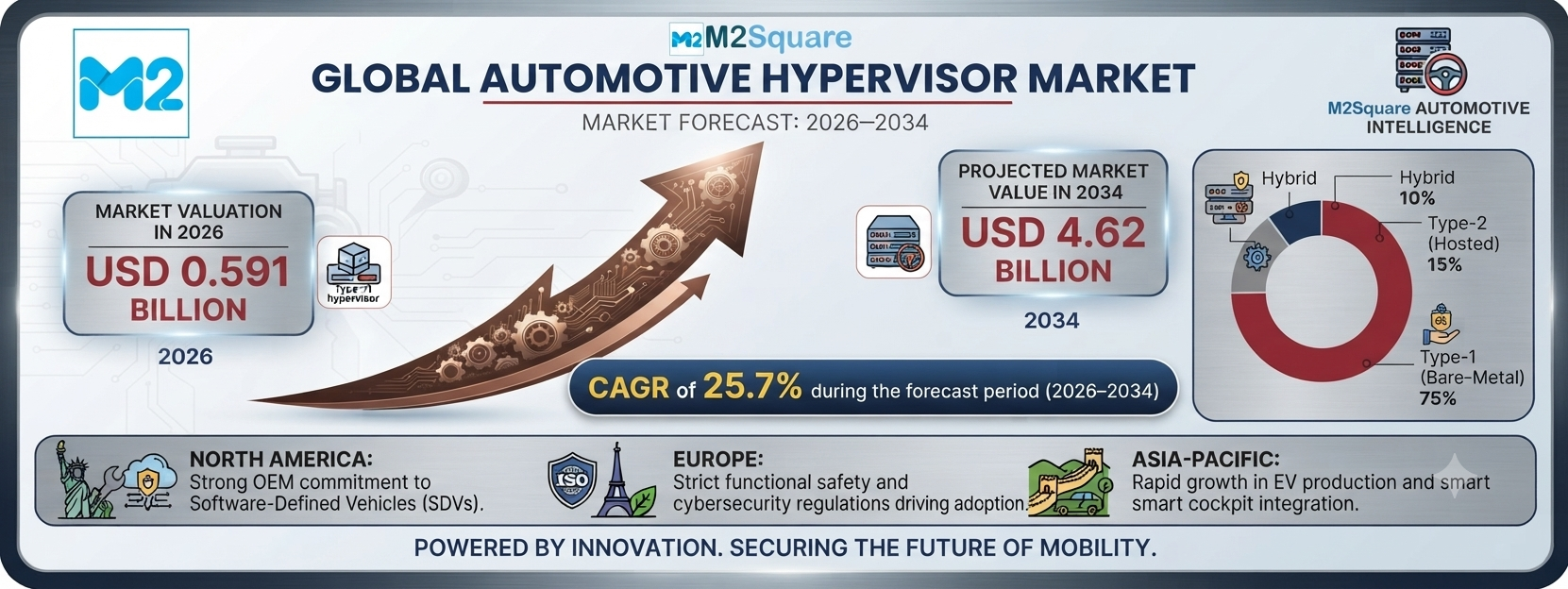
The Automotive Hypervisor Market was valued at USD 0.591 billion in 2026 and is projected to reach USD 4.62 billion by 2034, according to the supplied market estimates. The market is expected to experience strong growth as vehicle architectures become increasingly software-driven.
For automotive manufacturers, technology providers, and industry stakeholders, the Automotive Hypervisor Market offers important opportunities to understand emerging technologies, competitive developments, and future market potential.
Market Snapshot
| Market Parameter | Details |
|---|---|
| Market | Automotive Hypervisor |
| Market Size (2026) | USD 0.591 Billion |
| Projected Market Size (2034) | USD 4.62 Billion |
| Stated CAGR (2026–2034) | 25.7% |
| Industry | Automotive Software and Computing |
| Key Growth Factors | Software-defined vehicles, ADAS, connected vehicles, centralized computing |
Request Sample PDF:
https://m2squareconsultancy.com/request-sample/automotive-hypervisor-market/990
Key Factors Driving Automotive Hypervisor Market Growth
1. Rising Adoption of Software-Defined Vehicles
Software-defined vehicles are transforming how automotive manufacturers design, develop, and manage vehicle functions. Instead of relying on numerous independent electronic control units, automakers are increasingly exploring centralized and high-performance computing architectures.
Automotive hypervisors allow multiple software environments to operate on shared hardware. This supports the integration of different vehicle applications while maintaining separation between critical and non-critical functions.
2. Increasing Integration of Advanced Driver Assistance Systems
Modern vehicles increasingly incorporate ADAS technologies such as lane-keeping assistance, adaptive cruise control, collision warning, and automated parking.
These applications require reliable computing resources and efficient software management. Hypervisor technology can help organize multiple operating environments on a common computing platform, supporting the development of advanced automotive electronics.
3. Growing Demand for Connected Vehicle Technologies
Connected vehicles depend on software platforms that support communication, navigation, infotainment, cloud connectivity, and vehicle diagnostics.
As connected features expand, automotive manufacturers need flexible computing architectures capable of managing multiple applications. Hypervisors provide a virtualization layer that helps consolidate software workloads and manage computing resources.
4. Shift Toward Centralized Vehicle Computing
Traditional automotive architectures often distribute functions across multiple electronic control units. The industry is increasingly exploring domain controllers, zonal architectures, and centralized high-performance computing.
This transition creates opportunities for automotive hypervisor providers because virtualization can help different software applications share computing hardware while remaining logically isolated.
Emerging Trends in the Automotive Hypervisor Market
Software Virtualization and Multi-Operating-System Platforms
Automotive hypervisors enable different operating systems, including real-time operating systems and general-purpose platforms, to operate on the same hardware. This supports the integration of applications with different performance and safety requirements.
Growth of Automotive High-Performance Computing
High-performance computing platforms are becoming increasingly important for advanced vehicle functions. Hypervisor solutions help manage workloads across shared processors and computing resources.
Increasing Focus on Functional Safety and Cybersecurity
Automotive software platforms must address functional safety, system isolation, and cybersecurity requirements. Hypervisor providers are focusing on secure virtualization, controlled access, and separation between software environments.
Expansion of Electric and Autonomous Vehicle Technologies
Electric and autonomous vehicle development requires sophisticated software and electronic architectures. Virtualization can support the integration and management of multiple applications within these increasingly complex vehicle platforms.
Market Segmentation
The Automotive Hypervisor Market can be analyzed across several segments:
| Segmentation | Key Categories |
|---|---|
| By Type | Type 1 (Bare-Metal), Type 2 (Hosted) |
| By Vehicle Type | Passenger Vehicles, Commercial Vehicles |
| By Application | ADAS, Infotainment, Telematics, Vehicle Control, Connected Vehicle Systems |
| By Technology | Hardware-Assisted Virtualization, Software-Based Virtualization |
| By End User | OEMs, Automotive Technology Providers |
Regional Market Outlook
North America: Strong automotive technology development, investments in connected vehicles, and adoption of advanced computing platforms support market opportunities.
Europe: Established automotive manufacturers and growing emphasis on vehicle software, functional safety, and digital vehicle architectures contribute to regional demand.
Asia-Pacific: Expanding automotive production, electric vehicle development, and investments in automotive electronics across China, Japan, South Korea, and India create significant growth opportunities.
Latin America: Gradual adoption of connected vehicle technologies and automotive electronics provides opportunities for technology suppliers.
Middle East and Africa: Investments in smart mobility, connected transportation, and advanced automotive technologies are creating emerging opportunities.
Key Companies in the Automotive Hypervisor Market
The competitive landscape includes automotive software developers, semiconductor companies, and virtualization technology providers. Notable industry participants and technology providers include:
-
BlackBerry QNX
-
Green Hills Software
-
Wind River Systems
-
Elektrobit
-
Siemens
-
OpenSynergy
-
NXP Semiconductors
-
Qualcomm Technologies
-
Renesas Electronics
-
Vector Informatik
These companies participate in different parts of the automotive software and computing ecosystem, including operating systems, virtualization, semiconductor platforms, and automotive software integration. This is an illustrative list of relevant industry participants, not a verified market-share ranking.
Challenges Facing the Automotive Hypervisor Market
Despite strong growth potential, the industry faces several challenges:
-
Complex software integration: Combining multiple operating systems and applications on shared hardware requires extensive engineering and testing.
-
Functional safety requirements: Automotive computing platforms must address demanding safety requirements, particularly when supporting critical vehicle functions.
-
Cybersecurity risks: Connected vehicle architectures require robust protection against unauthorized access and software vulnerabilities.
-
High development costs: Developing and validating automotive-grade virtualization solutions requires specialized expertise and investment.
-
Hardware compatibility: Hypervisor platforms must support different processors, semiconductor architectures, and automotive computing systems.
Future Opportunities
The increasing adoption of software-defined vehicles is expected to create opportunities for automotive hypervisor developers and technology suppliers. Centralized computing, zonal architectures, and advanced vehicle operating systems are likely to increase the importance of virtualization.
Companies investing in secure hypervisor platforms, real-time computing, hardware-assisted virtualization, and software integration capabilities may benefit from growing automotive technology requirements.
The expansion of electric vehicles, connected mobility, and autonomous driving development also provides opportunities for suppliers to build advanced virtualization solutions for next-generation vehicle platforms.
Frequently Asked Questions
1. What is the Automotive Hypervisor Market?
The Automotive Hypervisor Market covers virtualization technologies that allow multiple operating systems and software environments to operate on shared automotive computing hardware.
2. What is the projected market size by 2034?
The market is projected to reach USD 4.62 billion by 2034, based on the supplied market estimate.
3. What are the major factors driving market growth?
Software-defined vehicles, ADAS integration, connected vehicle technologies, centralized computing, and increasing automotive software complexity are important growth factors.
4. What are the main types of automotive hypervisors?
The main types are Type 1 bare-metal hypervisors and Type 2 hosted hypervisors.
5. Which technologies are creating opportunities in this market?
Centralized vehicle computing, real-time operating systems, hardware-assisted virtualization, connected vehicle platforms, and automotive cybersecurity are creating opportunities.
Conclusion
The Automotive Hypervisor Market is becoming increasingly important as the automotive industry transitions toward software-defined vehicles and advanced computing architectures. Growing integration of ADAS, connected vehicle applications, infotainment, and centralized electronic systems is increasing the need for efficient software virtualization technologies.
Automotive hypervisors can help manufacturers consolidate computing resources, manage multiple operating environments, and support the development of more flexible vehicle platforms.
As automotive software becomes a central part of vehicle innovation, virtualization technology providers are positioned to explore opportunities across passenger vehicles, commercial vehicles, electric mobility, and next-generation automotive computing.
Read In-Depth Market Analysis
Explore the Automotive Hypervisor Market in depth to understand market size, growth drivers, technology developments, regional opportunities, competitive landscape, and future industry trends through 2034.
Read the Full Report | https://m2squareconsultancy.com/reports/automotive-hypervisor-market
About M2Square Consultancy
M2Square Consultancy is a market research and business intelligence company delivering industry analysis, market forecasts, competitive intelligence, and strategic insights across automotive, healthcare, ICT, energy, chemicals, and consumer goods.
Contact:
Email: sales@m2squareconsultancy.com
Phone (India): +91 80978 74280
Phone (US): +1 929 447 0100

 English
 Arabic
 French
 Spanish
 Portuguese
 Deutsch
 Dutch
 Italiano
 Russian
 Romaian
 Portuguese (Brazil)
 Greek