


Key Companies in the Green Steel Market: SSAB, Stegra, ArcelorMittal, thyssenkrupp, Salzgitter, Nucor, Tata Steel, POSCO
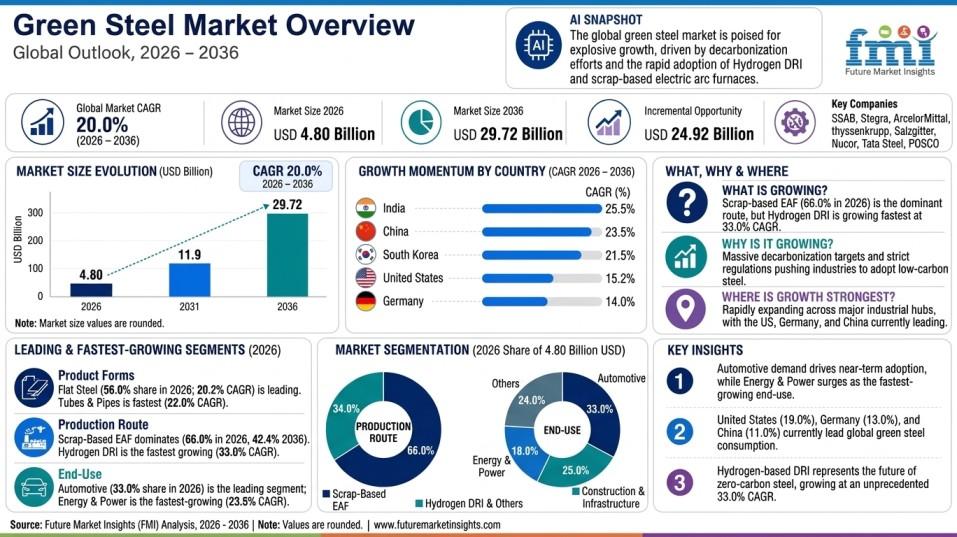
NEWARK, Del., November 26, 2026 — Future Market Insights (FMI), in its analysis of the Green Steel Market, identifies decarbonization targets, low-carbon steel production technologies, renewable energy availability, hydrogen-based ironmaking and long-term supply agreements as important factors influencing the industry's development. The global green steel market is estimated to reach USD 4.80 billion in 2026, up from USD 4.00 billion in 2025, and is projected to grow to USD 29.72 billion by 2036, registering a CAGR of 20.0% during the forecast period.
The assessment examines industry developments, production routes, product segmentation, regional demand and commercial opportunities for steel manufacturers, automotive companies, construction businesses, energy developers and industrial procurement teams.
The analysis identifies SSAB, Stegra, ArcelorMittal, thyssenkrupp, Salzgitter, Nucor, Tata Steel, voestalpine, Outokumpu and POSCO among the leading companies covered in the global green steel industry.
Get Detailed Market Forecasts, Competitive Benchmarking & Industry Insights: Request a Sample Report: https://www.futuremarketinsights.com/reports/sample/rep-gb-36297
Explore Market Competitive Benchmarking & Industry Insights
FMI's assessment examines how carbon reduction commitments, renewable electricity access, hydrogen-based direct reduction, electric arc furnace capacity and low-carbon material procurement influence competitive positioning in the global green steel market.
The report evaluates demand across scrap-based electric arc furnace steel, hydrogen-based direct reduced iron and other low-carbon production routes. It also examines flat steel, long steel and tubes and pipes, along with applications across automotive, construction, energy and power, machinery and equipment, and other industries.
For steel manufacturers, automotive OEMs, construction companies, energy developers, industrial distributors, procurement teams and institutional research buyers, the study provides market intelligence for company benchmarking, product planning, regional assessment and commercial research licensing.
Green Steel Market Structure and Competitive Landscape
Competition in the global green steel industry includes established steel producers, emerging hydrogen-based steel manufacturers and companies investing in lower-carbon production technologies.
FMI identifies SSAB, Stegra, ArcelorMittal, thyssenkrupp, Salzgitter, Nucor, Tata Steel, voestalpine, Outokumpu and POSCO among the leading green steel suppliers.
The competitive environment is influenced by carbon intensity, production technology, renewable energy access, product quality, supply reliability and the ability to meet the procurement requirements of industrial buyers.
Established Steel Producers and Low-Carbon Manufacturing
SSAB, ArcelorMittal, thyssenkrupp and Salzgitter are among the established steel producers identified in FMI's market assessment.
These companies are involved in low-carbon steel initiatives through production technology development, electric furnace investments, direct reduction projects and decarbonization strategies.
Their presence reflects the role of established steel manufacturers in transforming conventional steel production and responding to industrial demand for lower-emission materials.
Hydrogen-Based Steel and Emerging Production Capacity
Stegra is among the companies identified in the report's competitive landscape.
The company's hydrogen-based steel production approach reflects the growing role of direct reduced iron technology in the transition toward lower-carbon steelmaking.
Hydrogen-based production is gaining attention because it can reduce dependence on coal-based ironmaking when renewable hydrogen and low-carbon electricity are available.
Scrap-Based Electric Arc Furnace Producers
Nucor is among the companies identified in FMI's green steel market assessment.
Scrap-based electric arc furnace production is an established low-carbon steelmaking route, particularly where electricity is generated from renewable sources and suitable scrap is available.
Companies operating in this category compete through production efficiency, scrap sourcing, electricity costs, product quality and the ability to supply steel to automotive, construction and energy customers.
Asian Steel Manufacturers and Regional Supply Opportunities
Tata Steel and POSCO are among the representative companies covered in FMI's competitive landscape.
Their presence reflects the importance of Asian steel manufacturers in the development of lower-carbon production technologies and regional steel supply chains.
Companies operating in this category evaluate opportunities through hydrogen-based ironmaking, electric arc furnace investments, product development and low-carbon steel supply to export-oriented industries.
Commercial Factors Influencing Competitive Positioning
FMI's assessment identifies several developments influencing demand and competition in the global green steel industry.
Carbon Reduction Targets and Industrial Procurement
Carbon reduction commitments from automotive manufacturers, construction companies and energy developers are supporting demand for low-carbon steel.
Industrial buyers are increasingly evaluating the emissions associated with materials used in their products and infrastructure projects.
Steel procurement decisions are therefore influenced by carbon intensity, product quality, delivery schedules, certification and the ability to meet sustainability requirements.
Long-term supply agreements can provide steelmakers with greater revenue visibility while helping buyers secure future volumes of low-carbon steel.
Hydrogen-Based Ironmaking and Production Technology
Hydrogen-based direct reduced iron represents a major growth opportunity in the green steel market.
The production route can support lower-carbon steelmaking by replacing carbon-intensive reducing agents with hydrogen, provided the hydrogen is produced using low-carbon energy.
FMI projects hydrogen-based DRI to register a CAGR of 33.0% from 2026 to 2036, making it the fastest-growing production route.
The development of hydrogen supply, renewable electricity infrastructure and industrial-scale direct reduction facilities will influence the pace of adoption.
Scrap-Based EAF and Existing Production Capacity
Scrap-based electric arc furnace steel leads the green steel market, accounting for 66.0% of revenue in 2026.
The route benefits from established commercial capacity and the ability to recycle steel scrap into new products.
However, the availability of high-quality scrap can limit production growth, particularly for applications requiring specific material properties and high-quality flat steel.
Manufacturers must evaluate scrap sourcing, electricity costs, furnace efficiency and product quality when expanding this production route.
Flat Steel and Automotive Demand
Flat steel is the leading product form in the global green steel market, accounting for 56.0% of revenue in 2026.
Automotive manufacturers, machinery producers, appliance companies and energy equipment suppliers use flat steel in a wide range of applications.
The segment is projected to grow at a CAGR of 20.2% from 2026 to 2036.
Manufacturers can evaluate opportunities through product quality, carbon intensity, material consistency and supply agreements with industrial buyers.
Energy and Power Infrastructure
Energy and power is projected to be the fastest-growing end-use segment, registering a CAGR of 23.5% from 2026 to 2036.
Wind towers, solar infrastructure, grid equipment and power transmission projects create opportunities for low-carbon steel suppliers.
The development of renewable energy capacity and electricity infrastructure can support demand for steel products used in energy projects.
Renewable Electricity and Grid Availability
Electric arc furnaces and hydrogen-based ironmaking require substantial electricity supply.
Access to renewable power, grid connections and reliable energy infrastructure influences the economics of green steel production.
Manufacturers with access to suitable power supply and established industrial infrastructure can be better positioned to develop low-carbon production capacity.
Carbon Pricing and Regulatory Requirements
Carbon pricing and carbon-related trade requirements are influencing steel procurement decisions, particularly in markets with emissions reduction policies.
Industrial buyers evaluate the carbon footprint of steel alongside traditional procurement criteria such as price, quality and delivery reliability.
These requirements create opportunities for steel producers that can provide lower-carbon products and reliable emissions documentation.
Company Developments Mapped to Drivers, Trends and Opportunities (2026–2036)
2026–2036 – Global Green Steel Market Expansion
The global green steel market is projected to increase from USD 4.80 billion in 2026 to USD 29.72 billion by 2036, reflecting a CAGR of 20.0%.
The market is expected to generate an incremental opportunity of USD 24.92 billion over the forecast period.
This growth outlook creates opportunities for steel manufacturers to expand low-carbon production capacity, strengthen industrial supply agreements and respond to demand from automotive, construction and energy customers.
Companies can evaluate market opportunities through production technology investments, renewable electricity access, hydrogen supply partnerships and product development.
Scrap-Based EAF – Leading Production Route
Scrap-based electric arc furnace steel accounts for 66.0% of green steel market revenue in 2026.
Its leading position reflects the availability of established production capacity and the use of recycled steel in low-carbon manufacturing.
Companies can assess opportunities through scrap sourcing, furnace efficiency, renewable power procurement and product quality improvements.
Hydrogen-Based DRI – Fastest-Growing Production Route
Hydrogen-based direct reduced iron is projected to grow at a CAGR of 33.0% from 2026 to 2036.
The segment benefits from investment in hydrogen-based ironmaking and the development of low-carbon steel production facilities.
Manufacturers can evaluate opportunities through hydrogen supply agreements, direct reduction technology, renewable electricity infrastructure and long-term customer contracts.
Flat Steel – Leading Product Category
Flat steel accounts for 56.0% of green steel market revenue in 2026.
Its leading position reflects demand from automotive manufacturers, machinery producers, construction businesses and energy equipment suppliers.
Companies can use this segment to assess product differentiation, carbon intensity, material quality and customer procurement requirements.
Automotive – Leading End-Use Segment
Automotive accounts for 33.0% of green steel market revenue in 2026.
The segment benefits from vehicle manufacturers' efforts to reduce emissions across material supply chains.
Steel producers can evaluate opportunities through low-carbon flat steel, automotive-grade product development and multi-year supply agreements.
Energy & Power – Fastest-Growing End Use
Energy and power is projected to grow at a CAGR of 23.5% from 2026 to 2036.
The segment creates opportunities for green steel suppliers serving wind energy, solar infrastructure, grid equipment and power generation projects.
Manufacturers can assess opportunities through steel products designed for energy infrastructure and procurement partnerships with project developers.
India – Fastest-Growing Country Market
India is projected to register the fastest growth among the profiled country markets, with a CAGR of 25.5% from 2026 to 2036.
The market presents opportunities for steel manufacturers investing in lower-carbon production technologies and serving domestic and export-oriented industrial buyers.
Companies can evaluate opportunities through electric arc furnace capacity, hydrogen-based ironmaking, low-carbon product development and regional supply chain expansion.
These developments indicate that the global green steel market is being shaped by industrial decarbonization, production technology investments and growing demand for lower-emission materials. Carbon intensity, production costs, renewable energy access and long-term supply agreements remain important considerations for companies evaluating growth opportunities.
Explore the market outlook, competitive positioning, company profiles, regional growth trends and industry opportunities in the full report: https://www.futuremarketinsights.com/reports/sample/rep-gb-36297
Green Steel Market: Key Industry Questions
Q1. How large is the global green steel market?
The global green steel market is estimated at USD 4.80 billion in 2026, up from USD 4.00 billion in 2025. FMI projects the market to reach USD 29.72 billion by 2036, growing at a CAGR of 20.0% from 2026 to 2036.
Q2. Which companies are identified in the green steel market?
FMI identifies SSAB, Stegra, ArcelorMittal, thyssenkrupp, Salzgitter, Nucor, Tata Steel, voestalpine, Outokumpu and POSCO among the leading companies covered in its green steel market report.
Q3. Which production route leads the green steel market?
Scrap-based electric arc furnace steel leads the market, accounting for 66.0% of revenue in 2026. Its established production capacity and use of recycled steel support its leading position.
Q4. Which production route is expected to grow fastest?
Hydrogen-based direct reduced iron is projected to register the fastest growth, with a CAGR of 33.0% from 2026 to 2036.
Q5. Which product form leads the green steel market?
Flat steel leads the market, accounting for 56.0% of revenue in 2026. Its use in automotive manufacturing, machinery, construction and energy equipment supports its leading position.
Q6. Which end-use segment accounts for the largest share?
Automotive accounts for 33.0% of green steel market revenue in 2026. Demand is supported by vehicle manufacturers seeking to reduce emissions associated with steel procurement.
Q7. Which end-use segment is expected to grow fastest?
Energy and power is projected to register the fastest growth, with a CAGR of 23.5% from 2026 to 2036. Renewable energy infrastructure and grid equipment create opportunities for low-carbon steel suppliers.
Q8. Which country is expected to grow fastest in the green steel market?
India is projected to register the fastest growth among the profiled country markets, with a CAGR of 25.5% from 2026 to 2036. China follows with a CAGR of 23.5%, while South Korea is projected to grow at 21.5%.
Q9. What factors influence competitive positioning in the green steel industry?
Competitive positioning is influenced by carbon intensity, production technology, renewable electricity access, hydrogen availability, scrap sourcing, product quality and supply reliability.
Companies also evaluate production costs, regulatory requirements, long-term supply agreements and the ability to provide lower-carbon steel to automotive, construction and energy customers.
Related Chemicals & Materials Industry Reports
Retinaldehyde Market https://www.futuremarketinsights.com/reports/retinaldehyde-market
Micronutrient Uptake Boosters Market https://www.futuremarketinsights.com/reports/micronutrient-uptake-boosters-market
Nutrient Loss Reducers Market https://www.futuremarketinsights.com/reports/nutrient-loss-reducers-market
Bio-Based Spray Oils Market https://www.futuremarketinsights.com/reports/bio-based-spray-oils-market
About Future Market Insights (FMI)
Future Market Insights (FMI) is a market research and consulting organization providing syndicated research, customized market assessments, competitive intelligence and strategic industry analysis.
Future Market Insights, Inc. is registered in the State of Delaware, United States. FMI identifies itself as an ESOMAR-certified organization.
The research is designed to support steel manufacturers, automotive companies, construction businesses, energy developers, industrial distributors and institutional research buyers evaluating market opportunities, product strategies and regional expansion requirements.
For Press & Corporate Inquiries
Rahul Singh
AVP – Marketing and Growth Strategy
Future Market Insights, Inc.
+91 8600020075
For Sales: sales@futuremarketinsights.com
For Media: Rahul.singh@futuremarketinsights.com
For Web: https://www.futuremarketinsights.com/

 English
 Arabic
 French
 Spanish
 Portuguese
 Deutsch
 Dutch
 Italiano
 Russian
 Romaian
 Portuguese (Brazil)
 Greek