


Why Middle East & GCC Startups Deploy Core Workloads on a UAE VPS
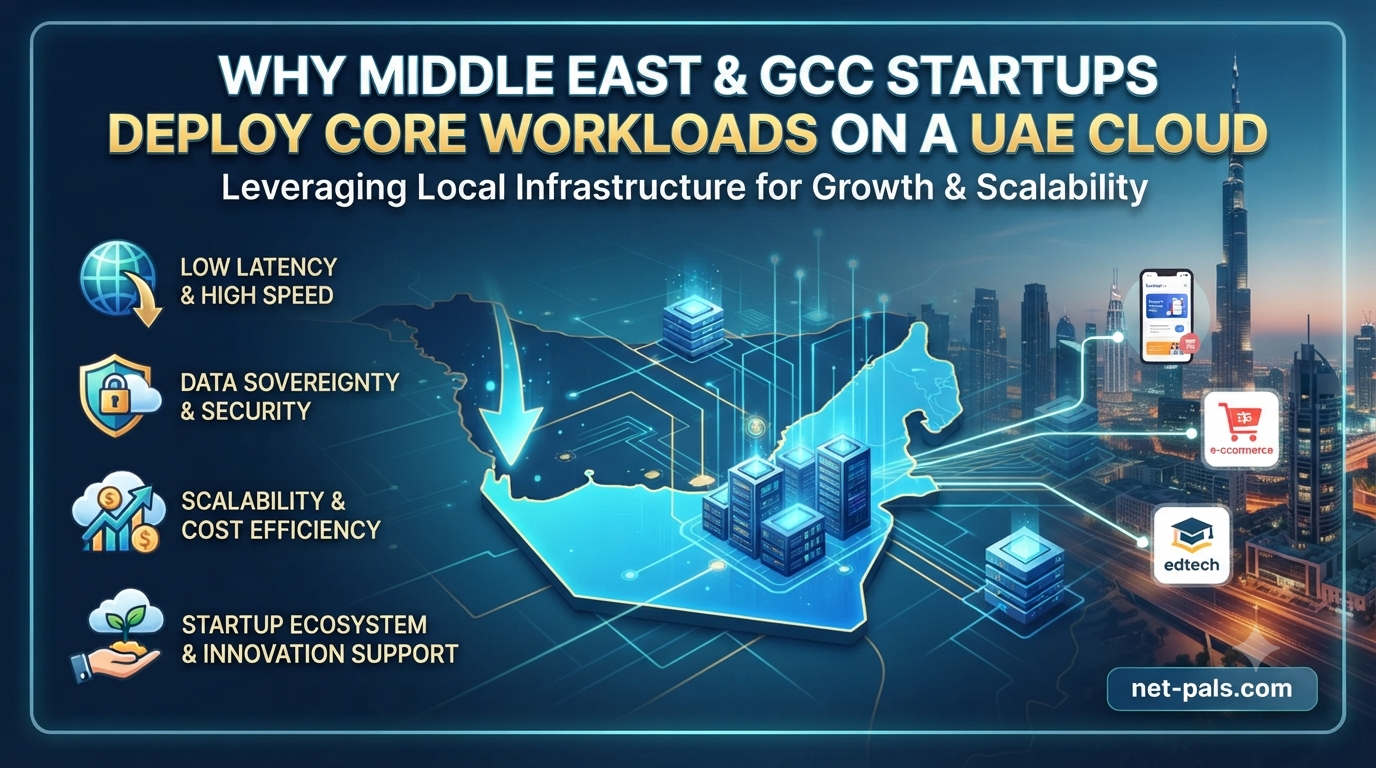
Quick Summary: Middle East and GCC startups deploy core production workloads on a UAE VPS to avoid cross-continental network routing through Europe, gain predictable KVM hardware isolation, and keep customer data closer to regional compliance boundaries without paying hyperscaler egress fees.
When early-stage teams across the Gulf launch SaaS dashboards, booking engines, or mobile APIs, many start with default cloud regions in Frankfurt or Amsterdam because they look cheaper per gigabyte. Within weeks, customer telemetry exposes the hidden tax of distance: mobile requests from Dubai, Riyadh, Doha, or Muscat travel thousands of kilometers over subsea cables before hitting an origin server. Moving primary compute to a local UAE VPS hosted inside a Dubai datacenter eliminates that unnecessary round-trip overhead and stabilizes response times for regional users.
Regional Proximity and Peering Across the GCC
Geographic proximity alone does not guarantee low latency if local telecom networks exchange traffic in Europe—a routing inefficiency known as traffic tromboning. What makes Dubai strategically valuable for Gulf startups is physical interconnection. Major Dubai facilities, including Equinix DX1 (home to the UAE Internet Exchange, UAE-IX), allow regional carriers such as e& (Etisalat), du, and neighboring GCC transit providers to exchange packets locally.
When an origin server sits inside a well-peered Dubai datacenter rather than Central Europe:
- - Intra-UAE traffic typically stays on domestic fiber paths instead of crossing international subsea links.
- - GCC cross-border API calls from Saudi Arabia, Oman, Bahrain, Kuwait, and Qatar traverse regional terrestrial and Gulf fiber corridors rather than looping through Marseille or Frankfurt.
- - Subsea cable resilience improves for regional users because domestic and GCC traffic remains isolated from Mediterranean or Red Sea transit disruptions.
For real-time applications—such as ride-hailing dispatch, delivery tracking, point-of-sale sync, and multi-step payment callbacks—cutting 60–100 ms per network round-trip changes how fast an app actually feels on 4G and 5G mobile connections.
KVM Isolation vs. Shared Cloud Contention
Startups running database-backed APIs quickly hit limits on shared web hosting or legacy container-based VPS plans where noisy neighbors exhaust CPU scheduler slices and disk I/O queues. Modern UAE infrastructure relies on KVM (Kernel-based Virtual Machine) virtualization, which runs each guest instance with its own isolated Linux or Windows kernel and dedicated vCPU/RAM reservations.
With KVM isolation paired with pure SSD or NVMe storage arrays, startups gain three practical operational advantages:
1. Consistent query latency: PostgreSQL, MySQL, and Redis workloads do not stall whenever another tenant runs a backup or experiences a traffic surge.
2. Custom kernel and container support: Teams can run Docker, Docker Compose, WireGuard VPNs, and custom firewall modules (nftables or ufw) without waiting on shared-host restrictions.
3. Full root control on 1Gbps network uplinks: Engineers can tune TCP congestion control (such as BBR), configure HTTP/3 reverse proxies, and manage TLS certificates directly.
Before committing to any node, startups should verify actual virtualization type from the shell using systemd-detect-virt (which returns kvm on genuine KVM nodes) and check disk throughput with fio rather than relying on marketing brochures.
Practical Data Residency and Sector Expectations
Regulatory expectations in the UAE also shape infrastructure choices. Under UAE Federal Decree-Law No. 45 of 2021 (PDPL), general personal data can only leave the country under recognized adequacy standards or approved legal safeguards. Meanwhile, sector-specific rules in banking, healthcare (such as Federal Law No. 2 of 2019 on health ICT), and government-linked projects often require strict onshore storage inside the UAE.
Hosting on a UAE VPS helps startups keep primary databases and backups inside national borders from day one, avoiding painful cross-region migrations before enterprise procurement audits. That said, server location alone never establishes legal compliance. Engineering teams still need encryption in transit (TLS 1.3), encrypted disk volumes or backups, strict SSH key-based access, and documented role-based permissions.
Predictable Billing vs. Hyperscaler Egress Surprises
For bootstrapped startups or seed-stage teams, hyperscaler virtual machines often introduce billing volatility through outbound data-transfer charges, NAT gateway fees, and paid static IPs. A flat-rate virtual private server in Dubai bundles predictable compute, memory, pure SSD storage, and bandwidth allocation into one monthly line item. That clarity makes unit economics easier to forecast as monthly active users grow across the MENA region.
When a UAE VPS Is Not the Right Fit
Local Dubai hosting is not ideal for every workload:
- - Global media-heavy audiences centered in North America or East Asia will see better origin latency in US or Singapore nodes unless fronted by an edge CDN.
- - Auto-scaling burst workloads that jump from 2 cores to 64 cores for two hours a day may still favor elastic cloud clusters.
- - Legacy monolithic apps expecting managed PaaS buildpacks require either managed VPS support or an internal DevOps owner to handle OS patching and monitoring.
How to Verify a Dubai VPS Before Production Cutover
Before pointing production DNS to a new node, run four quick checks over SSH:
1. Confirm local routing: Run mtr -rw <your-office-or-user-ip> from GCC locations to verify packets stay within regional peers rather than bouncing through Frankfurt or London.
2. Verify virtualization: Run lscpu and systemd-detect-virt to confirm KVM isolation and advertised core counts.
3. Test storage I/O: Run a non-destructive read/write check (fio --name=randread --ioengine=libaio --rw=randread --bs=4k --size=256M --numjobs=1 --runtime=15 --group_reporting) and remove the test file afterward.
4. Harden access before launch: Disable password SSH login, enable ufw or nftables, and configure automated off-site backups.
Frequently Asked Questions
Is a UAE VPS fast for users outside Dubai, such as Riyadh or Doha?
Yes, when the Dubai datacenter peers directly via regional exchanges like UAE-IX at Equinix DX1. Direct Gulf terrestrial and subsea routes keep round-trip latency across neighboring GCC capitals much lower than routing back through European cloud hubs.
Does hosting on a UAE VPS automatically make my startup PDPL compliant?
No. Local hosting supports onshore data residency requirements, which simplifies procurement and sector rules, but compliance under UAE PDPL also requires access controls, encryption, retention policies, and lawful data-processing practices.
What stack works best on an entry-level UAE VPS?
A typical 2–4 vCPU KVM instance handles Nginx or Caddy as a reverse proxy, a Docker Compose stack with Node.js or Python FastAPI, and a tuned PostgreSQL or MySQL database with Redis caching comfortably.
Can startups upgrade resources on a UAE VPS without rebuilding?
Most KVM providers allow vertical scaling of RAM, vCPU cores, and SSD storage with minimal reboot downtime, though you should always take a snapshot and verify filesystem resizing before scaling.
Next Step for Your Regional Deployment
If your customers and API traffic sit primarily in the Emirates and wider Gulf, benchmarking a single Dubai node against your current European instance takes less than an hour. Evaluate Onlive Server's UAE VPS configurations with KVM isolation, pure SSD storage, and 24/7 technical support to test real latency for your workload.

 English
 Arabic
 French
 Spanish
 Portuguese
 Deutsch
 Turkish
 Dutch
 Italiano
 Romaian
 Portuguese (Brazil)
 Greek