


Catalyst Carriers Market Set to Hit USD 660.9 Million by 2035, with Top Players Almatis, BASF and Evonik Industries in Focus
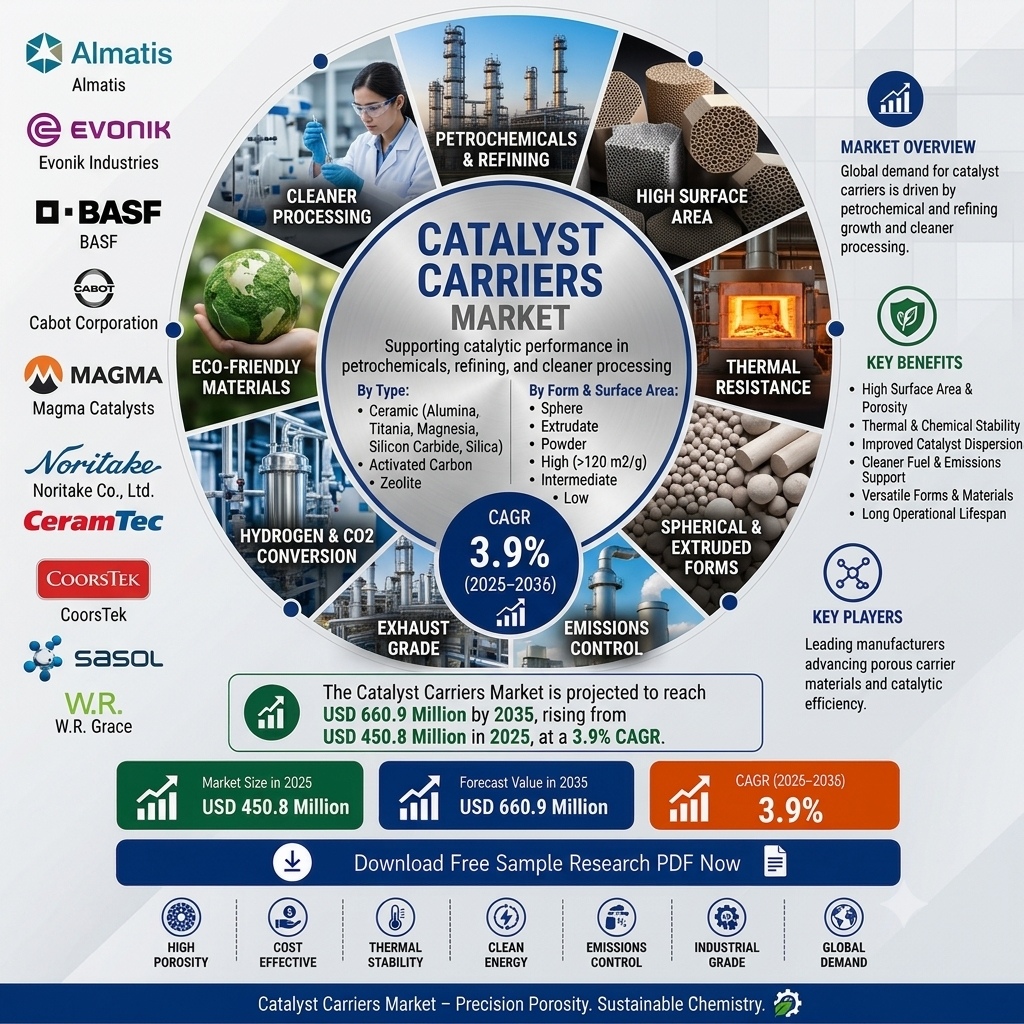
November 27, 2026 — Rockville, MD: The global catalyst carriers market is valued at USD 450.8 million in 2025 and is projected to reach USD 660.9 million by 2035, expanding at a 3.9% CAGR during the forecast period. Rising demand from petrochemical and refining industries, stricter environmental regulations, and the need for more efficient catalytic processes are supporting market expansion.
Catalyst carriers provide a support structure that helps improve catalyst performance, reaction efficiency, and operating stability across industrial processes. They are used in refining, petrochemical production, chemicals, automotive emissions control, pharmaceuticals, and agrochemicals. Advancements in nanomaterials, optimized porosity, 3D printing, and environmentally oriented carrier materials are creating additional opportunities for manufacturers.
Request full Report Pricing and sample Report:
https://www.factmr.com/connectus/sample?flag=S&rep_id=1263
Catalyst Carriers Market Outlook
Growing industrial energy-efficiency requirements are increasing the need for catalyst carriers that can improve reaction performance while supporting lower energy consumption and emissions. Petrochemical infrastructure expansion in Asia Pacific and the Middle East is also strengthening demand, particularly for carriers used in refining and chemical manufacturing.
Environmental regulations are another important market factor. Catalytic systems used for emissions control and cleaner fuel production depend on carrier materials capable of supporting efficient reactions under demanding operating conditions.
Ceramic Catalyst Carriers Maintain a Strong Market Position
Ceramic carriers remain widely used because of their hardness, corrosion resistance, and suitability for high-temperature applications. Alumina, titania, magnesia, silicon carbide, and silica are among the ceramic materials used in catalyst carrier systems.
Activated carbon is also emerging as an important alternative because its high internal surface area supports catalyst dispersion and makes it suitable for powder, granular, and extruded forms. The growing requirement for efficient catalytic systems is encouraging manufacturers to improve carrier structure, surface characteristics, and durability.
High Surface Area Carriers Support Advanced Industrial Processes
High surface area carriers hold a leading position because of their ability to support complex catalytic reactions across refining, petrochemical processing, and emissions control. Activated alumina, silica, and zeolites are widely used where greater porosity and catalyst dispersion are required.
Intermediate surface area carriers are also gaining attention because they provide a balance between performance and cost. Their applications include specialty chemicals, gas purification, water treatment, and moderate-temperature processes, creating opportunities across developing industrial markets.
North America, Asia Pacific and Europe Offer Growth Opportunities
North America remains an important market due to its established refining and petrochemical industries. In the United States, demand is supported by hydroprocessing, catalytic cracking, emissions-control applications, and continued investment in cleaner industrial technologies.
Asia Pacific is a major growth region, with China, India, Japan, and South Korea benefiting from expanding chemical and petrochemical production. China is positioned as the region's largest consumer, while India's growing chemical manufacturing activity is expected to support catalyst carrier demand. Japan is also developing specialized carriers for hydrogen production, fuel-cell technologies, and carbon-related applications.
Europe presents another important opportunity as environmental policies and cleaner production requirements encourage greater adoption of advanced catalyst systems. European catalyst carrier sales are projected to reach US$ 132.6 million by 2034, expanding at a 4.2% CAGR from 2024 to 2034.
Competitive Landscape
The competitive landscape includes Almatis, Evonik Industries, BASF, Cabot Corporation, Magma Catalysts, Noritake Co., Ltd., CeramTec, CoorsTek, Sasol and W.R. Grace. Companies are competing through material innovation, carrier geometry, surface area, thermal stability, mechanical strength, and application-specific performance.
Manufacturers are also investing in local production and supply-chain integration to reduce exposure to raw-material volatility. Recent developments include BASF's introduction of a high-performance alumina catalyst carrier for hydrogen production in February 2024. Clariant also introduced CATOFIN 312 in April 2024, with the company reporting a 20% improvement in catalyst lifetime and greater selectivity.
To View Related Reports
Agricultural Grade Zinc Sulfate Monohydrate Market https://www.factmr.com/report/agricultural-grade-zinc-sulfate-
monohydrate-market
Microemulsions Market https://www.factmr.com/report/microemulsions-market
Isopropylamine Market https://www.factmr.com/report/isopropylamine-market
Circular Polyester Intermediates Market https://www.factmr.com/report/circular-polyester-intermediates-market
About Fact.MR
Fact.MR is a market research and competitive intelligence provider delivering market intelligence, competitive analysis, and forecasting across global industries. Its research helps businesses evaluate market demand, understand competitive developments, and identify growth opportunities.

 English
 Arabic
 French
 Spanish
 Deutsch
 Turkish
 Dutch
 Italiano
 Russian
 Romaian
 Portuguese (Brazil)
 Greek