


PBAT Market Approaches USD 5.2 Billion as Sustainable Plastic Demand Accelerates
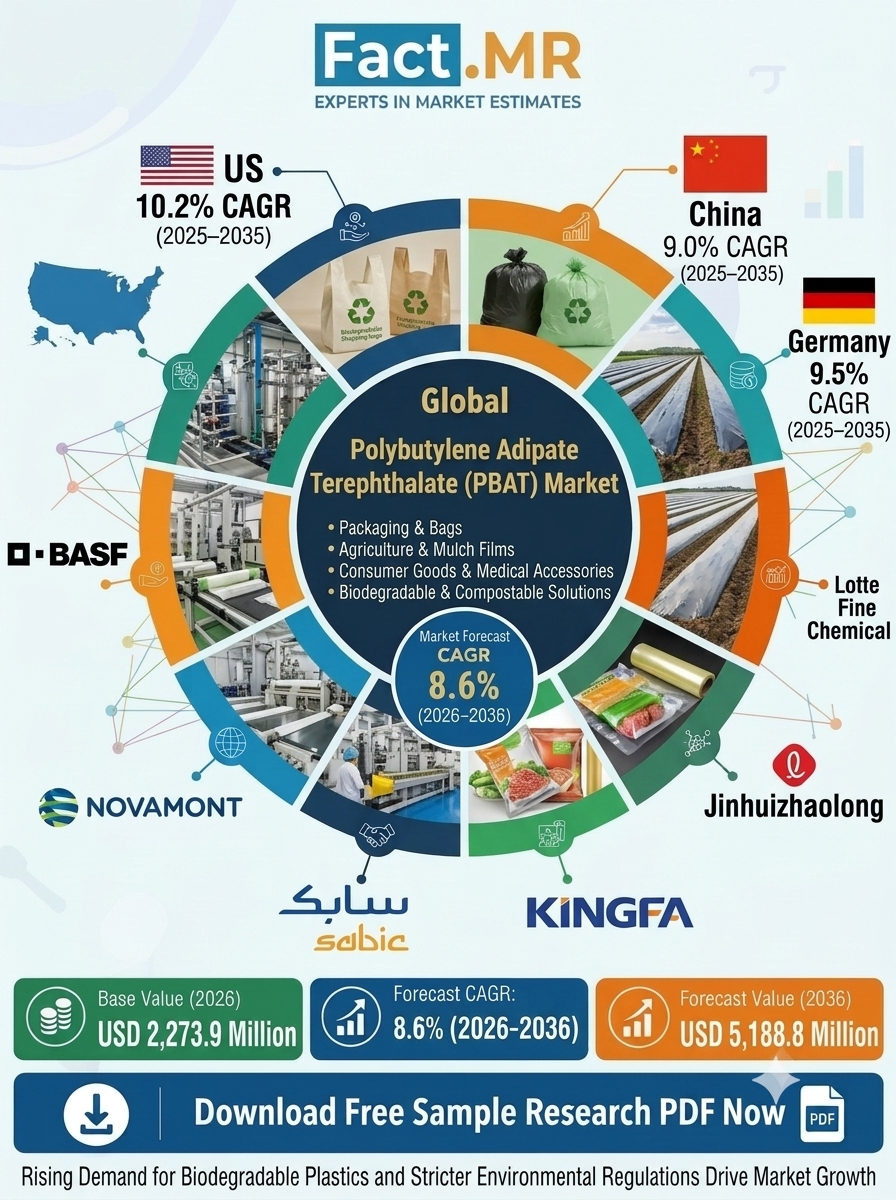
Rockville, MD, November 27, 2026 — The global polybutylene adipate terephthalate (PBAT) market is projected to reach USD 5,188.8 million by 2036, increasing from USD 2,273.9 million in 2026 at a CAGR of 8.6% during the forecast period, according to Fact.MR. Demand for biodegradable plastics is rising as governments tighten restrictions on conventional plastic products and packaging manufacturers seek materials that meet compostability requirements. PBAT's flexibility and mechanical strength make it suitable for applications across packaging, agriculture, and consumer goods.
Request for PDF Report Sample Pages: https://www.factmr.com/connectus/sample?flag=S&rep_id=3218
The market's expansion reflects a practical shift in packaging requirements. Fresh produce distributors, supermarkets, and agricultural businesses need lightweight materials that protect perishable products during storage and transportation. PBAT-based materials offer an alternative for applications where flexibility, durability, and biodegradability are important purchasing considerations.
The Short Version
The polybutylene adipate terephthalate market is gaining momentum as environmental regulations influence material selection across packaging and agriculture. Compost and garbage bags represent a major application segment, supported by restrictions on conventional single-use plastic bags. Films and sheets also hold an important position because of their use in flexible packaging, agricultural mulch films, and food-related applications.
Polybutylene adipate terephthalate (PBAT) is a biodegradable thermoplastic polymer that combines flexibility and strength for applications requiring alternatives to conventional plastics.
Fact.MR identifies the United States, Germany, and China among the country markets recording strong growth prospects, with projected CAGRs of 10.2%, 9.5%, and 9.0%, respectively, between 2025 and 2035.
Three Numbers That Matter
- USD 2,273.9 million: Estimated global market value in 2026.
- USD 5,188.8 million: Forecast market value by 2036.
- 8.6%: Projected compound annual growth rate during 2026–2036.
These figures point to expanding commercial opportunities for PBAT manufacturers and packaging converters. The transition will depend partly on production economics and the availability of appropriate waste-processing infrastructure.
Market Segmentation and Demand Analysis
Films and sheets hold a prominent position in the PBAT market. Their mechanical strength, printability, and flexibility support applications in compostable bags, cling wraps, agricultural mulch films, and food packaging. Manufacturers can use these materials to develop packaging formats that meet functional requirements while supporting sustainability targets.
Compost and garbage bags represent another important application category. Government restrictions on conventional plastic bags are encouraging municipalities, retailers, and hospitality businesses to consider compostable alternatives. PBAT offers flexibility and tear resistance, making it suitable for waste collection and disposal applications.
Agriculture and horticulture provide additional demand opportunities. PBAT-based materials can be used in protective packaging for fruits and vegetables, helping businesses manage handling and transportation requirements. Seafood packaging and medical accessories are also identified as potential application areas.
Where Growth Is Strongest
The United States is projected to record a 10.2% CAGR between 2025 and 2035. Demand is supported by municipal restrictions on non-degradable plastics and increasing interest in compostable packaging. Food packaging films, shopping bags, and agricultural mulch films are among the applications supporting adoption.
Germany is forecast to expand at a 9.5% CAGR. European Union environmental requirements and domestic waste-reduction policies are encouraging the use of compostable materials. Germany's established recycling capabilities and industrial composting infrastructure provide additional support for market development.
China is expected to register a 9.0% CAGR through 2035. Government policies targeting plastic pollution, investments in domestic production facilities, and growing e-commerce activity are supporting PBAT adoption. The country's agricultural export sector also creates demand for protective packaging materials.
Asia-Pacific is positioned for further expansion as agricultural distribution networks modernize. Rising exports of perishable products are increasing the need for affordable packaging solutions that protect goods during transportation.
Market Dynamics: Production Costs and Recycling Remain Challenges
Despite favorable demand conditions, PBAT manufacturers face cost and infrastructure constraints. Limited recycling facilities and inadequate sorting systems can prevent plastic materials from entering appropriate recovery streams. Organic matter contamination creates additional difficulties for waste processing.
Price competition also matters. Agricultural businesses in developing markets often prioritize inexpensive packaging to protect operating margins. Higher production costs for sustainable alternatives can slow purchasing decisions, particularly among smaller producers.
Manufacturers must also manage fluctuations in petroleum-based raw material prices and seasonal supply requirements. Alternative packaging formats, including breathable films and rigid containers, add competitive pressure.
Who Is Moving
The competitive landscape includes BASF SE, Novamont, SABIC, Kingfa Science & Technology Co., Ltd., Jinhuizhaolong, Lotte Fine Chemical, Dongguan Xinhai Environmental-Friendly Material Co., Ltd., and Green Science Alliance Co., Ltd.
BASF SE produces ecoflex®, a PBAT material used in compostable packaging. In June 2024, BASF expanded its biopolymers portfolio with ecoflex® F Blend C1200 BMB, a biomass-balanced PBAT grade reported to have a 60% lower product carbon footprint than its standard grade. This development illustrates how manufacturers are working to incorporate renewable feedstocks without sacrificing material performance or compostability certifications.
Novamont develops biodegradable materials through its Mater-Bi® portfolio, serving packaging, agricultural, and food-service applications. Kingfa Science & Technology Co., Ltd. and Jinhuizhaolong also participate in the market through biodegradable polymer manufacturing and supply operations.
Fact.MR estimates that the top five players account for approximately 50% to 60% of the market, while Tier II companies represent around 20% to 25%.
Analyst Perspective
The next phase of PBAT market development will depend on how effectively manufacturers balance material performance, production costs, and environmental requirements. Bio-based polymer innovation and automated manufacturing systems are expected to influence production strategies through 2035.
Emerging applications in seafood packaging, industrial containment, and medical packaging could broaden the market's customer base. However, adoption will also depend on improvements in composting infrastructure and the affordability of finished products.
View Related Reports :
Agricultural Grade Zinc Sulfate Monohydrate Market : https://www.factmr.com/report/agricultural-grade-zinc-sulfate-monohydrate-market
Microemulsions Market : https://www.factmr.com/report/microemulsions-market
Isopropylamine Market : https://www.factmr.com/report/isopropylamine-market
Circular Polyester Intermediates Market : https://www.factmr.com/report/circular-polyester-intermediates-market
About Fact.MR
Fact.MR is a global market research and consulting firm that provides actionable insights, industry analysis, and strategic intelligence across diverse markets. The company delivers research covering market size, competitive landscapes, emerging trends, and growth opportunities to help businesses make informed decisions.

 English
 Arabic
 French
 Spanish
 Portuguese
 Deutsch
 Dutch
 Italiano
 Russian
 Romaian
 Portuguese (Brazil)
 Greek